
Google does not penalize content just because AI wrote it, but mass-produced, low-value pages built to manipulate rankings can be demoted or removed. The curse is volume plus thin intent, not the quill that wrote the page.
Most advice this year treats AI like a forbidden rune. Throw out the model, hire a human, and the dragon goes back to sleep. That story is tidy, and it is wrong. Say a bakery owner asks a model for one page on sourdough starter care, checks the steps against a trusted baking book, and adds the kitchen temperature that worked. That page can compete. Say she then publishes 800 near-copies, one for every town in three states, swapping only the city name. That swarm is what spam systems notice.
People keep asking whether Google penalizes AI content as if the author were the whole spell. Scale and purpose decide it.
Table of Contents
- Why AI Authorship Alone Is Not a Curse
- Content Patterns That Summon a Penalty
- How Scaled Content Abuse Casts the Spell
- What Ranking Data Reveals About AI Pages
- How to Publish AI-Assisted Pages Safely
- Signals That Show Your AI Pages Are Healthy
- Check for a Penalty and Recover Safely
- Confirm Your Workflow Before the Next Page Goes Live
Why AI Authorship Alone Is Not a Curse
A wizard walks into the square with a scroll. Visitors either leave wiser or they leave annoyed. The crowd does not care whether a human mage or an AI familiar inked the letters.
Google's February 8, 2023 guidance states that appropriate use of AI or automation is not against its guidelines. AI-generated content is evaluated like any other content. It may perform well when it is useful, original, reliable, and demonstrates experience, expertise, authoritativeness, and trustworthiness (E-E-A-T). The same guidance draws the line on intent. Using automation, including generative AI, primarily to manipulate search rankings violates Google's spam policies.
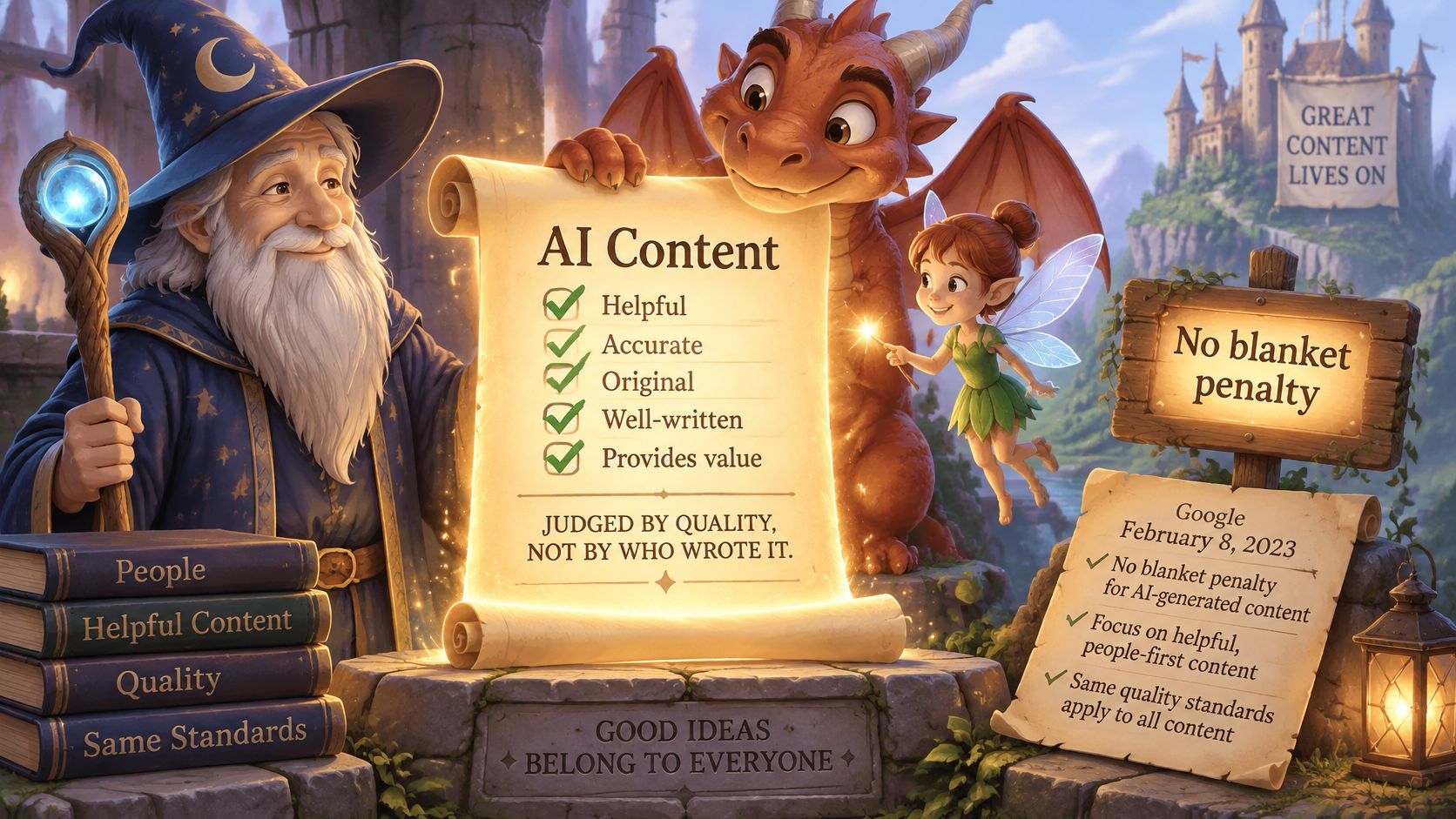
The spell is judged by the visitor
People-first ranking systems prioritize information created to benefit people rather than pages designed to manipulate rankings. One careful page about shipping delays can help a buyer decide whether to wait or reorder. A pile of pages that exist only to catch "shipping delays" plus a city name does not.
Disclosure is not a universal ranking tax. Google recommends explaining automation when a visitor would reasonably wonder how the content was created. A medical how-to might need that note. A plain product description usually does not.
If you are picking drafting tools, the SemDash guide to AI SEO tools is a practical map of what each familiar can and cannot do. Then judge the finished page, not the tool that touched the draft.
Practical rule: Ask what the page does for a person. If the honest answer is that it fills a keyword slot, the writing method will not save it.
Content Patterns That Summon a Penalty
Read the Risk level column first. Six patterns, from a dragon's appetite down to a quiet pixie chore.
| Content pattern | Risk level | Why it matters | Safer move |
|---|---|---|---|
| Mass-produced pages targeting keyword variations | High | Matches scaled content abuse | Publish fewer pages, each with a distinct purpose |
| Near-duplicate pages with only a city or product name swapped | High | Thin, repetitive value | Merge them into one stronger page |
| Scraped or lightly synonymized feeds | High | Adds no original value | Add original data, analysis, or examples |
| Unedited AI drafts with unverified claims | Medium to high | Accuracy and trust risk | Verify each claim and add expertise |
| AI-assisted metadata rewrites on existing pages | Low | Improves relevance when accurate | Review every title for accuracy |
| AI-assisted page with first-hand examples and a clear purpose | Low | Useful to people | Keep it and monitor results |
Scaled content abuse means producing many pages mainly to manipulate rankings rather than to help users. Google's spam-policy examples name generative AI tools used to create many pages without adding user value. The same list covers scraping feeds or search results, synonymizing or translating scraped material, stitching pages together without added value, spinning up multiple sites to hide the scale, and keyword-filled pages that make little sense to a reader. Google is not hunting an "AI percentage." It is watching whether automation multiplies thin, derivative, or incoherent pages.
High-risk rows
Mass-produced keyword variants. Say a warlock wants "best running shoes" in 400 phrasings. Each URL is a costume change. The set exists to occupy results, not to answer a distinct question. Publish fewer pages, and give each one its own job.
City or product swaps. "Plumber in Oakville" and "Plumber in Oakdale" with the same paragraphs are near-duplicates. Merge them unless you have local proof for each town.
Scraped or lightly synonymized feeds. A pixie copies a directory, swaps a few synonyms, and calls it original. It is not. Add data, analysis, or examples you gathered yourself.
Medium and low
Unedited drafts with unverified claims sit in the medium to high band. Treat them as high risk on health, money, or law. A wrong dosage or a wrong tax rule burns trust faster than a clumsy metaphor.
Metadata rewrites that improve accuracy stay low risk when a person checks every title. An AI-assisted page with a first-hand example and a clear purpose is low risk too. Keep it, then watch what visitors do.
What changes the band is repetition, audience, and accuracy. One odd page is a mistake. The same thin pattern across many URLs is a strategy.
If a pattern repeats across many URLs, the pattern is what gets judged, not any single page.
How Scaled Content Abuse Casts the Spell
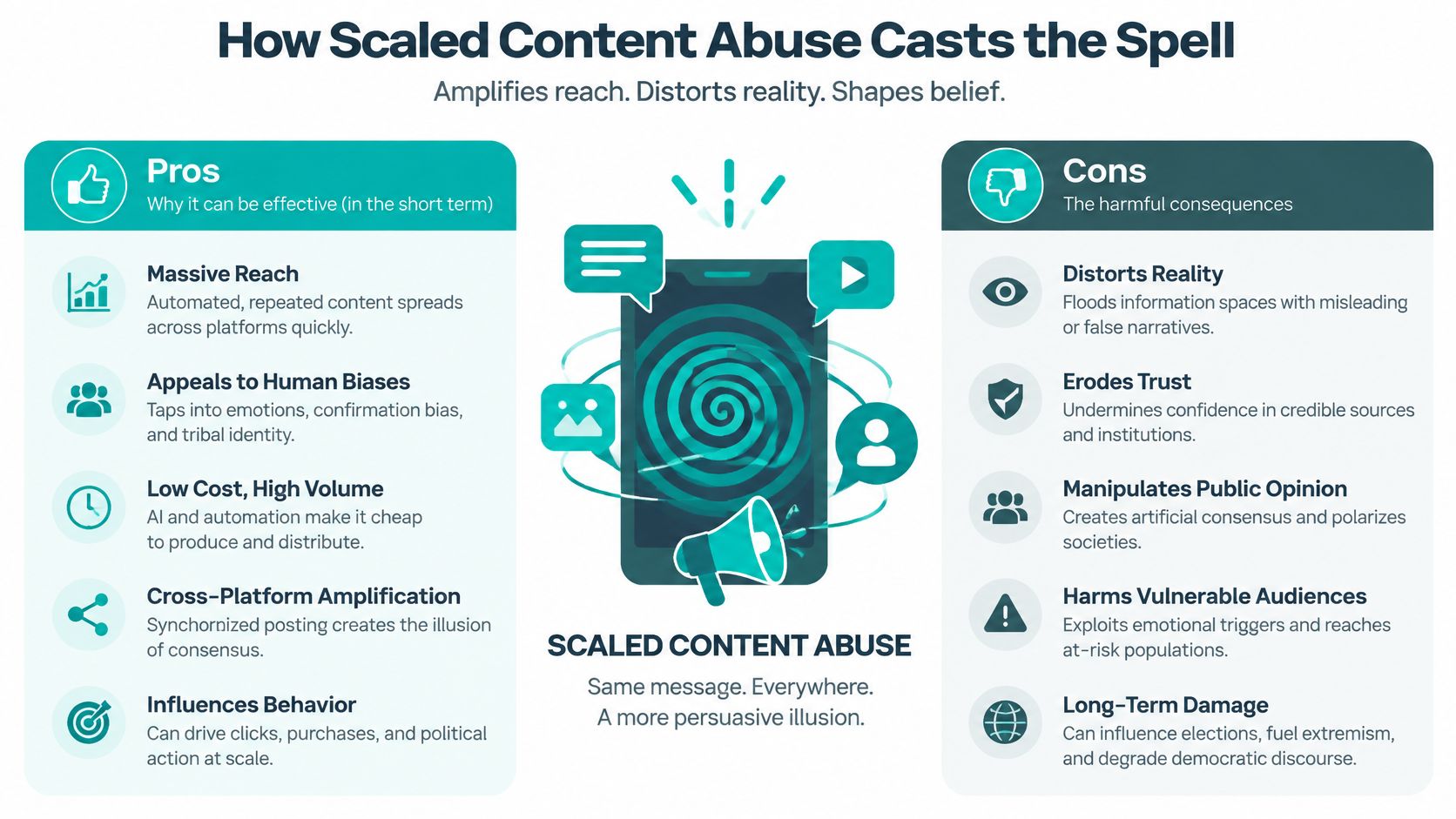
On March 5, 2024, Google introduced scaled content abuse as a spam-policy category, which Google's core update and spam policies post defines as producing many pages primarily to manipulate Search rankings, especially when the pages are unoriginal or provide little or no value.
The rule is wider than robots. Enforcement can apply when the pages come from automation, human labor, or a combination of both. A tired editor who rubber-stamps hundreds of thin pages is not a shield. Human hands on a bad strategy still cast the same spell. Earlier guidance already treated generative AI as spam when ranking manipulation was the main purpose. The 2024 line reached scaled operations where the production method is harder to spot.
What the systems actually do
Google can act on pages that imitate answers to popular searches and then fail to deliver real help. Consequences include algorithmic demotion, because spam systems detect problems automatically, or a manual action when human reviewers step in on serious cases.
Generating many pages is not forbidden by itself. The working standard is scale plus quality. Each page needs a legitimate audience, distinctive value, accurate claims, and a purpose beyond catching keyword variations.
Say you publish 500 location guides built on real opening hours, local photos, and notes from visits. That set can serve people. Publish 500 copies of one guide with only the city name swapped, and you have summoned the curse.
A short walkthrough makes the contrast easier to see before the next batch ships.
Check your own site for that split this week. If twenty URLs could trade titles and nobody would notice, you already know which pile to thin.
What Ranking Data Reveals About AI Pages
Fear-based advice says the model itself gets you demoted. A large ranking study pushes back, and then it stops.
A 2025 Ahrefs analysis of 600,000 pages reported that 86.5% of top-ranking pages contained some AI-generated content, and that the AI-content-to-ranking-position correlation was only 0.011. That is effectively no relationship. Pages with some AI in them sit at the top all the time, which is a fair counterweight to the ban-the-model story.
What one correlation cannot prove
- Correlation shows association, not cause. A figure that small does not prove the model helps or hurts.
- Partial AI help is not a fully generated site. Many of those ranking pages only used a model for a section, then a person shaped the rest.
- A ranking is a snapshot, not a long verdict. The analysis does not measure factual accuracy, originality, manual actions, traffic losses from helpful-content systems, or results after months of large-scale publishing.
Can AI pages rank at first and then fade once quality signals, satisfaction, and trust get weighed? That question is still open. Treat the correlation as a rebuttal to panic, not as a green light to publish anything the model emits.
Medical, financial, and legal topics raise the stakes further. An unsupported generated claim there can damage trust and search performance together, even when a detector never flags the prose.
How to Publish AI-Assisted Pages Safely
Treat the model as a familiar. It drafts fast. A wizard still checks the spell before it leaves the tower.
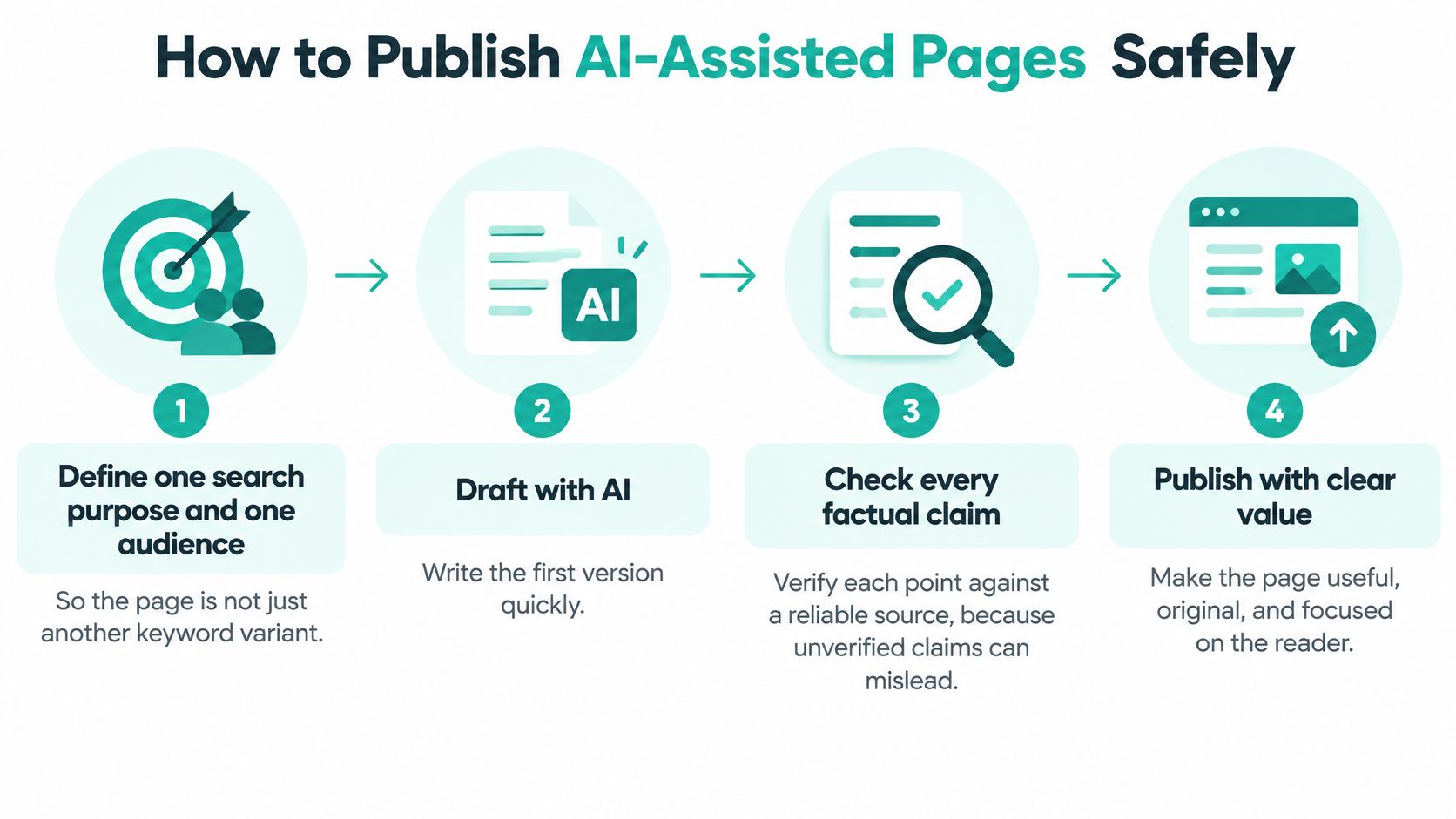
- Name one search purpose and one audience. A page for first-time landlords about late rent is not a glossary of lease terms. The slip is publishing both ideas as keyword twins that could swap titles overnight.
- Draft with AI, then verify every factual claim against a reliable source. The common slip is a plausible statistic with no document behind it. Teams that want the prose to sound like a person, after the facts are solid, can use AI humanizer workflows for content teams. Polishing voice before checking facts just hides a bad spell.
- Add something only you can provide. A first-hand example, an original number, a real observation, or a quote from someone who did the work. Your return rate or the temperature that worked is the part a model cannot invent.
- Search the site for near-duplicates and merge what you find. Overlap is how one helpful page turns into a swarm. Keep the strongest URL and fold the rest into it.
- Review the title, metadata, and intro for accuracy rather than keyword stuffing. A stuffed title is a costume, not a promise. When the wording needs a clean pass, how to edit website text keeps the change on the sentence, not on a new pile of variants.
- Explain the automation only when a visitor would reasonably wonder how the piece was made. A lab-style explainer may need that note. A shop announcement often does not. Do not add a disclosure badge to every URL out of superstition.
- Publish one small batch, watch it for about a month, and only then repeat the pattern. Scaling on day two is how a test becomes a curse. If the small batch looks thin in the results, fix the pattern before you copy it.
Would this page still be worth publishing if the AI tool vanished tomorrow? If the answer is no, it is not ready.
Signals That Show Your AI Pages Are Healthy
Use this as the monitoring card. Read it row by row, starting with the group, not the single URL.
| Metric | Healthy sign | Warning sign | Action |
|---|---|---|---|
| Impressions by page group | Steady or rising | Sudden drop across many pages | Check the group against the risk table |
| Indexed page count | Matches the pages you intended | Thin or duplicate URLs indexed | Noindex or consolidate them |
| Click-through rate | Stable against baseline | Falls after a metadata rewrite | Revert the affected titles |
| Engagement time and scroll depth | Visitors read past the first screen | Immediate exits from AI-written pages | Rewrite the intro with specifics |
Impressions by page group come first. A dip on one URL can be a weak headline. A sudden drop across one template means the pattern is sick, so compare that group with the risk patterns before you touch copy.
Indexed page count should match the pages you meant to publish. Surprise thin or duplicate URLs are the warning, and crawling and indexing in SEO shows how those extra URLs get discovered in the first place.
The two signals people skip
Click-through rate after a metadata rewrite only means something against the baseline from before the change. If it falls, revert the titles that moved. Do not "optimize" them a second time in the same week.
Engagement time and scroll depth show whether people get past the first screen. Immediate exits on a fresh AI draft usually mean the intro is vague. Rewrite that opening with a concrete detail, not another keyword.
Check weekly during the first month, then monthly. AI-detection scores are not reliable signals of quality or ranking health. A detector can scold a careful page and miss a useless one. When a warning shows up, match it to the publishing pattern before you change anything.
Check for a Penalty and Recover Safely
Do not delete a folder because a traffic chart looked scary. Name the kind of hit first.
Manual action or quiet demotion
- Open the Manual actions report in Google Search Console, under Security and Manual Actions. A spam-policy notice names the affected pages or sections. That is a manual action, and you can request review only after the fix.
- If no notice appears, but impressions fell across one template around a core update, treat it as algorithmic demotion. Diagnose it with impressions by group and the indexed-page count, not with a hunch about the model.
- Map every affected URL to a pattern in the risk table. Separate scaled thin pages from pages that still help someone. A useful guide that happens to mention a city is not the same creature as 400 swapped city pages.
- Remediate in that order. Noindex or remove pages with no distinct audience. Merge near-duplicates into one stronger page and redirect the old URLs. Correct unverified claims. A structured pass, such as a website SEO audit, keeps you from deleting by panic.
- Submit a reconsideration request only after cleanup, and only for a manual action. Describe what you removed and why it will not return. Asking for review while the thin pages are still live wastes the request.
The common slip is deleting good pages beside the thin ones. You erase traffic you never needed to lose.
Recovery is not instant. Recrawling and re-evaluation can take weeks or months, so keep the same weekly review. If the pile is large and the notice is already in Search Console, expert help recovering from Google penalties can sort which URLs stay while you do the cleanup.
Confirm Your Workflow Before the Next Page Goes Live
Audit your top 10 pages this week. For each one, confirm a single purpose and a single audience, merge any duplicates, and verify every claim on the pages visitors use.
Put any new AI-assisted batch on a weekly review for the first month.
The SEO Seer familiar crawls pages nightly, rewrites meta, and fixes broken links. Every Web Mage site also includes four built-in AI agents, called familiars, that run automatically every 24 hours with no manual setup. Automation is only as good as the rules behind it, so you still review every generated title, claim, and page purpose before it goes live. Schedule that audit before the next page is published.
Web Mage turns a plain description into a live website or sales funnel, then keeps later pages tied to a real audience instead of a pile of thin copies. If you want drafting help that still leaves purpose, accuracy, and publishing decisions with you, start with Web Mage.