
You've polished a beautiful page, published it, and waited for visitors who never arrive. The tower is full of useful gold, yet the search results remain quiet. In the language of crawling and indexing in SEO, your page may be visible to a crawler but still absent from the great library where searchers can find it.
That distinction turns many website owners into accidental apprentices. They check whether Googlebot visited, see activity in their logs, and assume the spell worked. But crawling is discovery, while indexing is inclusion. A search dragon can fly over your tower, inspect its windows, and still decide not to record its location in the search index.
Table of Contents
- How Search Dragons Discover Your Digital Kingdom
- Casting Sitemaps and Recrawl Incantations
- The Mystery of Pages That Disappear After Being Found
- Blocking the Eyes of Digital Pixies and Goblins
- Summoning the Web Mage Spirits for Continuous Magic
- Mastering the Crawl to Secure Eternal Search Visibility
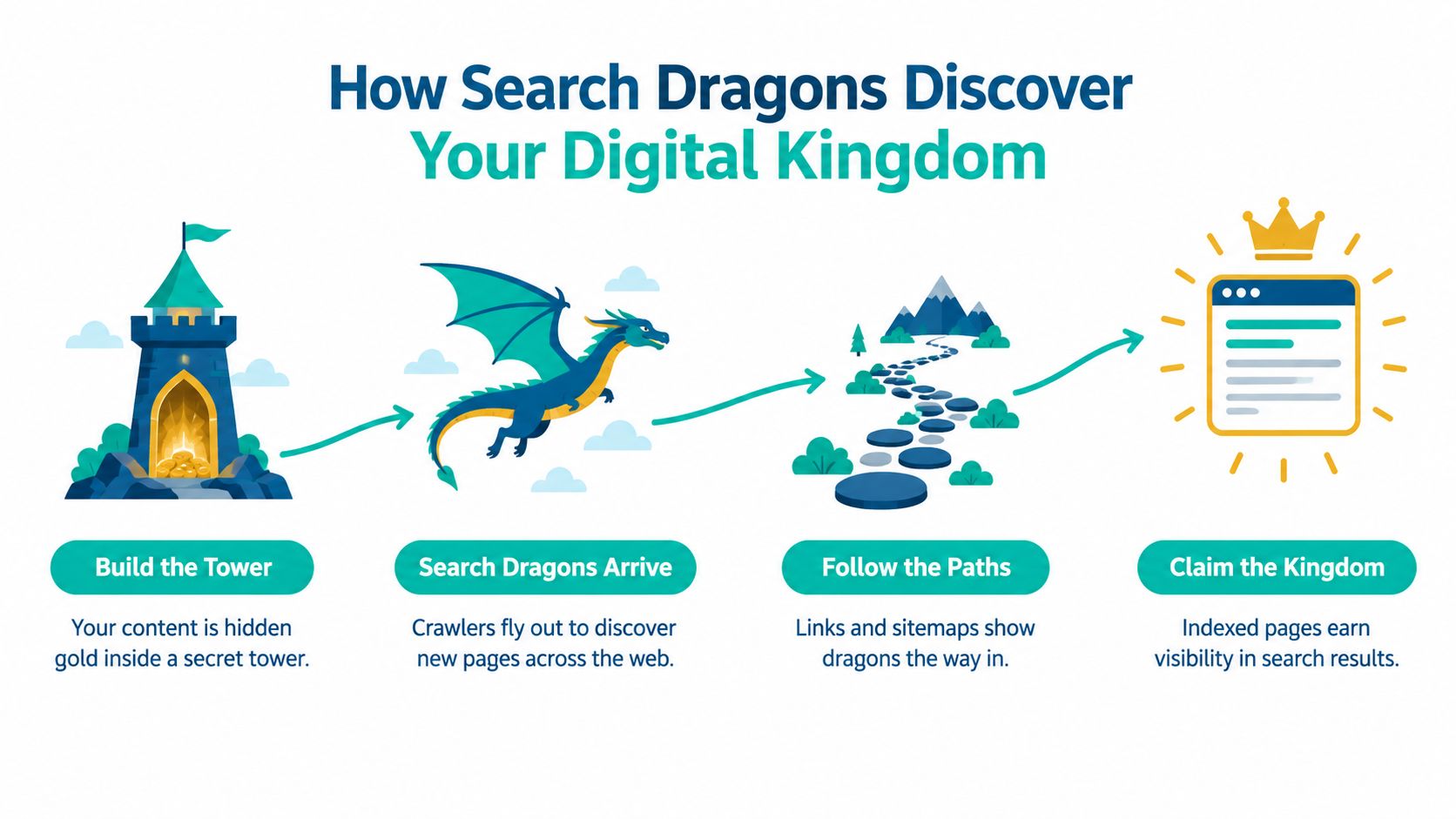
How Search Dragons Discover Your Digital Kingdom
A village wizard once built a tower for a rare collection of maps. The tower contained everything an explorer might need, but it stood beyond a forest with no road, sign, or messenger path. Search dragons circled the nearby hills, yet none found the door. The treasure wasn't useless because it was poor. It was useless because discovery failed.
That's the first encounter in SEO. Crawling happens when automated programs discover and download the text, images, and videos on a page. Indexing happens later, when Google analyzes that material and stores it in its large search database. Google explains the difference in its documentation on how Search works, and the distinction matters because a page can be fetched without appearing in search results.
The road to the tower
Your internal links are the stone paths between chambers. A crawler that reaches a strong article can follow a relevant link to a product page, then travel onward to a supporting guide. Those paths help search engines understand which rooms belong together and which pages deserve attention.
A sitemap is a more deliberate map. It can help Google learn about new or updated URLs, especially pages that are difficult to discover through ordinary links. It isn't a royal decree, though. Submitting one doesn't guarantee crawling or indexing, as Google states in its guidance on building and submitting sitemaps.
A new site can therefore have excellent writing and still hide behind tangled corridors. If the homepage doesn't link to an important service page, and no sitemap points toward it, the page may remain an unvisited chamber. A clean site structure, descriptive internal links, and a current sitemap give your local pixies several ways to guide the dragon inside.
Practical rule: A page needs both a discoverable route and a reason for Google to remember it.
Before you summon crawlers, build a kingdom they can interpret. A website generated from a clear prompt still needs intentional architecture, useful page relationships, and content that answers a real query. This guide to building a website with AI can help you think about the tower before you start decorating its battlements.
The web's earliest search creatures faced a much smaller wilderness. The World Wide Web Wanderer appeared in June 1993, measuring web growth and creating Wandex, one of the first search indexes. JumpStation followed in December 1993, combining crawling, indexing, and a user-facing search interface. By 1998, when Google began crawling the web, its index reportedly held about 25 million unique URLs, and by 2008 Google announced it had seen 1 trillion unique URLs, a history recorded in this account of technical SEO milestones. The dragon's territory has grown from a village trail into a continent, so clear maps matter more than ever.
Casting Sitemaps and Recrawl Incantations
A sitemap spell is simple, but careless wizards often expect it to force an immediate appearance in search. It doesn't. Think of a sitemap as a lantern and a route map, not a command that compels the dragon to claim every room.
Google defines crawl budget through crawl capacity and crawl demand. Capacity concerns how much crawling a site can handle, while demand reflects how much Google wants to revisit its pages. Google's crawl budget documentation, maintained in its developer guidance and updated on 2026-09-24, also makes clear that not every crawled page will be indexed.
The sitemap rite
Use this sequence when you publish or reorganize a substantial site:
Choose worthy chambers. Include canonical, indexable URLs that you want searchers to find. Keep out private areas, duplicate variants, and pages that carry no independent value.
Keep the map honest. Remove URLs that redirect, return errors, or have been deliberately excluded from indexing. A map filled with false doors makes the crawler spend attention on the wrong rooms.
Submit the map. Add the sitemap through Google Search Console and make sure your site's navigation also points toward important pages. The sitemap supports discovery, but it can't replace useful internal paths.
Watch the responses. Inspect representative URLs rather than treating submission as proof of inclusion. A successful submission means Google received the map, not that every destination earned a place in the index.
This distinction is especially important for large, frequently updated domains. A catalog may contain thousands of URLs, but the most valuable product, category, and editorial pages should receive the clearest signals. Crawl efficiency beats raw activity when the goal is visibility for priority pages.
The recrawl rite
When you substantially improve a page, open URL Inspection in Google Search Console and request an individual recrawl. For larger batches, submit or resubmit the sitemap after the changes are live. Google says recrawling can take a few days to a few weeks after a change, so the ritual doesn't produce instant magic. The timing guidance appears in Google's recrawl documentation.
A recrawl request starts a queue. It doesn't skip the queue.
Use requests for meaningful changes, not every typo. A rewritten title, repaired canonical signal, expanded answer, or major template correction may justify attention. Repeatedly requesting the same unchanged URL won't transform weak content into an indexed page.
Also check the server's health while you wait. Industry coverage of Google Search Central APAC's 2025 guidance notes that server-side 5XX errors consume crawl budget directly, while 4XX and 1XX responses don't have that same direct effect. If your castle repeatedly throws internal errors at visiting dragons, fix the gate before drawing a more elaborate map.
The Mystery of Pages That Disappear After Being Found
Mara, a fictional shopkeeper, publishes a guide to choosing enchanted garden tools. Her analytics show that Googlebot visited. Search Console says the URL was discovered. Yet a search for the page's title returns nothing. She has proved the dragon can reach the tower, but she hasn't proved the dragon chose to catalogue it.
That is the central mystery of crawling and indexing in SEO. Crawlability answers whether Google can fetch a page. Indexability answers whether Google chooses to store and serve it. The first is a technical gate. The second also involves content quality, usefulness, duplication, relevance, and the page's relationship to the rest of the site.
A 2025 study summarized by Search Engine Journal examined a dataset of 16 million pages. It reported that 37.08% were indexed, while 61.94% were marked page not indexed, and about 20% of indexed pages were later deindexed. Those figures come from the Search Engine Journal coverage of Google Search Central APAC 2025. They don't mean every site has the same pattern, but they expose the trap: a crawl event is not a coronation.
Why the dragon refuses the scroll
Google may fetch a page and still decide it doesn't add enough distinct value. A thin location page that repeats another page with a swapped place name may be reachable, readable, and technically sound, yet offer little reason to keep a separate entry. A product page with vague copy, no meaningful details, and no useful relationship to supporting content can meet the crawler at the gate and still fail the librarian's test.
Diagnose the missing page as a chain of questions:
- Can Google access it? Check the response, rendering, redirects, and accidental barriers.
- Does the page identify itself clearly? Review canonical signals, title, main content, and structured relationships.
- Does it deserve its own shelf? Compare it with nearby pages for duplication, depth, and distinct search intent.
- Does the site support it? Look for internal links from relevant, accessible pages.
- Did the page change recently? A crawler may need time to revisit and process the update.
Do not respond by generating dozens of near-identical pages. That creates more corridors for the dragon to inspect without improving the treasure in any chamber. Strengthen the page's original purpose, answer the query directly, remove repeated material, and connect it to the site's most relevant resources.
Crawl logs are not victory banners
A crawl report can tell you that a bot arrived. It can't, by itself, tell you that Google accepted the page into its index or will show it for the query you want. Search Console's indexing reports, URL Inspection, page content, canonical signals, and internal links each reveal a different part of the enchantment.
The useful question isn't, “Why hasn't Google visited?” It may be, “What did Google find when it visited, and why might this page not deserve a separate place?” That change in perspective moves the investigation from gatekeeping alone to quality and usefulness.
A page that disappears after inclusion deserves another inspection. Content may have become obsolete, duplicated by a stronger URL, accidentally marked for exclusion, or weakened by a template change. Treat deindexing as a diagnostic signal, not as a reason to cast random technical spells.
Blocking the Eyes of Digital Pixies and Goblins
Every kingdom has rooms that shouldn't appear on the public map. A checkout confirmation, an internal search result, a staging page, or a duplicate print version may be useful to visitors in a specific moment but unsuitable for search.
Two protective spells are often confused: robots.txt and noindex. They solve different problems. One controls whether a crawler may enter or fetch a path. The other tells a crawler that can access the page not to include it in the index.
Choosing Your Digital Blocking Spell
| Method | What It Does | When to Use |
|---|---|---|
robots.txt | Restricts crawler access to specified paths, so the crawler may not fetch the page or read its directives. | Use when you need to manage access to areas that shouldn't be crawled, such as crawl traps or non-public resource paths. |
noindex meta tag | Places an exclusion instruction in the page's HTML for supported crawlers. | Use when Google may access the page but you don't want the URL included in search. |
noindex HTTP response header | Sends the same type of exclusion instruction through the HTTP response rather than the HTML. | Use when the resource isn't ordinary HTML, or when server-side control is more practical. |
Google states that a noindex directive can appear as an HTML meta tag or an HTTP response header, and that the effect is the same for supported crawlers. The page must remain accessible so the crawler can see the instruction. The details are set out in Google's documentation on blocking indexing.
Pick the barrier for the intention
Suppose a wizard has a duplicate spellbook that should never appear in search, but still needs to inspect it remotely. noindex fits that intention. The crawler can enter, read the sign, and leave the book out of the public catalogue.
Now suppose the wizard wants to reduce crawling of an endless calendar that creates countless low-value URL variations. A robots.txt rule may help limit access, but it isn't a reliable way to remove a URL that Google already knows about. If the crawler can't access the page, it can't see a noindex tag, so the URL may remain indexed.
The protective barrier must match the problem. Blocking access isn't the same as requesting exclusion from the index.
Check the result after implementation. A misplaced rule can hide an important page from crawlers, while a noindex directive on a valuable page can quietly remove it from search. Test staging, templates, faceted navigation, and downloadable resources with the same care you'd use when sealing a dangerous chamber.
Summoning the Web Mage Spirits for Continuous Magic
A neglected kingdom doesn't collapse because one brick falls. It declines through small unattended failures, a broken link here, stale metadata there, a heavy image slowing the gate, and a valuable page buried beneath newer rooms.
Continuous maintenance gives each problem a named spirit. Web Mage is one example of an AI-driven website and funnel builder that generates pages, copy, imagery, and styling from natural-language prompts, then uses autonomous agents to monitor SEO, performance, analytics, and conversion activity.

Give each spirit a narrow duty
The SEO Seer crawls pages on a nightly cycle, rewrites metadata, repairs broken links, and identifies additional keyword opportunities. That doesn't guarantee indexing, and it can't replace editorial judgment. It does reduce the chance that basic maintenance tasks wait until a human remembers to inspect them.
The Speed Sprite compresses assets, lazy-loads media, and prunes unnecessary bloat. Faster delivery helps both visitors and the systems that must retrieve page resources, but performance work should serve the page rather than become a ritual performed for its own sake.
The Analytics Oracle reads traffic patterns, surfaces drop-offs and popular sections, and prioritizes potential fixes. Its role is not to declare a page successful because a crawler visited. It helps the team decide which content, paths, and conversion moments deserve investigation.
A nightly system works best when its powers have boundaries:
- Let automation find routine defects. Broken links, missing metadata, oversized assets, and unusual traffic patterns are good candidates for recurring checks.
- Reserve judgment for meaning. A human should decide whether a page is genuinely useful, whether two URLs deserve separate identities, and whether a rewrite preserves the audience's intent.
- Inspect important changes. Review templates and high-value pages after automated edits, especially when a change affects canonicals, visibility directives, navigation, or core copy.
- Measure the right outcome. Track index status, impressions, clicks, engagement, and conversions rather than treating crawl frequency as the final prize.
For teams comparing approaches, SEO automation software can clarify which repetitive checks are suitable for agents and which decisions still require a Web Mage's discernment.
The broader crawler ecosystem is also changing. Cloudflare reported that AI and search crawler traffic grew 18% from May 2024 to May 2025, and its analysis described a shift in which crawlers visit sites. The finding appears in Cloudflare's 2025 crawler analysis. That makes it sensible to understand crawler traffic, but don't confuse more visitors at the gate with better search visibility. The kingdom still needs clear priorities, healthy responses, and pages worth remembering.
Mastering the Crawl to Secure Eternal Search Visibility
The apprentice's mistake is to treat search visibility as one spell. The master recognizes a sequence.
First, build a tower with a clear purpose. Then create paths through internal links and a sitemap so search dragons can discover the right chambers. After discovery, earn index inclusion with content that offers a distinct, useful answer. Finally, protect private or duplicate rooms with the correct barrier, and maintain the whole kingdom as pages change.

The Web Mage's field ritual
Begin with a small inspection rather than a grand incantation. Select important URLs and ask:
- Discovery: Can a crawler reach each page through links or a sitemap?
- Access: Do the pages return healthy responses and load their essential content?
- Identity: Does each URL have a clear canonical purpose?
- Value: Does the page answer a distinct need better than a duplicate or weaker alternative?
- Control: Are
noindexand robots.txt rules protecting the right rooms? - Patience: Has enough time passed for recrawling and processing after a change?
That checklist creates a better operating model than chasing crawler activity alone. It also prevents a common waste of effort: repairing crawl paths to pages that should never have entered the public index.
Search engines are not treasure hunters rewarding every visible tower. They are librarians managing an enormous, changing grimoire. Your task is to make the important pages easy to discover, easy to understand, and worthy of preservation.
Final incantation: Open the road, strengthen the scroll, mark the forbidden doors, and let time complete the spell.
If your site needs a more systematic ritual, optimizing website speed can support the performance side of the work while you improve structure, content, and indexing signals. Keep reviewing the kingdom after publication, because a page can lose usefulness, links can break, and templates can change the rules without warning.
Web Mage can generate pages and funnels from plain-language prompts while its SEO Seer, Speed Sprite, and Analytics Oracle handle recurring checks across content, links, performance, and analytics. Visit Web Mage to build a searchable digital kingdom and give your important pages a clearer path to the search dragons.