
You're staring at a landing page that almost works. The headline is fine, the button is fine, and last Tuesday sales jumped after you swapped one line. Wednesday went quiet again. You can't tell whether the new wording helped, or whether a lucky spell landed on a slow afternoon.
That's the moment a b testing for marketing earns its keep. It turns a hunch into a fair duel between two versions, so a spike in sales has to beat chance before you crown a winner.
Table of Contents
- What an A/B Test Actually Does
- How Many Visitors and Days You Really Need
- Which Marketing Elements Are Worth Testing First
- How to Run a Test From Hypothesis to Result
- Statistical Traps That Turn Winners Into Frogs
- Rolling Out Winners and Avoiding Common Failures
- Launch Your First Test This Week
What an A/B Test Actually Does
Say a bakery owner changes one headline on her cupcake page and orders jump that night. The kitchen cheers. Nobody knows whether the words did it, or whether a birthday rush walked in at the same hour.
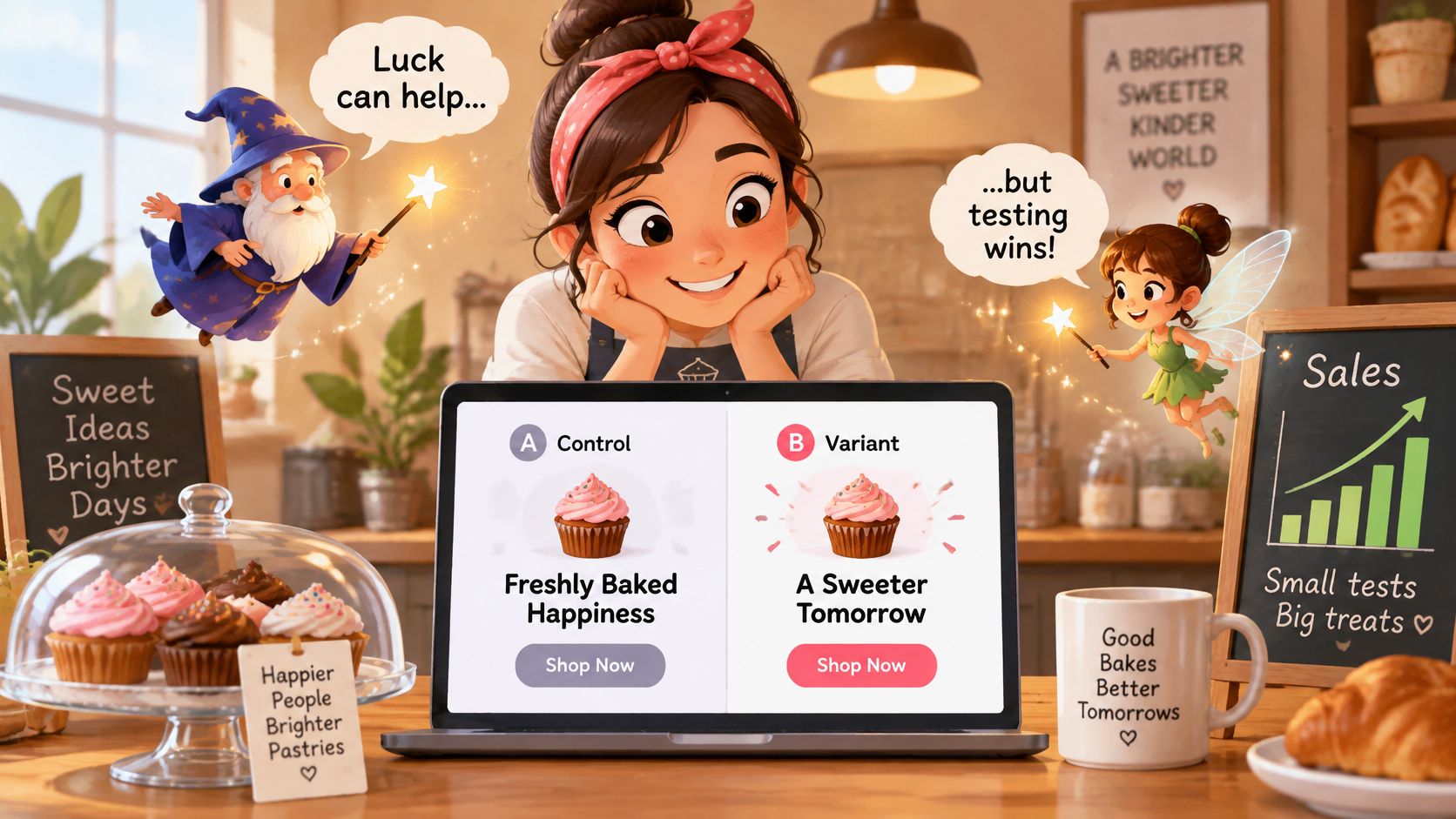
An A/B test is that duel with rules. The control is the page you already run. The challenger is the same page with one change. Visitors are dealt to each side at random, the way two brewers share one moon, the same cauldrons, and a single new herb in one pot. If the new brew sells more, the herb is the likely cause.
The habit is older than landing pages. In 1923, Claude Hopkins described keyed coupons in Scientific Advertising: each ad carried its own code so responses could be counted and compared, an early split test built on actions rather than opinions, as PPC Land's history of A/B testing traces from Student's 1908 t-test through Fisher's randomized field trials.
Random assignment, comparable groups, and a success metric you name before the first visitor arrives are what separate a real lift from a lucky charm. A pretty winner can still be noise.
Every proper test has three parts.
- Control: the live version, left alone.
- Challenger: one deliberate change, nothing else.
- Goal: one countable outcome, such as purchases or qualified leads.
Apprentice check: If you can't describe the test in one sentence, it isn't ready to cast.
Teams that want the longer craft, not a single trick, can study structured experimentation for growth teams before they start swapping headlines at random.
How Many Visitors and Days You Really Need
A duel with twelve visitors is a coin flip in costume. Sample size is the ward that keeps a tiny wobble from looking like magic.
| Baseline conversion | Target rate | Visitors per variant |
|---|---|---|
| 5% | 6% (20% relative lift) | about 8,200 |
| 5% | 5.5% (10% relative lift) | about 31,000 |
| 10% | 12% (20% relative lift) | about 3,900 |
| Email response gap | 7.5 points higher | 693 per condition (1,386 total) |
Read the first two rows as a planning chart at 95% confidence and 80% power, not as a law carved in stone. A page converting at 5% that you hope to move to 6% wants on the order of 8,200 visitors on each side. Chase a smaller step, 5% to 5.5%, and the same page wants roughly 31,000 per side. The lift shrank, so the crowd has to grow.
The four inputs you lock first
A sample-size guide from CloudResearch powers a test from four numbers you write down before traffic moves: baseline conversion rate, minimum detectable effect (MDE), significance level, and statistical power. A conventional design uses a 5% significance level and 80% power. That means you accept about a 5% chance of crying "winner" when nothing changed, and you give yourself an 80% chance of catching a real effect at least as large as the MDE.
One worked email experiment in that same guide, with a 7.5-percentage-point response gap, α = 0.05, and 80% power, needed 693 people per condition, 1,386 in total. Your MDE should be the smallest lift that pays for the build, the risk, and the fuss. A detectable bump that doesn't cover its own cost is a shiny pebble, not treasure.
Low baselines and tiny lifts stretch for months because each extra visitor carries less signal. Don't shrink the MDE to look rigorous if the business wouldn't ship a 0.2-point gain anyway.
How long the cauldron has to simmer
Divide visitors needed per variant by the daily visitors that variant will receive. Then add about a week so weekdays and weekends both appear. A test that can't reach its sample in about six weeks is aimed at a change that's too small for your traffic. Test a bolder difference instead of waiting half a season for a whisper.
Which Marketing Elements Are Worth Testing First
Tiny tweaks can print money, and they can also waste a season. Google famously ran its ad links through a lineup of blue shades rather than letting designers pick one by eye. The winning shade was later credited with roughly $200 million in additional annual ad revenue, a figure The Verge reported as the company's own business estimate. At global volume, a pixel matters. On a page with a few hundred visits a week, that same pixel is a pixie you will never catch.
So rank candidates by three things: exposure, possible impact, and how cheap the change is to build. Exposure decides whether the sample ever fills. Impact decides the size of the prize. Cost decides whether the test pays for its own ingredients. A brilliant test on a page nobody visits never fills its sample.
| Element | What to vary | Primary metric |
|---|---|---|
| Headline | Promise, length, wording | Click-through or sign-ups |
| Call to action | Button text, placement | Click rate on the button |
| Offer | Discount versus free bonus | Purchases or revenue per visitor |
| Form | Number of fields | Form completion rate |
| Pricing page | Price framing, plan order | Paid plan selection |
A headline duel you can actually finish
Take a services page with 4,000 weekly visitors. You pit a promise, "Cut your invoicing time in half," against a question, "Still chasing invoices by hand?" An even split gives each version about 2,000 visitors a week. The roughly 8,200 visitors a 5% baseline needs to catch a move toward 6% lands in about four weeks. That's a duel a small team can finish. A button-color shade on that same page would need a far larger crowd, so save color hunts for pages that already roar with traffic.
The priority rule is plain. Start on the highest-traffic page, then the biggest drop-off, then the cheapest change that could move the metric in the table. Offer and form tests usually beat decoration because they change what the visitor gets or how much work they must do. If you're mapping where people stall before you pick an element, a pass through conversion rate optimization and UX shows the leaks worth aiming at.
One last filter favors patient wizards: pick elements whose victory you can verify once the confetti settles. When the winner goes live, keep a small holdout on the old version and watch guardrails such as revenue per visitor and form completion beside the headline metric. A variant that wins the duel still has to win with the full crowd.
Which element on your own page should go first? If you hesitate, it's the one sitting on the busiest URL.
How to Run a Test From Hypothesis to Result
A clean test is a ritual with the steps in order. Skip one and the result starts arguing with itself.
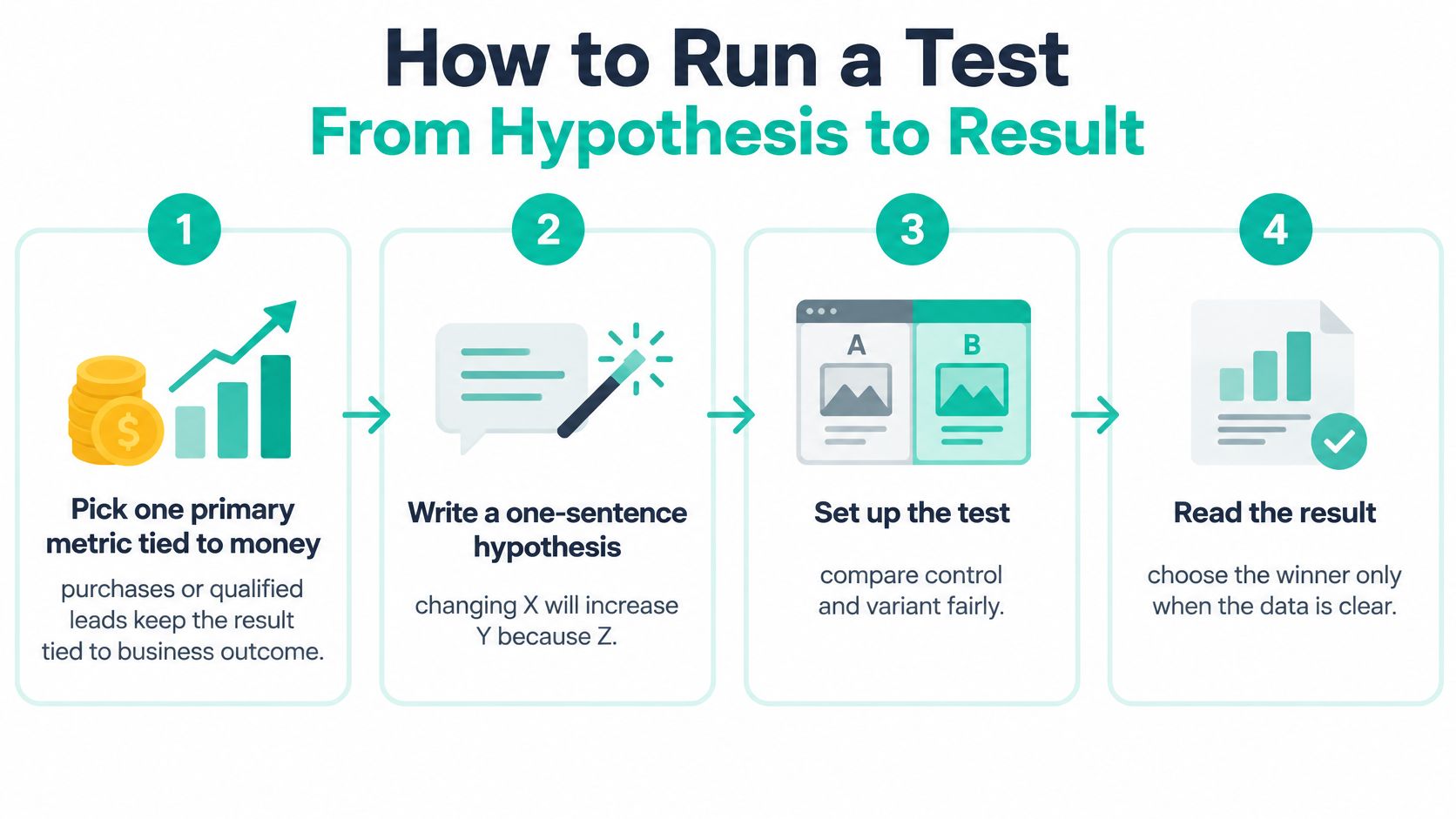
Picture a SaaS pricing page where annual plans are buried under monthly ones. You'll walk that page through all eight steps.
- Pick one primary metric tied to money. For this page, paid plan selection is the score. Clicks are a scout, not the verdict, because a curious click that never pays doesn't keep the lights on.
- Write a one-sentence hypothesis. "Putting annual plans first will increase paid selections because buyers see the better yearly price before the monthly default." If you can't finish "because," you don't have a reason, only a preference.
- Build the challenger with one change. Plan order moves. Prices, copy, and the button stay put, so a difference has a single likely cause.
- Fix the sample and the stopping rule before launch. Use the visitor target from your baseline and MDE, write the end date, and don't renegotiate when a chart looks exciting on day three.
- Set the split and leave it. Google Ads documentation explains that a 70–30 split sends 70% of auction opportunities to the control and 30% to the treatment, and that the percentage can't be changed after the experiment is set. For Demand Gen experiments, Google recommends a 50% split because equal exposure gives the cleanest comparison. An even split is the right default unless you have a stated reason to protect the control.
- Launch, then keep both versions untouched. No headline tweaks, no traffic shove toward the side that's "feeling lucky." Mid-run edits give the two groups different weather.
- Run until the sample is reached. A thrilling Tuesday is not a stopping rule. Weekday and weekend traffic have to both show up.
- Compare, record, decide. If the challenger clears the threshold you set, ship a controlled rollout. If it doesn't, call the test inconclusive, keep the control live, and choose a bigger change or a longer run. Don't crown a loser because you're tired of waiting.
A healthy-test checklist
- One metric that points at money or a qualified lead.
- One change, so the cause stays visible.
- Fixed sample and a stopping rule written before launch.
- Stable split that nobody nudges mid-test.
If you're choosing software to hold that split steady, compare options in this guide to A/B testing tools before the first visitor is assigned. The tool should refuse to move the allocation once the run has started.
Statistical Traps That Turn Winners Into Frogs
The common habit is to peek every morning and stop the moment a variant "hits significance." That habit mints false winners. Ordinary p-values assume you look once, at the end. Every extra look is another chance for noise to hop the fence.
A 0.05 significance level, the usual 95% confidence standard, means you accept a 5% chance of declaring a difference that isn't there. Mastercard's experimentation guidance puts it that way: a Type I error, and it treats exposed visitors as independent observations. The same person refreshing the page all afternoon is not five separate pieces of evidence. Set the threshold before you open the results, or the number becomes a decoration you move until it flatters you.
What repeated peeking actually costs
In 1,000 simulated A/A and A/B trials, unadjusted repeated testing produced a realized Type I error of 27.4%, versus 5.1% after sequential-testing and variance-control methods were applied, according to evidence on digital experimentation summarized on EconPapers. The adjusted design used 68.4% of the fixed-horizon sample on average and still kept 81.2% power. Peeking doesn't just add a little risk. It can turn a 1-in-20 false alarm into something closer to 1-in-4.
Multiple comparisons pile on the same problem. Five headlines, three calls to action, and two offers in one brew is ten chances for a fluke to wear a crown. A "winner" that only appears inside one audience slice you noticed after the fact is a story for the next test, not proof for this one.
The wards that hold
- Precommit: lock sample size and the stopping rule, or use a sequential method built for continuous monitoring.
- Freeze the metric: don't swap the primary goal because a secondary one looks kinder.
- Label slices as scouting: subgroup sparks become the next hypothesis, not an automatic promote.
A winner that appears too early is usually a mirage. Let the sample finish before you knight anyone.
Rolling Out Winners and Avoiding Common Failures
A significant result on a slice of traffic is not the same as a win in the wild. GrowthLoop's write-up of marketer research reports that 77% of marketers say their "winning" tests fail after implementation at least sometimes. The unanswered question is what happens once the winner meets the full audience, other channels, and an ordinary month.
Novelty wears off once the new layout stops feeling new. Seasonality shifts, so a January pricing test can lie about March. A higher checkout rate can arrive with lower-quality buyers, more refunds, or leads your sales team can't close. Some of the "lift" is just customers who would have bought on the old page, or demand that moved from one step of the funnel to another.
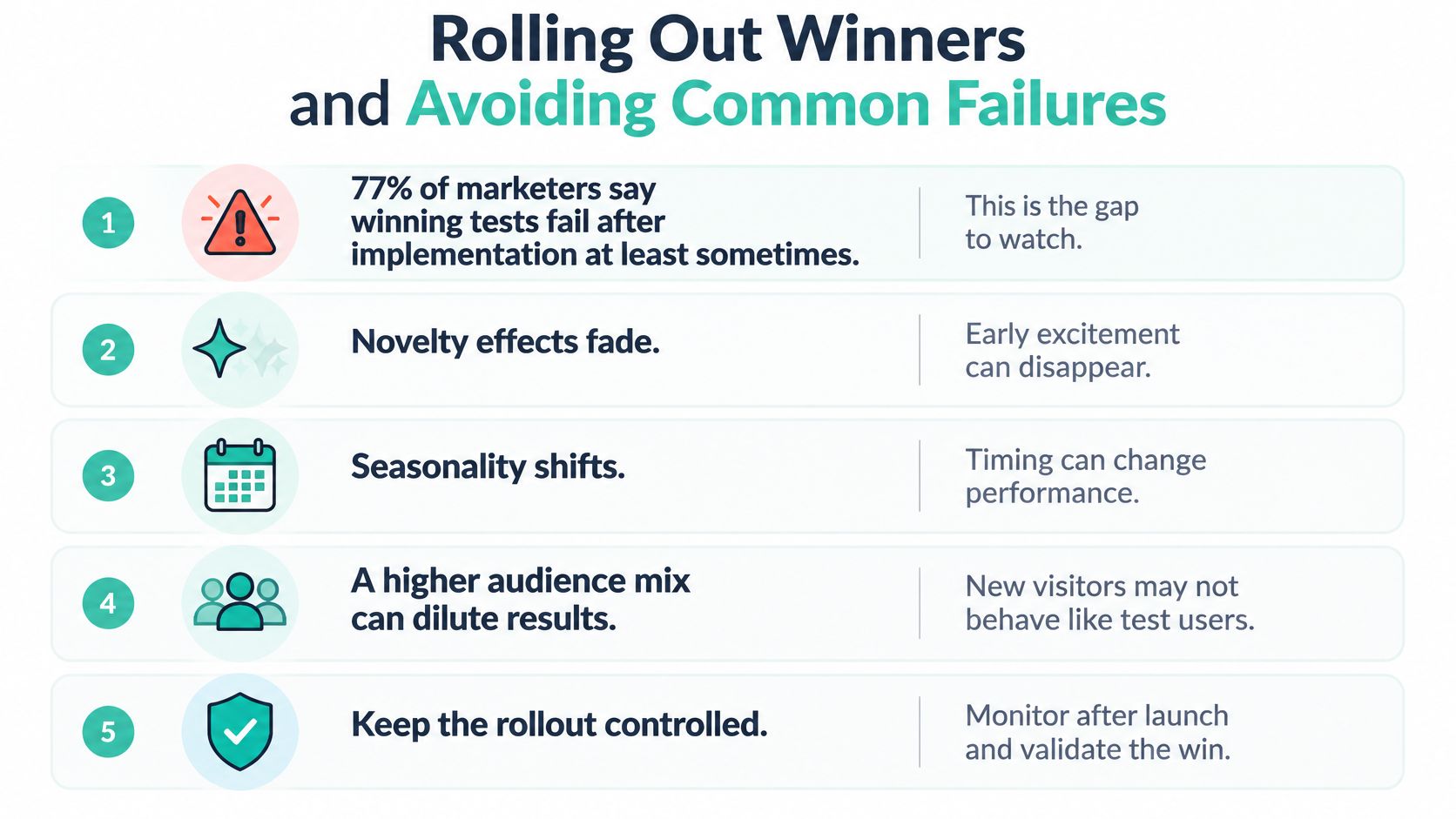
A rollout you can actually watch
- Keep a holdout. After you promote the challenger, leave 5% to 10% of visitors on the old control.
- Name guardrails before the promotion. Refunds, lead quality, retention, and support contacts. A checkout win that doubles refund tickets is not a win.
- Review on a set window. For slower conversion cycles, Google's Performance Max experiment guidance recommends at least 4–6 weeks so delayed conversions can land and performance can settle. Compare the promoted version with the holdout, not with your memory of the test week.
- Watch delivery, not just the rate. Google notes that auction behavior can produce normal spend discrepancies below 20%. A gap past 20% after the learning phase means you check budgets and mismatched targets before you trust the result.
The same research notes that 44% struggle to measure personalization's impact, and 35% need one to two months to tell whether a change improved a key metric. Patience here is measurement, not hesitation.
Failures worth ticking off your own test
- Tiny samples that get promoted because a chart spiked.
- Mid-test traffic changes that give the two sides different conditions.
- No holdout, so you can't see the win decay.
- A local lift that never shows up in revenue.
Resource limits are common, not a personal failing. In 2025, 51% of small-business marketers cited lack of resources as a leading testing challenge, and 49% cited insufficient traffic for significant results, in Unbounce and Ascend2 research reported by MarketingProfs. A short holdout and two guardrails still fit a lean team. For the page that follows a purchase, borrow patterns from these thank-you page examples so the win doesn't die at the last step. Broader A/B testing tips for better conversions cover the same idea: a conversion bump only counts if the business still wants the customers it attracted.
Launch Your First Test This Week
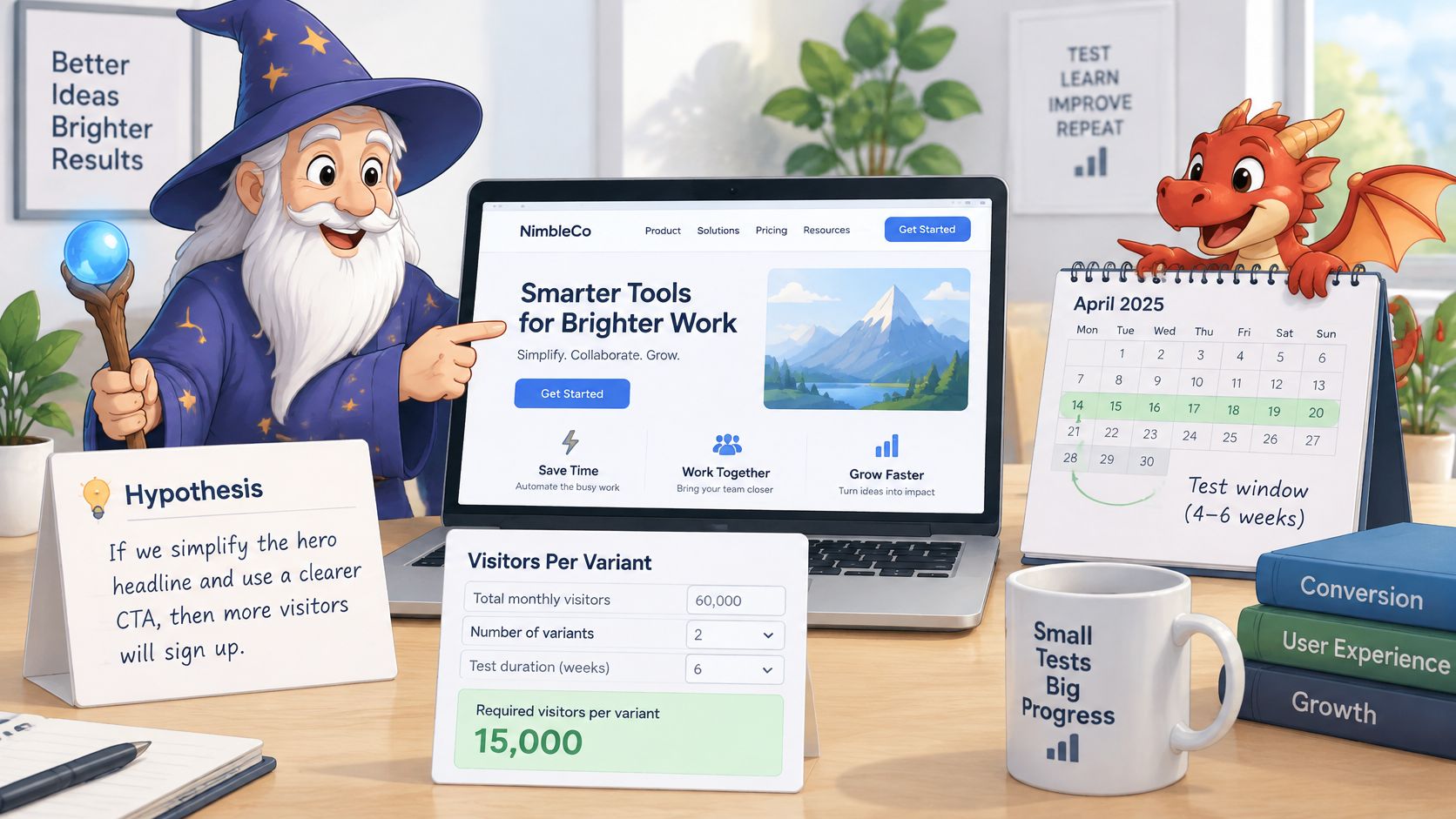
Pick one page, the busiest one, and run a single headline test this week. Write the hypothesis in one sentence, pull the visitors-per-variant figure from your baseline and target lift, and book a four-to-six-week window that ends with the holdout review, not with a victory lap on day five.
Say the page converts at 5% and draws 4,000 visitors a week. The challenger is one new headline. You split 50/50, give the test the weeks it needs to hit the per-variant target, and only then promote with a small control still watching. If the math says you can't finish inside about six weeks, change a bigger element. Don't pray for a smaller effect to reveal itself.
Automation doesn't replace that arithmetic. Our Conversion Alchemist can draft challenger variants and allocate traffic, and the Analytics Oracle flags visitors who stall or abandon, but you still confirm that a loser isn't retired before the fixed sample is in. The $8 monthly plan includes 500 credits, and creating and monitoring one split test costs about 5 credits, so the first experiment is a small draw on the pouch, not a new department.
If the sentence, the sample, and the end date aren't written down, you don't have a test yet. You have a wish.
A short walkthrough of the same duel, control against challenger, sits in this video. Watch it with your own page's hypothesis in mind, then book the window on a calendar before the week gets away from you.
Go cast it properly, apprentice. One change, a full sample, and a holdout that tells you whether the charm still works once the whole village sees it.
Web Mage builds a live site or sales funnel from a plain-English description, then keeps testing the pages that are supposed to convert. The Conversion Alchemist drafts split-test challengers, splits traffic, and promotes a winner only when you hold it to a real sample, which is the difference between a lucky week and a durable lift. When you're ready to put a control and a challenger on a page you own, start at Web Mage.