
A funnel builder is an AI-driven orchestration layer that connects landing, checkout, and upsell pages into one tracked conversion path. Median landing-page conversion is 6.6%, while broader website conversion averages sit around 5.13%, so the core job is turning more of the visitors you already have into customers.
You know the scene. It's late, the offer is ready, and your screen displays a blank page with a blinking cursor that seems to be judging your life choices. You need a landing page, a checkout, an upsell, and a thank-you page. Instead, you're dragging buttons across a canvas, hunting for the right shade of blue, and wondering whether the checkout form is passing customer data to the email sequence.
The old way treats each page like a separate parchment. The modern way treats the entire journey as one spell. You describe the offer in plain language, and an AI funnel builder can generate the page structure, copy, imagery, styling, connections, and tracking needed to move a visitor from interest to action.
That distinction matters because a website invites browsing, while a funnel engineers progression. A website may offer a menu of destinations. A funnel gives the visitor one clear path, preserves what they've done, and records where they leave.
Table of Contents
- Summoning Your First Conversion Path
- The Ancient Origins of the Sales Funnel
- Anatomy of a High-Converting Magic Funnel
- Prompt-to-Page Generation Versus Template Grimoires
- Autonomous Agents and Conversion Alchemy
- Casting Funnels for Different Marketing Archetypes
- Mastering the Art of Funnel Optimization
Summoning Your First Conversion Path
A founder preparing a live email strategy workshop has a clear offer but no conversion route. She asks for a registration funnel with a landing page, checkout, confirmation page, and optional private-review offer. In a traditional builder, that sentence becomes a tedious trek through templates, sections, forms, integrations, and settings.
An AI-driven funnel builder treats the request as a spell instruction. Prompt-to-page generation turns the brief into a connected blueprint, while autonomous agents assign each page a job, draft supporting copy, configure handoffs, and prepare the events needed to observe the journey. The result is an automated version of the century-old AIDA sequence, expressed through pages and actions rather than a dusty diagram.

The difference between a page and a path
A standard website builder creates individual pages. A funnel builder connects landing, offer, checkout, thank-you, and sometimes post-purchase steps into one measurable conversion path. It records a visitor's state, attribution, and events as that person moves from one stage to the next. That orchestration is the technical heart of AI-powered landing page creation.
For the workshop founder, the connected trail answers practical questions:
- Where did the visitor arrive? An advertisement, search result, email, or referral.
- What did the visitor do? View the offer, click the registration button, begin checkout, or complete payment.
- Where did the visitor vanish? On the landing page, inside the form, at checkout, or after an upsell.
Every extra step offers another place for a prospect to drop out. The builder must preserve the thread between pages, letting a marketer inspect the leak instead of comparing disconnected dashboards. The page is only one chamber. The event trail reveals whether the spell worked.
Practical rule: Build the journey before decorating the rooms.
The economic case is plain. Funnel benchmarks cited in conversion-funnel research place many B2B lead-to-customer rates between 2% and 5%, or roughly 20 to 50 customers per 10,000 visitors. Those figures do not condemn the workshop offer. They show why clarity, speed, flow, and controlled experiments deserve attention before ornamental design.
Once the path is observable, every redesign decision starts from evidence instead of aesthetics.
The Ancient Origins of the Sales Funnel
Before the first landing page was coaxed into existence, salespeople already understood that a stranger rarely leaps straight to a purchase. Attention comes first. Interest follows. Desire gathers strength. Action closes the circle.
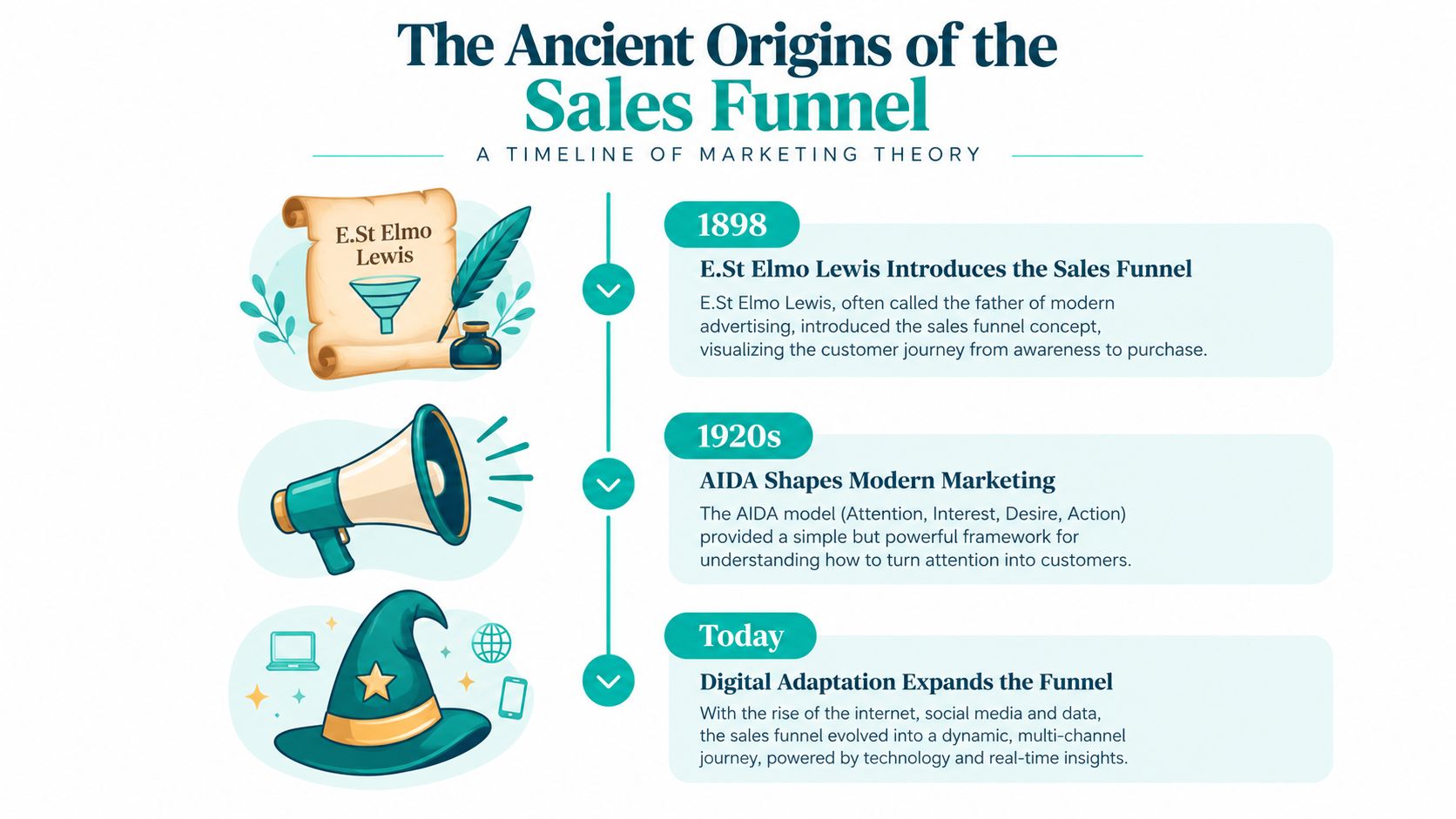
In 1898, advertising pioneer E. St. Elmo Lewis introduced the AIDA model, meaning Attention, Interest, Desire, and Action, to describe how prospects move from awareness toward purchase. The model gave marketers a sequence for thinking about persuasion, long before browsers, pixels, and abandoned-cart emails entered the guild hall.
The funnel metaphor arrived later. In 1924, William Townsend used the visual idea in Bond Salesmanship, helping popularize the image of a broad stream of prospects narrowing toward a smaller group of buyers. The historical development is documented in Marketing Week's account of the sales funnel's origins.
Old runes, newer machinery
A modern funnel builder doesn't replace AIDA with a shiny new theory. It operationalizes the old sequence.
- Attention becomes the headline, creative, search result, or opening promise.
- Interest grows through useful detail, proof, demonstrations, and relevant framing.
- Desire takes shape when the visitor understands the offer's value and fit.
- Action becomes the form submission, booking, subscription, or purchase.
The software adds something Lewis couldn't have summoned with a quill: persistent event tracking across a digital sequence. It can connect the initial message to the landing page, the landing page to the offer, and the offer to checkout. It can also show which stage loses momentum.
That creates a useful historical insight. A funnel builder is not a page-design category. It's a process automation category built around a century-old model of human decision-making. The page editor is only the visible spellbook. The deeper system manages order, state, signals, and follow-up.
Why the narrowing shape still helps
The funnel shape isn't a promise that every customer behaves in a perfectly straight line. Real people wander. They compare offers, return later, ask questions, and abandon carts while supposedly “just checking something.” The narrowing diagram remains useful because it forces the marketer to separate stages and inspect what happens at each one.
A visitor who never understands the offer has a different problem from a buyer who reaches checkout and encounters friction. An AI funnel builder can treat those as separate diagnostic problems instead of reporting one vague number called “website performance.”
The old model gave marketers the map. Automation gives the map moving parts, memory, and instruments.
Anatomy of a High-Converting Magic Funnel
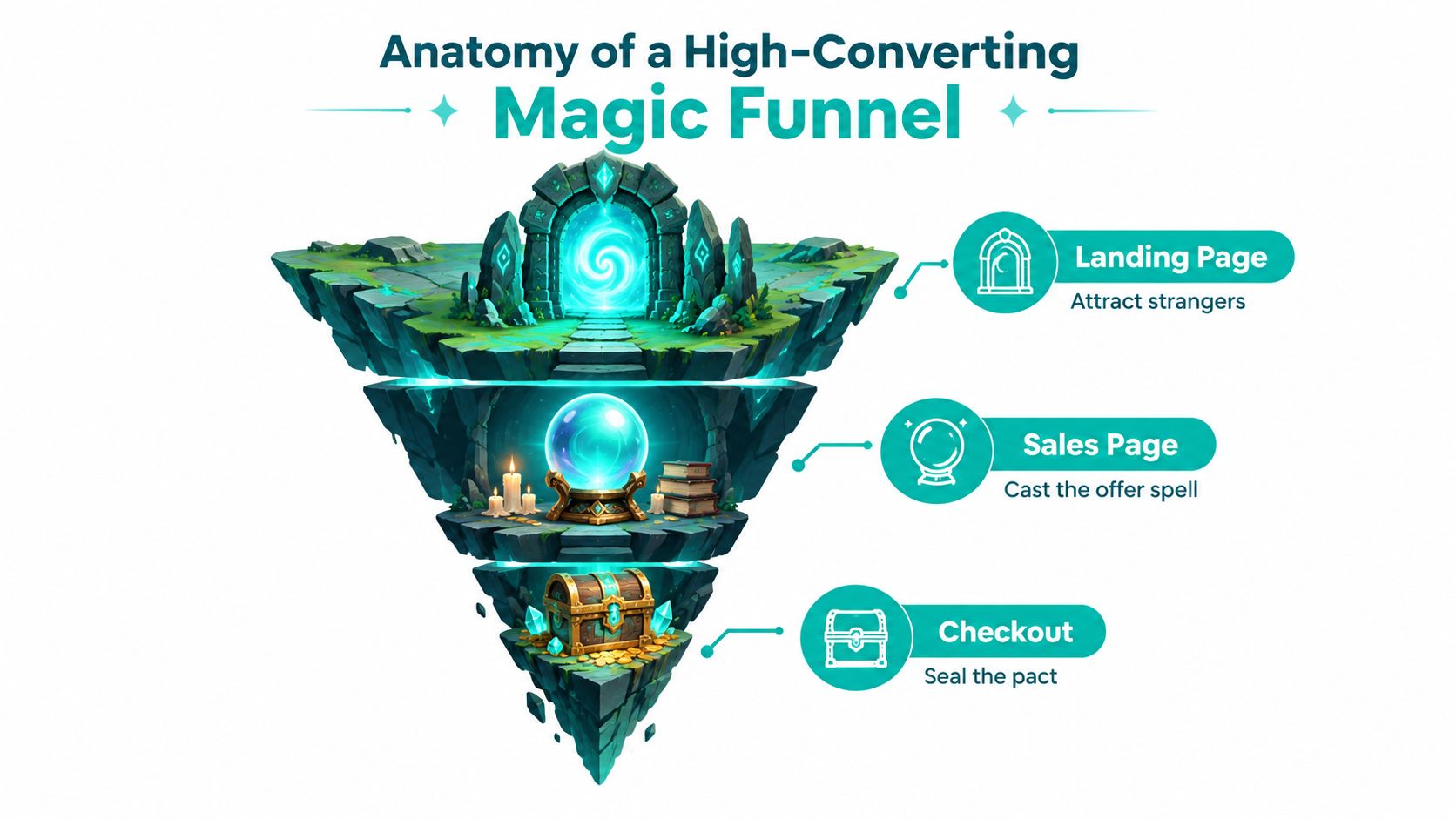
A useful funnel resembles a dungeon with distinct chambers. The entrance must attract the right adventurers. The central chamber must explain the treasure. The final vault must make claiming it feel safe and simple.
The sequence usually begins with a landing page, moves through an offer or sales page, reaches checkout, and continues to a thank-you or post-purchase experience. A funnel builder connects those chambers and carries the relevant context between them, including the selected offer, form state, cart details, and conversion events.
The entrance portal
The landing page earns attention and captures intent. It should make the visitor's problem recognizable, present a specific promise, and offer one obvious next action. If the page serves an email course, the form should support that purpose. If it sells a consultation, the page should guide the visitor toward booking rather than scattering attention across unrelated links.
The offer or sales page gives the promise substance. It answers practical questions, handles objections, clarifies who the offer suits, and shows what happens after purchase. For a course, that may mean explaining the learning experience. For software, it may mean showing the workflow a buyer will use.
The transaction vault
The checkout page exists to reduce uncertainty and friction at the moment of commitment. It should preserve the chosen product and present the payment decision clearly. A funnel builder's value appears here in the connections. The visitor shouldn't have to re-enter information or wonder whether the button has sent them into a different system.
An upsell page offers a relevant next step after the primary decision. It might present a private consultation after a course purchase or an expanded service after a starter package. The offer needs to fit the original intent. A random treasure chest placed in the corridor is still clutter.
Finally, the thank-you page confirms what happened, delivers access or instructions, and establishes the next relationship. It can explain onboarding, invite a reply, or direct the customer toward the first useful action.
The best funnel sequence feels less like a maze and more like a guided walk through a well-lit castle.
The funnel-builder architecture overview describes this orchestration as a connected flow across landing, checkout, thank-you, automation, analytics, and integrations. That combination separates a conversion system from a collection of attractive pages.
Prompt-to-Page Generation Versus Template Grimoires
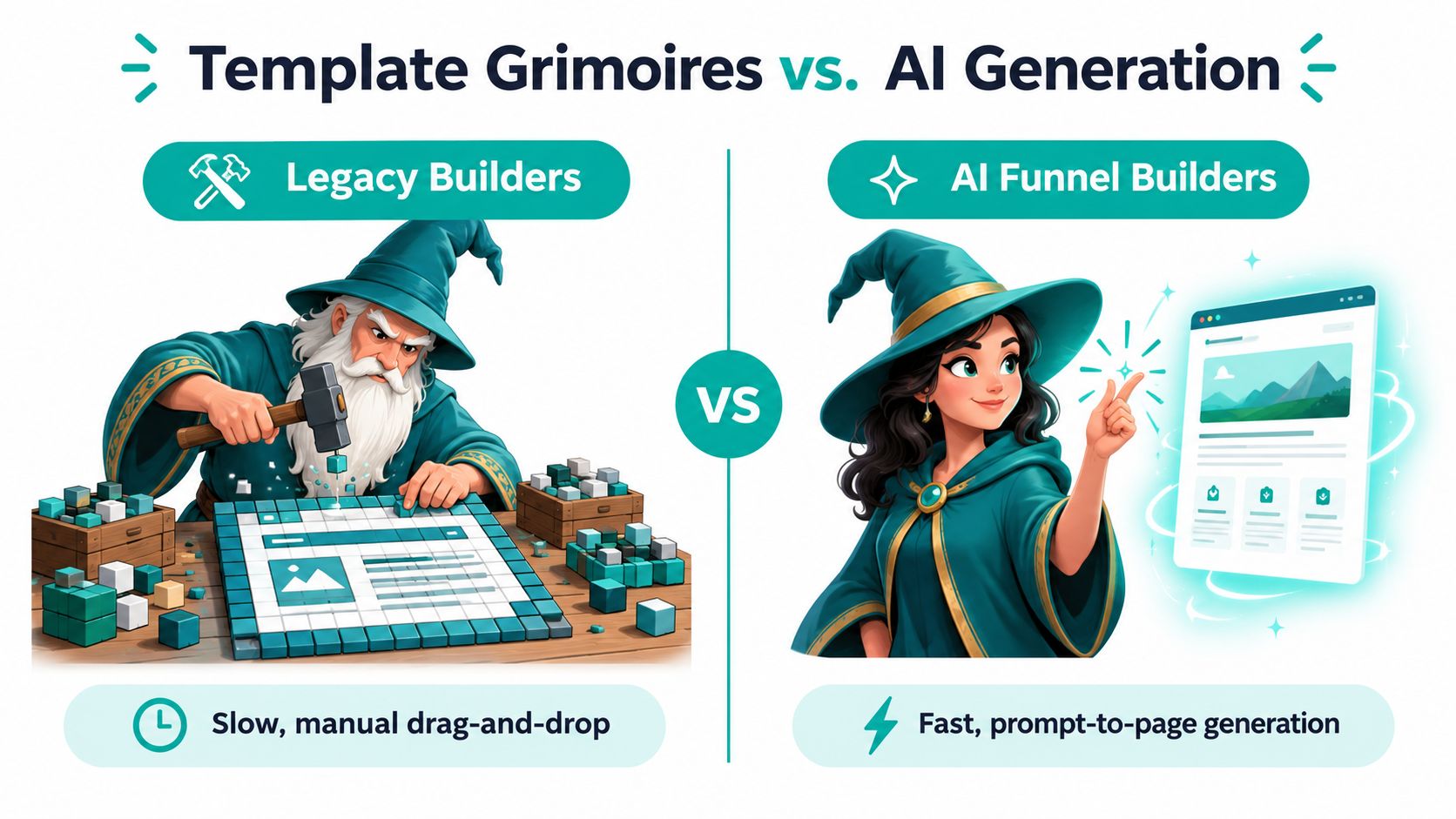
Template builders ask you to choose a room before you know what castle you're building. You select a layout, drag in a headline, adjust spacing, change colors, wire a button, duplicate the page, and repeat the ritual until your afternoon has evaporated.
That method can work. It gives careful designers control, and some marketers prefer making every decision by hand. But it turns a strategic task into a sequence of tiny mechanical tasks. The builder becomes a pixel workshop, while the actual customer journey waits outside in the rain.
Prompt-to-page generation reverses the order. You begin with intent: the audience, offer, tone, desired action, and sequence. The AI then proposes the structure, writes initial copy, selects imagery, applies styling, and connects the pages. You refine the result through conversation rather than rebuilding the spell from its ingredients.
Two approaches to the same incantation
| Traditional template builder | AI funnel builder |
|---|---|
| Starts with a preset layout | Starts with a plain-language brief |
| Requires manual element placement | Generates page structure from intent |
| Applies changes page by page | Can apply chat-based changes across the flow |
| Makes the marketer manage connections | Treats the journey as a connected system |
| Rewards patience with the canvas | Rewards clarity in the prompt |
A course creator might type, “Create a warm, practical funnel for a beginner's photography course, with a free lesson, a course sales page, checkout, and a post-purchase welcome page.” The first draft won't possess perfect wisdom. It may need sharper objections, a more precise promise, or a less enthusiastic dragon in the hero image. But it gives the creator a functioning starting point instead of an empty stage.
Editing by conversation
Chat-based editing changes the maintenance ritual. Instead of hunting through every page to replace a phrase, a marketer can request a consistent adjustment across the funnel, such as making the tone more direct, strengthening the guarantee language, or changing the call to action for a different audience.
The important productivity gain isn't the novelty of generating a headline. It's the ability to alter a connected experience without losing its shape. The guide to building a website with AI reflects this broader shift from manipulating individual design elements to describing the desired result.
Prompting still demands judgment. A vague instruction produces a vague funnel. The apprentice who says “make it persuasive” receives a fog cloud. The apprentice who names the audience, pain, offer, proof, objections, and action receives a much more useful spell.
Autonomous Agents and Conversion Alchemy
A funnel that launches and never changes is a stone golem guarding an empty vault. Traffic sources shift, pages accumulate clutter, links break, and visitors reveal new patterns. Continuous optimization keeps the system alive.
The most useful AI funnel builders can assign recurring work to specialized agents. Think of them as resident creatures with narrow jobs. One watches technical search signals. Another guards performance. A third studies behavior. A fourth proposes controlled experiments.
The SEO Seer
An SEO-focused crawler can systematically visit URLs and extract signals such as title tags, meta descriptions, heading structure, canonical tags, hreflang attributes, internal-link anchor text, and page-speed metrics. This is what makes automated SEO more substantial than sprinkling keywords across a page. The workflow resembles repeated technical inspection, as described in this overview of SEO automation.
A Seer might flag a missing description, identify a broken internal path, or notice that a new page has no meaningful connection to the rest of the site. The marketer still owns the strategy and approval. The agent handles the patrol.
The Speed Sprite and Analytics Oracle
A performance agent can compress assets, defer unnecessary media, and identify page elements that slow the visitor's first interaction. A measurement agent can surface sections with unusual exits, reveal which sources bring engaged visitors, and rank possible fixes by impact.
These agents shouldn't turn optimization into superstition. They turn recurring inspection into a routine. Instead of asking whether a page “feels slow,” the team can investigate the relevant performance signals. Instead of guessing where interest fades, the team can inspect the sequence.
The Conversion Alchemist
Split testing creates two versions of a page or funnel element and compares their conversion outcomes. The split-testing guidance from ClickFunnels describes an even traffic split, such as 50/50, and discusses allowing enough time for a dependable conclusion, with recommendations that include at least 30 days in one approach and a minimum two-week window in another.
The testing agent can draft a variant, route visitors, monitor the selected metric, and retire an underperformer after the decision threshold is reached. That doesn't mean every test deserves automation. A headline, form length, price presentation, or call-to-action may be a sensible candidate. Changing everything at once creates a potion with too many ingredients to identify.
Automation should remove repetitive labor, not remove human judgment.
Casting Funnels for Different Marketing Archetypes
A solo founder often has one offer, one audience, and very little patience for a month-long website project. Suppose she's preparing a free webinar about improving client proposals. With a one-sentence brief, she can define the registration page, confirmation experience, reminder path, and a related paid review session.
Her important decision isn't whether the button has a twelve-pixel radius. It's whether the webinar promise matches the problem her audience already wants solved. AI can assemble the structure, but the founder supplies the hard-won knowledge that makes the message credible.
The agency warlock
An agency has a different monster to fight. Its team may understand conversion strategy perfectly while losing hours to repetitive client maintenance. One client needs a lead-generation flow. Another needs a consultation funnel. A third needs a product launch sequence with a different visual identity.
Prompt-based generation can give the agency a consistent production method without forcing every client into the same template grimoire. Chat-based revisions can also reduce the effort required to apply a shared change across connected pages. The strategist spends more time reviewing positioning and less time repairing the same layout by hand.
The course creator
A course creator needs the promise, transaction, and delivery experience to agree with one another. A visitor might begin on a free lesson page, move to the course offer, select a payment option, encounter a relevant upgrade, and reach a welcome page with clear instructions.
The funnel builder becomes useful when these steps behave like one experience. A purchase should lead to the right confirmation. An upsell should make sense in the context of what the buyer just chose. A student shouldn't receive a thank-you page designed for a completely different product.
The SaaS growth mage
A SaaS team may care less about a traditional checkout sequence and more about free-trial activation. Its funnel could begin with a feature-focused landing page, continue to account creation, guide the new user toward a first meaningful action, and measure where registration stalls.
The same orchestration principle applies. The team defines the desired path, records the events, and tests a focused change. The spell differs by archetype, but the discipline remains: connect the stages, preserve context, and improve the point where people leave.
Mastering the Art of Funnel Optimization
A funnel builder proves its worth when the first visitor arrives. An AI-driven orchestration spell can turn a prompt into pages, connect the AIDA stages, and let autonomous agents watch what happens next. The strategist still reads the signs, chooses the intervention, and decides whether the change improved the intended behavior.
Begin with a baseline for every meaningful stage, from the first click to the completed purchase. A healthy-looking landing page can still hide a leaky form, a confusing offer, or a checkout that sends ready buyers fleeing. Record where visitors enter, continue, hesitate, and leave. Those patterns give your audience, offer, traffic source, and buying friction a starting map.
A strategist can then use this guide to conversion rate optimization while keeping strategic decisions human-led. The agents may flag a broken event or a sudden fall in form completions, but humans decide which explanation deserves a test.
A practical testing ritual
- Choose one leak. Focus on the stage where visitors leave, whether that is the form, offer explanation, checkout, or a handoff between pages.
- Change one meaningful variable. Test a headline, call to action, form field, image, objection section, or offer presentation. The funnel-testing framework from Unbounce recommends tracking click-through rate, bounce rate, and conversion rate while changing one element at a time to isolate causation.
- Keep the measurement honest. Define success before the test begins. A button that earns more clicks has not won if completed checkouts fall.
- Let the test run properly. Use balanced allocation where appropriate and allow enough time for the result to become reliable, following the testing guidance cited earlier.
- Document the lesson. A losing variation still reveals what this audience did not prefer under these conditions.
The apprentice's final checklist
- Trace the path: Visit every step as a customer. Confirm that links, forms, cart state, and confirmations behave coherently.
- Inspect the message: Match the landing-page promise to the offer at checkout.
- Watch the exits: Separate traffic-quality problems from page-friction problems.
- Test with discipline: Change one important variable instead of throwing the entire cauldron into the fire.
- Review continuously: Use automated audits for technical SEO, performance, analytics, and conversion opportunities, while people set the strategy.
Web Mage turns plain-language prompts into websites and connected funnels, including structure, copy, imagery, styling, and conversion steps. Its autonomous agents can monitor SEO, performance, analytics, and testing. Visit Web Mage to turn a funnel idea into a working conversion path without rebuilding every page by hand.