An AI Powered Landing Page Builder can turn a plain-English prompt into a complete, optimized page and funnel in minutes, and the broader market around AI-powered website builders is projected to rise from about $3.24 billion in 2026 to roughly $17.43 billion by 2035, a 20.55% CAGR projected over that period (precedenceresearch.com). The reason founders keep reaching for this kind of tool is simple, they're tired of wrestling with blank canvases when they need a page that sells now.
Table of Contents
- The Frustration of Blank Canvas Builders
- What Makes an AI Landing Page Builder Different
- Meet Your New Magical Crew
- Template Builders Versus AI-Powered Systems
- Why Conversion Optimization Matters More Than Creation Speed
- When to Summon an AI Landing Page Builder
- The Hidden Costs Most Guides Ignore
The Frustration of Blank Canvas Builders
You open a builder with high hopes, then spend the next hour nudging sections a few pixels left, rewriting the headline for the sixth time, and wondering why the page still feels like a polite brochure instead of a machine that converts. The work looks creative from a distance, but it's often just a stack of tiny decisions that drain momentum.
A founder with three launches in motion doesn't need another design puzzle. They need a page that says the right thing, carries the right visual tone, and points visitors toward one clear action without a long detour through margin controls and widget menus.

The blank canvas tax
That first blank screen has a cost. It steals attention from the offer, and attention is usually the one thing you can't afford to waste when a campaign is waiting in the wings. The best builders reduce that tax by removing the middleman of manual design decisions.
A simple index-page example shows the difference clearly. Instead of assembling blocks one by one, an AI powered landing page builder can take a short description, assemble the structure, draft the copy, shape the styling, and hand you a page that already looks like it belongs to your brand.
The real win isn't just speed, it's the removal of friction between the idea and the launch.
That's why the promise matters so much to small teams. When the tool handles the page foundation, you can spend your energy on the offer, the audience, and the follow-up instead of on the mechanics of dragging boxes around a canvas.
What Makes an AI Landing Page Builder Different
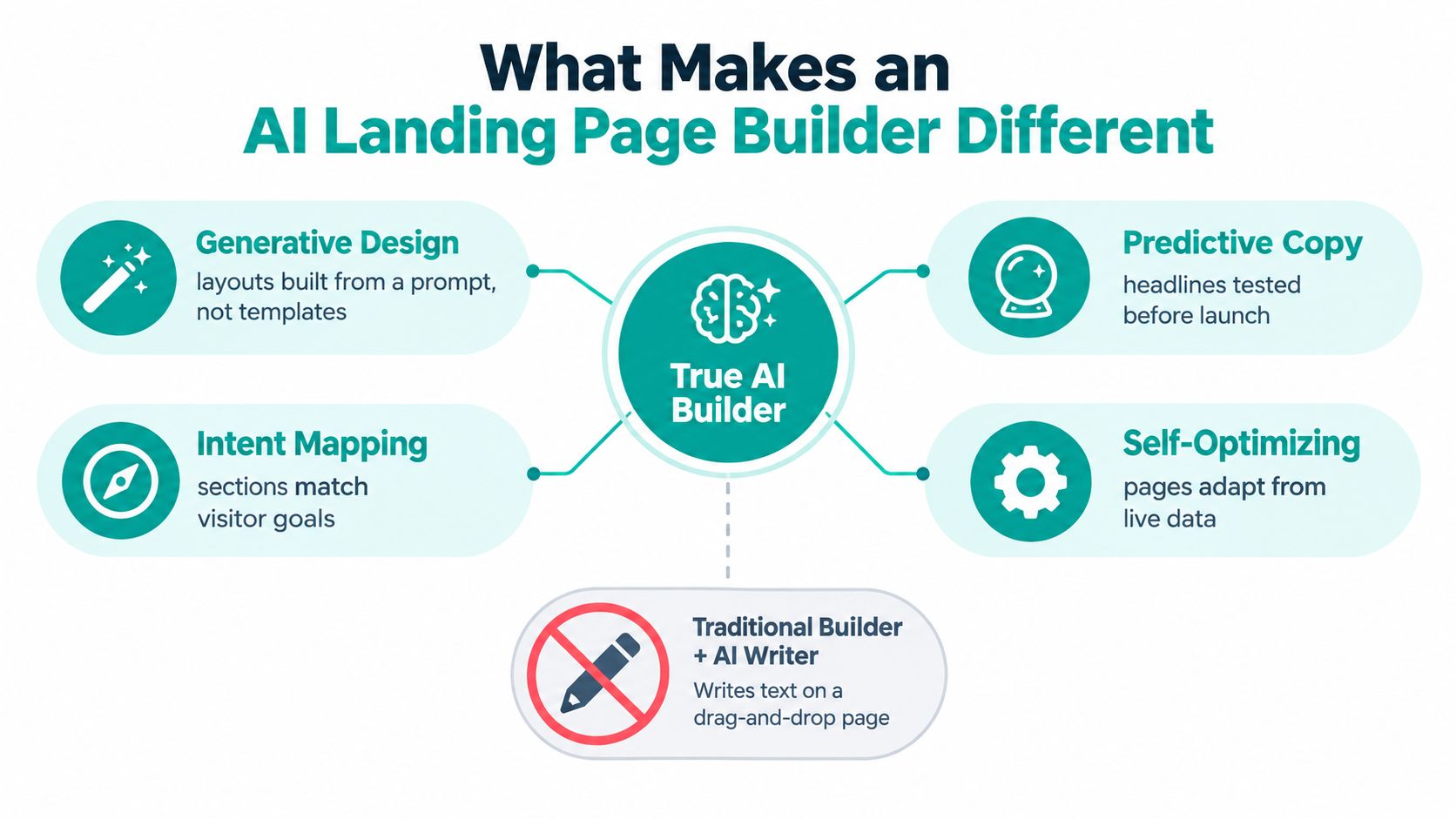
A founder opens a blank page with a launch waiting, a product hook half-written, and a design choice on every corner. A true AI Landing Page Builder starts from that intent and turns it into a page, visuals, and funnel logic that work together from the first draft.
Four pillars that change the game
The first pillar is prompt-driven generation. You describe the goal, and the builder shapes the page structure without forcing you to pick from a stack of templates first. That removes the old habit of letting the template decide the message before the message has a chance to breathe.
The second pillar is integrated copy and imagery. A page will struggle if the headline says one thing, the body says another, and the visuals feel borrowed from three different brands. The builder keeps the message consistent from top to bottom.
The third pillar is autonomous optimization. That is the hidden second layer many guides skip. Once the page goes live, the system keeps checking what is working, what is slow, and what visitors ignore, then adjusts from there instead of freezing after launch.
The fourth pillar is built-in funnel architecture. A landing page usually needs more than a single screen. It may need a checkout step, an upsell, or a thank-you page, and the builder should connect those steps instead of treating them as loose extras.
Why this is more than a prettier editor
A traditional builder helps arrange content. A true AI system helps decide what that content should become next. That distinction matters because landing pages are already a mature acquisition channel, with an average conversion rate of 6.6% and personalized calls-to-action producing 42% higher conversion rates than generic ones, according to a landing-page statistics summary from Hostinger.
A copy generator guide makes the practical side obvious. If the copy, layout, and funnel flow are generated together, the page feels like one conversation instead of a pile of disconnected parts. That is the difference between a page that exists and a page that guides a visitor somewhere useful.
Meet Your New Magical Crew
At Web Mage, the work after launch belongs to a small enchanted crew that never seems to sleep. They are not decorative mascots. They represent the jobs an AI powered landing page builder should keep handling after the first draft goes live.
A client launches a page on Monday, then sees search traffic drift by Friday. The SEO Seer responds by rewriting metadata, repairing broken links, and looking for fresh keyword opportunities while the team is offline. The point is continuity, not spectacle.
A different page starts to feel sluggish after a few new sections and scripts get added. The Speed Sprite trims the weight, compresses assets, and lazy-loads media so the page stays quick as it grows.
The oracle that reads traffic and the alchemist that tests
The Analytics Oracle watches traffic patterns for drop-offs and weak spots. It does not guess. It shows where visitors hesitate, so the next fix has a reason behind it.
The Conversion Alchemist brings split-test goblin energy to the page. It drafts variants, divides traffic, tracks results, and promotes the winner automatically. Independent guidance on landing-page A/B testing describes the process as a controlled experiment, with one version shown to one group and a modified version shown to another, then the winner chosen by results such as conversions or click-throughs (Webflow).
Practical rule: if a builder cannot explain how it tests, tracks, and promotes winners, it is probably helping you decorate, not optimize.
A crowded market makes this crew feel less like fantasy and more like infrastructure. One industry summary says at least 206 builders are already in the market, with large operators such as ClickFunnels at 147,299 live websites, Unbounce at 46,724 active sites, and Landingi at 45,806 active sites. In a field that busy, the tools that keep working after launch are the ones that earn their keep.
The fastest way to judge a builder is simple. Ask whether it only generates pages, or whether it keeps improving them with agents that watch SEO, speed, analytics, and conversion behavior over time. That is the difference between a fancy wand and a working spell.
Template Builders Versus AI-Powered Systems
Template builders still have a place. If you need a simple informational page, a tiny portfolio, or a stopgap site with almost no moving parts, a template can get the job done without drama.
But the tradeoff shows up fast when the page has to carry revenue. Template systems make you do the thinking, the updating, the testing, and the cleanup manually, while AI-powered systems shift more of that work into the platform itself.
| Dimension | Template Builders | AI-Powered Builders |
|---|---|---|
| Setup | You choose a layout, then fill in the blanks | You describe the goal and get a complete page draft |
| Ongoing maintenance | Manual edits and checklists | Continuous agents handle SEO, speed, and iteration |
| Conversion work | Static layout, limited personalization | Dynamic copy, testing, and optimization loops |
| Funnel flow | Separate tools or plugins for multi-step journeys | Landing, checkout, upsell, and thank-you flow together |
| Cost shape | Multiple subscriptions can stack up | One system can cover hosting, optimization, and edits |
The best comparison isn't aesthetic, it's operational. A builder that saves time on day one but creates more maintenance on day thirty hasn't really saved you anything. That's why some teams end up preferring systems that can keep the page healthy without asking for a manual tune-up every time a headline changes.
A speed benchmark from a landing-page plugin comparison helps make the point concrete. One lightweight option loaded in 556 ms with 16 total requests, while heavier alternatives in the same comparison were slower at 985 ms and 1,882 ms (SeedProd). Pages get slower when they get heavier, and the builder matters because it shapes what gets shipped in the first place.
Why Conversion Optimization Matters More Than Creation Speed
A visitor lands on a polished page for Web Mage, sees the headline, and leaves without clicking. The spell looked finished, but it never pulled its weight. That is the failure.
Landing-page guidance shows why speed alone is a weak victory. Pages loading in under 1 second can convert at roughly 3x the rate of pages loading in 5 seconds, and each extra second of load time can reduce conversions by about 4.4% to 7% (Shopify). Fast creation helps. Fast persuasion pays.
Testing has to be disciplined
The first draft is only the opening incantation. Real gains come from the testing loop, where small changes earn their keep or get banished. Practical A/B testing guidance says many teams use alpha 5%, power 80%, and need about 1,000 to 2,000 conversions per variant to detect a 10% to 20% relative lift with 95% confidence, while only about 1 in 8 tests produces a statistically significant winner (Colorlib). That is why a builder cannot just generate variants and hope for magic.
Rule of thumb: if traffic is thin, automate the discipline, not just the design.
The hidden second layer matters here. A builder with autonomous agents can generate a page, split traffic, watch the results, and keep refining after launch instead of treating publication as the finish line. That same optimization logic is the point of a good conversion optimization software guide, because the work only starts once people arrive.
Web Mage's resident magical creatures make this easier to see. One creature can try a tighter headline, another can adjust the call to action, and a third can keep the better version running while new ideas are tested. The page becomes a living system, not a one-time artifact.
That is why the optimization layer matters more than the launch button. A page that keeps learning can outperform a page that merely appeared quickly.
When to Summon an AI Landing Page Builder
A solo founder should reach for one when the launch date is close and the design team is basically just them and a mug of coffee. A marketing agency should reach for one when it's juggling multiple client pages and can't afford to rebuild the same funnel logic from scratch for every account.
Course creators and coaches fit the spell too, especially when the journey includes landing, checkout, and thank-you steps that need to feel connected. E-commerce startups also benefit when the job is less about artistic novelty and more about improving conversion flow without hiring extra specialists.
The clearest signals
- Speed to market matters: you need a page live before the opportunity cools off.
- Design help is thin: there's no full-time designer waiting in the wings.
- Optimization can't wait: you want testing and iteration without building a separate stack.
- The funnel has multiple steps: one page isn't enough, the offer needs a path.
Traditional builders still make sense when you need a highly custom experience with unusual interactions, or when an existing dev team already has the bandwidth to build and maintain the page by hand. If the project is mostly about brand theatre or bespoke functionality, a more manual route can be the right one.
The quick decision is simple. If the page is supposed to launch fast, improve continuously, and connect to a real funnel, an AI powered landing page builder is the right kind of magic. If the page is a one-off showcase with no appetite for ongoing optimization, a simpler tool may be enough.
The Hidden Costs Most Guides Ignore
A launch that looks polished can still bleed value after day one. The actual test starts when visitors arrive from phones, search, and AI assistants, because the page has to keep working long after the first publish button is clicked.
Mobile performance is one of the easiest places to lose that value. Recent coverage says 58.67% of global web traffic comes from mobile devices, and 53% of mobile users abandon pages that take longer than 3 seconds to load (Elementor). A builder that produces a sharp desktop layout but lets mobile speed slip is working against itself.
The next blind spot is the visitor's intent. Adobe's 2026 guidance says AI-referred traffic needs testing for context, continuity, and alignment with the conversation that led it there. The page has to answer the question already in the visitor's head, not just look attractive in a preview.
Maintenance carries its own hidden bill. If a builder stops at generation, the team inherits SEO upkeep, broken-link cleanup, performance tuning, and experiment management. Web Mage's resident magical creatures matter here because they keep working after launch, watching for drift and adjusting the page instead of leaving it frozen in its first draft.
One 2026 industry roundup reports broad adoption and more companies planning to follow, which explains why buyers are asking sharper questions. The tools that win next will not just build pages faster. They will keep pages alive, relevant, and worth the traffic they receive.
Web Mage builds landing pages and funnels from plain-language prompts, then keeps tuning them with autonomous agents for SEO, performance, analytics, and conversion work. If you want one system that can create the page, wire the funnel, and keep improving it after launch, visit Web Mage and see how the workflow fits your next launch.