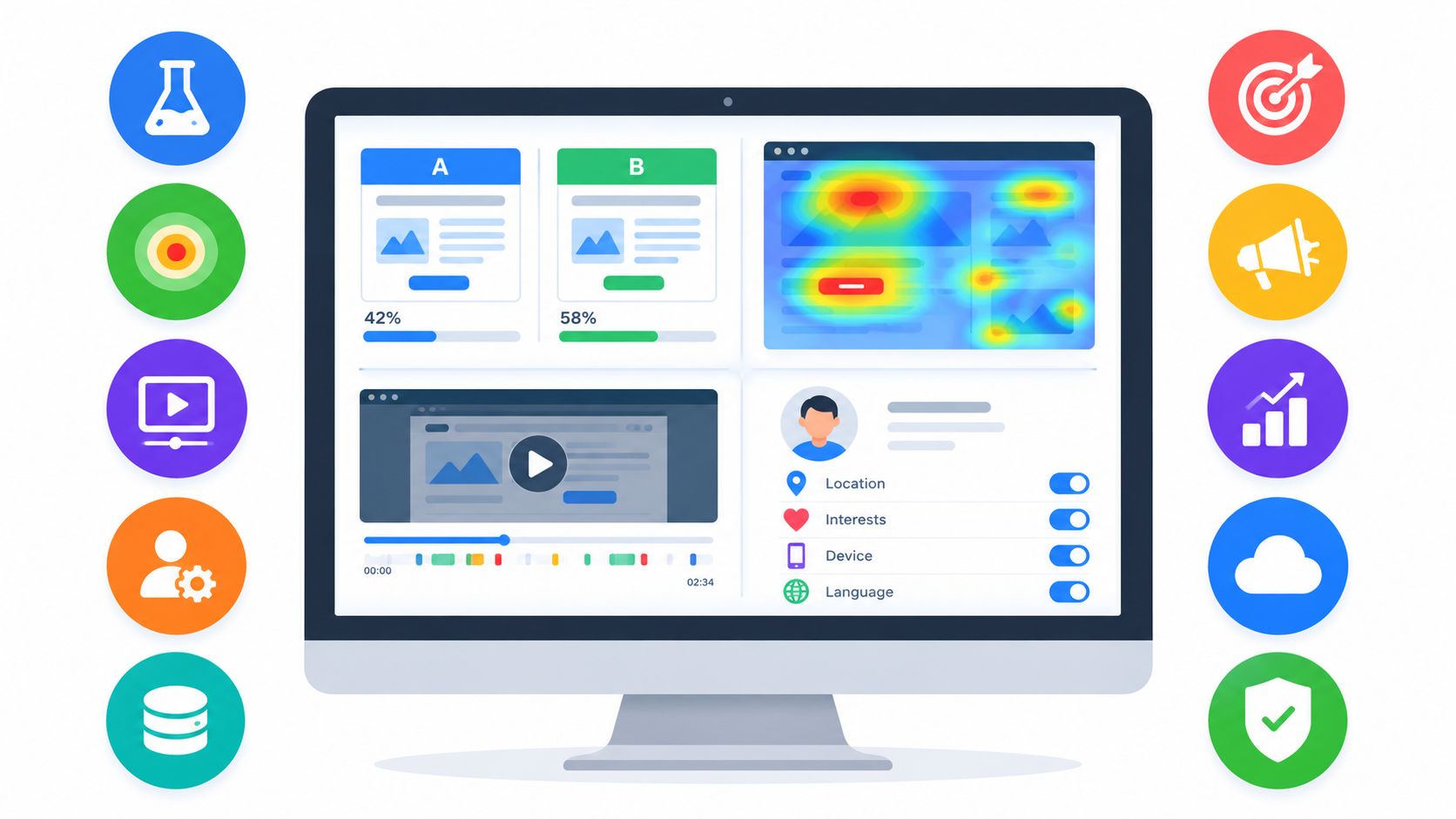
Your team has traffic, a backlog of funnel ideas, and a checkout that leaks somewhere between “interested” and “bought.” The awkward part is choosing the right familiar. Do you need research to discover why users hesitate, an experimentation engine to test stronger answers, personalization to match different visitors, or an all-in-one builder that can create and improve the funnel for you?
The best conversion optimization software depends on your implementation maturity, traffic, technical access, governance needs, and appetite for automation. A solo founder and a global retailer can both want higher conversion rates, but they shouldn't buy the same spellbook.
The ten picks below are grouped by the CRO job they solve. You'll find prompt-built experimentation, enterprise governance, qualitative research, privacy-forward testing, autonomous optimization, and personalization systems. Each comparison weighs practical setup effort, control, testing discipline, and where the tool's magic starts to look more like maintenance.
Table of Contents
- 1. Web Mage
- 2. Optimizely Experimentation
- 3. VWO
- 4. AB Tasty
- 5. Convert Experiences
- 6. Kameleoon
- 7. Omniconvert Explore
- 8. Evolv AI
- 9. Dynamic Yield by Mastercard
- 10. Intellimize
- Top 10 Conversion Optimization Tools Comparison
- Turn Your Winning Spell Into a Repeatable System
1. Web Mage
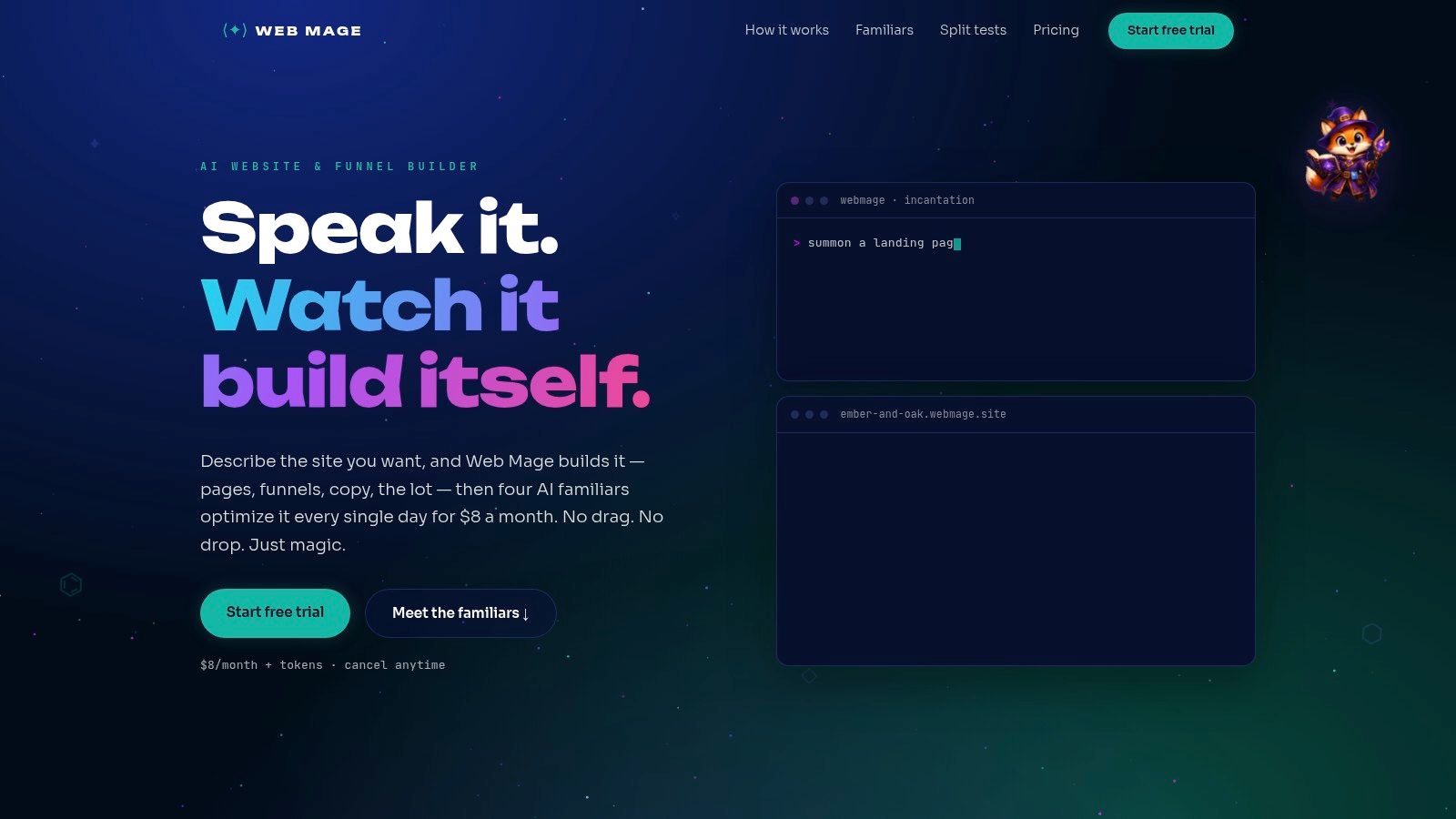
A founder with a live offer, a leaky funnel, and limited development time needs a shorter route from hypothesis to test. Web Mage addresses that bottleneck by letting you describe a site or funnel in plain language. Its AI-first builder creates pages, copy, imagery, styling, and connected funnel steps without requiring a template-library workout.
The entry plan costs $8 per month and includes managed hosting, SSL, a custom .webmage.site subdomain, and 500 monthly credits. A page uses about 60 credits, while a five-page funnel uses about 300 credits. Purchased top-ups, such as 1,000 credits for $20, do not expire, while monthly credits reset. Confirm current terms on the Web Mage website, since product details can change.
The four familiars do the repetitive work
Web Mage's optimization loop assigns routine tasks to four familiars. SEO Seer rewrites metadata, repairs links, and finds keyword opportunities. Speed Sprite compresses assets, prunes bloat, and keeps performance fixes on the agenda. Analytics Oracle surfaces drop-offs and priority changes. Conversion Alchemist drafts variants, routes traffic, checks significance, and promotes winners.
That combination suits founders, agencies, course creators, ecommerce operators, and small SaaS teams that need a working CRO process without stitching together a builder, hosting layer, analytics workflow, and testing plugin. It solves prompt-built creation and ongoing iteration in one workflow, rather than serving as a specialist enterprise experimentation system.
Practical rule: Use automation to remove neglected work, not judgment. Review changes involving pricing, positioning, tracking, and brand-sensitive copy before they reach visitors.
Control is the trade-off. There is no drag-and-drop canvas for pixel-perfect composition or highly bespoke interactions, and credit usage can increase with heavy editing or frequent optimization actions. The included plan provides a .webmage.site subdomain, so teams requiring a fully custom domain should verify provisioning before committing.
Web Mage fits teams prioritizing speed and continuous improvement over handcrafting every layer. Product examples cite an LCP improvement from 2.4 seconds to 1.1 seconds and a pricing-page CTR gain of 18%, but treat those as examples, not promises. The practical appeal is the loop: build quickly, let the familiars monitor the site, and turn observations into tests.
2. Optimizely Experimentation
Optimizely is the serious enterprise wizard in this list. It combines client-side web experimentation with server-side feature testing, feature flags, and controlled rollouts, so a team can test a headline in the browser and a product behavior in the backend without maintaining separate experimentation kingdoms.
The visual editor helps marketers create web variants, while SDKs support full-stack experiments and feature releases. Its Stats Engine is designed for always-valid analysis and reliable audience bucketing, which matters when several teams run overlapping programs across products, markets, or regulated workflows.
Optimizely also markets Agentic Experimentation, bringing AI assistance into planning, execution, and analysis. That can shorten the path from a hypothesis to an executable test, but it doesn't eliminate the need for clean event definitions, release controls, or careful interpretation.
The platform's strength is governance. Large teams can manage permissions, audiences, experiment history, and rollout logic with considerably more structure than a lightweight visual testing tool. Its weakness is equally clear: pricing is quote-based and can be premium for smaller organizations, while JavaScript-based testing still requires performance discipline.
Before choosing it, read this practical guide to A/B testing tools. Optimizely fits teams with engineering support, meaningful traffic, and a need to connect marketing experimentation with product delivery. It isn't the first familiar I'd summon for a founder testing one landing page.
3. VWO
VWO suits teams that want research and experimentation in one suite. Instead of stitching together a testing platform, heatmap product, replay tool, and personalization layer, teams can use VWO for A/B, multivariate, and split-URL tests alongside behavioral investigation.
The research side matters because a test without a reason is just an expensive coin toss. Heatmaps can show where visitors interact, session replays can expose hesitation or confusion, and the resulting evidence can shape a better hypothesis before traffic is divided.
VWO also supports rules-based personalization, integrations, and workflow utilities for managing experiments. That breadth is useful for a CRO team that wants one operating surface. It can also create redundancy. If your analytics, replay, and personalization tools already work well, paying for overlapping capabilities may add procurement weight without adding insight.
VWO's documentation and market familiarity can make onboarding and hiring easier. The trade-off is that exact public pricing isn't listed, so buyers need a sales conversation and a careful comparison against their existing stack.
Performance still deserves attention. A testing tag can become another piece of browser work, and no suite can rescue a page overloaded with scripts, uncompressed media, or unclear analytics. Use VWO when your central problem is connecting “what users do” with “what should we test next.” For the broader technical side, this guide to website performance optimization tools is a useful companion.
4. AB Tasty
AB Tasty is built for organizations that need experimentation to move at campaign speed without losing enterprise workflow. Its visual editor supports rapid variant creation, while client-side, server-side, and feature experimentation cover more than page-level changes.
Retail and travel teams often have many concurrent promotions, audiences, and seasonal journeys. AB Tasty's tooling helps coordinate those tests and reduce interaction effects, the dangerous situation where one experiment changes the context of another. Its integrations can also centralize reporting in an existing analytics environment rather than forcing every stakeholder into a new reporting universe.
The strongest reason to choose AB Tasty is implementation support. Enterprise rollouts rarely fail because the visual editor lacks a button. They fail because teams disagree about ownership, release safety, audience definitions, or how results feed into product and merchandising decisions. Vendor-led services can help when the organization has budget but not enough internal experimentation operations.
There are two practical cautions. Public list pricing isn't available, and buyer datasets commonly reference annual contracts in the mid-five-figure range. That figure isn't a universal quote, so request a proposal based on traffic, domains, users, and experimentation scope rather than treating it as a rate card.
AB Tasty is a strong fit for large commercial teams with varied experiment types. It may be excessive for a small site that needs a fast first test and has no appetite for enterprise procurement.
5. Convert Experiences
Convert Experiences takes a more focused route. It concentrates on A/B, split-URL, multivariate testing, and personalization, with an emphasis on privacy, transparent plans, self-serve onboarding, and client-side delivery that aims to avoid visual flicker.
That focus appeals to ecommerce teams and agencies that want reliable experimentation without buying an entire digital experience platform. Shopify integration helps ecommerce operators get moving, while SmartInsert and related performance measures address the familiar CRO contradiction: adding a test shouldn't make the page noticeably worse.
Convert supports classical frequentist statistics, which can be easier to explain in teams that want a conventional testing model. That clarity comes with responsibility. You still need a defined primary metric, a stable audience, an adequate sample, and a decision rule before looking at results.
The main limitation is what Convert doesn't natively emphasize. Heatmaps and session replays generally require companion tools, and server-side experimentation needs additional setup. That isn't a flaw if your research stack is already mature. It is a gap if you expect one login to explain user motivation, run the test, and manage the release.
Choose Convert when testing reliability and cost transparency matter more than a sprawling feature catalog. It works especially well for agencies managing multiple client accounts and for ecommerce teams that want a practical testing layer with less enterprise ceremony.
6. Kameleoon
Kameleoon brings a useful bridge between marketer-friendly experimentation and developer-controlled product testing. Its web and feature experimentation capabilities live in one platform, while Prompt-Based Experimentation lets non-technical users describe a proposed change and generate a testable variant.
That workflow attacks a familiar bottleneck. A marketer may know exactly what a pricing page needs, yet wait for design and engineering capacity before learning whether the idea deserves a permanent release. Kameleoon's prompt-driven approach can shorten time to first test and reduce dependency on developers for straightforward changes.
Its AI Copilot supports analysis and “Learnings” summaries, and the platform documents its statistical methodology. Those features are useful when the team has many results to interpret but doesn't want a machine to turn a weak signal into a confident story.
Prompt generation isn't a replacement for design-system review. Generated output can violate accessibility rules, brand conventions, responsive behavior, or product logic. Have a human review the variant before production exposure, especially when the change affects checkout, account permissions, pricing, or data collection.
Kameleoon's pricing is quote-based and varies by configuration, so verify the commercial model directly. The best fit is a mixed marketing and product team that wants faster ideation without abandoning governance. It gives the apprentice mage a faster wand, but someone still needs to check where the spell lands.
7. Omniconvert Explore
Omniconvert Explore is an accessible starting point for teams that need both qualitative evidence and basic experimentation. It combines A/B/n testing, web personalization, overlays, on-site surveys, targeting rules, and a WYSIWYG editor with custom-code support.
The surveys are particularly valuable for smaller teams. A heatmap may show that visitors stop interacting with a section, but it won't necessarily tell you whether the copy is unclear, the offer feels risky, or the visitor isn't the intended audience. A short survey can provide the missing motive before you spend time polishing a variant.
Explore's free tier covers up to 50,000 tested visitors, which lowers the barrier for an early CRO program. That makes it attractive to SMBs that aren't ready for a sales-assisted enterprise platform and want to learn whether their team can maintain a testing habit.
The trade-off is governance. Advanced workflow controls are lighter than those in top-tier enterprise suites, and client-side changes rely on a JavaScript tag. Simple tests may be marketer-led, but complex changes still deserve developer review for performance, tracking, and accessibility.
Use Omniconvert when your first question is “Why are visitors hesitating?”, followed by “What can we test?” It's a sensible familiar for a small team building its first repeatable research-to-experiment loop.
8. Evolv AI
Evolv AI changes the shape of the experiment. Instead of asking you to choose one control and one challenger, it uses machine learning to explore many ideas in parallel and allocate traffic toward better-performing experiences.
That model is useful when the optimization space is combinatorial. Merchandising teams may have multiple copy, image, offer, and layout ideas. Funnel teams may want to explore combinations faster than a sequence of isolated A/B tests allows. Evolv AI also offers Experience Generation for copy, images, and code variants, with self-serve and managed packages.
The advantage is velocity. A conventional testing roadmap can leave promising ideas waiting while one experiment runs. Dynamic exploration can search more broadly, particularly when the team has enough traffic and a clean signal.
The danger is objective drift. An autonomous system can optimize exactly what you tell it to optimize, even when that metric is a poor proxy for revenue, retention, qualified pipeline, or customer value. Define the KPI hierarchy before launch, and inspect whether short-term engagement is displacing the business outcome you care about.
Pricing is custom and not publicly posted. Evolv AI is best for teams that have many plausible experience ideas, strong measurement, and enough operational maturity to govern automated allocation. It isn't a shortcut around bad event tracking or unclear strategy. A dragon can explore many caves, but it still needs a reliable map.
9. Dynamic Yield by Mastercard
Dynamic Yield is a personalization platform first, with experimentation embedded into a wider experience system. Its capabilities span predictive targeting, recommendations, affinity-based personalization, campaign templates, APIs, and omnichannel delivery across web, app, and email.
That makes it a strong candidate for retailers, travel businesses, and financial services organizations that want to personalize more than a landing page. A visitor's behavior can inform recommendations, audience membership, and future experiences, while built-in A/B testing and auto-allocation help evaluate whether those interventions are working.
Dynamic Yield's predictive targeting can mine tests for segment-level lift. That is more ambitious than asking which page won overall. A treatment may underperform across all traffic while helping a valuable segment, or it may create a pleasing average result while damaging an important customer group. Segment analysis helps expose those differences.
The price of that sophistication is data and implementation. Custom pricing is typical, and the strongest outcomes require high-quality event data, reliable identity resolution, integration work, and people who can maintain the operating model. Personalization without trustworthy inputs becomes a very expensive familiar with a broken crystal ball.
Choose Dynamic Yield when personalization is a strategic capability, not merely a campaign feature. Mastercard ownership supports a strong enterprise roadmap, but buyers should still validate data requirements, integration responsibilities, governance, and the path from experiment result to production rule.
10. Intellimize
Intellimize is designed for teams that want continuous personalization rather than a long queue of manually gated tests. It serves individualized page variants at runtime, using predictive models to explore combinations and adapt experiences as signals accumulate.
The platform includes a no-code editor, dynamic content, landing-page capabilities, ABM audiences, B2B features, and a Shopify app. That combination makes it particularly relevant to B2B teams with account-based journeys and ecommerce teams that want personalization without building every variant into the core site.
The operational benefit is clear. Instead of waiting for a team member to declare a winner and start the next test, models can explore variants in parallel. That reduces manual test cycling, but it also changes how the team must think about control groups, model behavior, creative review, and long-term outcomes.
Before adopting an autonomous system, make sure your conversion signals are clean and meaningful. Intellimize requires sufficient traffic and clear outcomes for models to train effectively. If your primary event is noisy, rare, or disconnected from customer value, automation may make the wrong answer arrive faster.
Pricing is sales-assisted and negotiated, and onboarding fees can vary. For guidance on the content side of personalized landing pages, see this resource on an AI landing page copy generator. Intellimize fits teams ready for runtime personalization and continuous optimization, not teams still debating what counts as a conversion.
Top 10 Conversion Optimization Tools Comparison
| Product | Core features | Automation & optimization | Target audience | Pricing & value |
|---|---|---|---|---|
| Web Mage (recommended) | Prompt-to-page generation; one-sentence funnels; chat edits; managed hosting & SSL | Four nightly agents (SEO Seer, Speed Sprite, Analytics Oracle, Conversion Alchemist); auto A/B creation & promotion | SMBs, founders, agencies needing fast launch + low ops | $8/mo incl. 500 credits; 1k credits $20 top-up; hosting + .webmage.site subdomain |
| Optimizely Experimentation (Web + Feature) | Visual editor + SDKs; server-side feature flags; robust stats engine | AI-assisted planning; strong bucketing & governance; enterprise-grade experimentation | Large enterprises; high-traffic programs; regulated orgs | Quote-based, premium enterprise pricing |
| VWO (Testing, Insights, Personalize) | A/B, MVT, split-URL; heatmaps; session replay; personalization | Experiment/workflow utilities; integrated research -> test prioritization | CRO teams wanting combined research + testing | Sales-assisted pricing; all-in-one value vs multiple tools |
| AB Tasty | Client & server experiments; visual editor; release management | Tools to coordinate concurrent tests and mitigate interactions | Retail, travel, enterprise teams needing vendor support | Quote-based; often mid–five-figure contracts |
| Convert Experiences | A/B, multivariate, split-URL; Shopify integration; flicker-free rendering | Performance-focused insertions (SmartInsert); classical stats | E-commerce stores and agencies seeking reliable testing | Transparent tiered plans; generally more affordable than legacy enterprise tools |
| Kameleoon | Web + feature flags; Prompt-Based Experimentation (PBX); AI Copilot | PBX-generated variants; automated analysis & "Learnings" summaries | Marketers and product engineers wanting prompt-driven ideation | Quote-based; pricing varies by needs |
| Omniconvert Explore | Unlimited A/B/n, personalization, overlays; on-site surveys | 40+ targeting rules; WYSIWYG editor; basic automation for campaigns | Early CRO programs, SMBs, cost-sensitive teams | Generous free tier up to 50k tested visitors; paid tiers available |
| Evolv AI | ML-driven multi-idea exploration; experience generation | Traffic auto-allocation; parallel idea testing; generative assists | High-velocity optimization teams (merchandising, funnels) | Custom enterprise pricing; self-serve or managed packages |
| Dynamic Yield (Experience OS) | Personalization, recommendations, predictive targeting; omnichannel | Auto-allocation; affinity modeling; campaign templates across web/app/email | Retail, travel, finance; enterprise omnichannel personalization | Custom enterprise pricing under Mastercard ownership |
| Intellimize | Runtime individualized variants; no-code editor; ABM features | Continuous Conversion models; runtime personalization & dynamic content | B2B (ABM) and e-commerce teams with sufficient traffic | Sales-assisted pricing; negotiated onboarding fees possible |
Turn Your Winning Spell Into a Repeatable System
The right tool follows your operating reality. Choose an integrated builder when your biggest constraint is getting a site or funnel live and maintained. Choose a research-led suite when you don't understand why visitors hesitate. Choose a dedicated experimentation platform when analytics are trustworthy and you need rigorous tests across web and product. Choose an enterprise personalization system when your data, identity layer, governance, and implementation resources can support individualized experiences.
Market demand reflects that broader job. One independent estimate values the conversion optimization software market at about US$1.7 billion in 2025 and projects US$5.0 billion by 2035, with an 11.6% CAGR in that forecast. A separate estimate places the market at US$3.8 billion in 2025 and projects US$10.2 billion by 2034, also at 11.6% CAGR, while assigning North America 38.2% of global revenue in 2025. These are different market models, but both point to sustained demand for CRO as part of the broader performance-marketing stack. See the market estimate comparison for the underlying figures.
Adoption is still uneven. A 2026 technology-tracking analysis estimates that about 2.2 million websites use experimentation platforms, roughly 0.2% of an estimated 1.1 to 1.2 billion active websites. Usage rises sharply among larger properties, with 32% of the top 10,000 sites, 20.95% of the top 100,000, and about 11.5% of the top 1 million using an A/B testing or personalization platform, according to the NBER working paper. The lesson for smaller teams isn't “buy enterprise software.” It's “earn the overhead before you adopt it.”
Start with one controlled spell
Define one primary conversion event first. That could be a qualified form submission, completed purchase, activated trial, or another action tied directly to business value. Keep secondary events for diagnosis, but don't let a collection of clicks crown a winner while the meaningful outcome declines.
Then verify analytics and audience bucketing. A/B testing normally compares a control page with a variant, splits traffic, and measures conversion rates, with statistical significance helping distinguish a reliable difference from random noise. The basic method is summarized by this explanation of statistical significance in A/B testing.
Establish a baseline before changing the experience. Write down the hypothesis, audience, exposure rules, primary metric, guardrail metrics, and decision rule. Test one meaningful change at a time unless your platform and analysis plan explicitly support more complex designs.
Treat significance as a decision rule
A common industry target is 95% confidence, corresponding to a p-value of 0.05 or lower, although lower-stakes situations may use a different threshold. Treat that as a planning convention, not a magic incantation. The CRO testing guidance on confidence levels explains the distinction.
Some platforms impose minimum sample conditions before declaring a winner. Optimizely, for example, says binary metrics need at least 100 visitors or sessions and 25 conversions in both the variation and baseline before a winner is declared. Those conditions come from Optimizely's statistical significance documentation, and they shouldn't be copied blindly into every program.
Document exposure and decision rules before results arrive. Check implementation quality, including event firing, audience assignment, consent behavior, responsive layouts, page speed, and revenue reporting. If a variant wins because the tracking broke, the familiar has summoned an illusion.
Keep performance inside the spell circle
CRO software can improve a page while making it slower. For pages where the largest content element is an image, Google's web.dev guidance recommends loading that LCP image early and at high priority, using fetchpriority="high" or preload, removing lazy-loading from that same image, and deferring non-critical resources. Follow the Core Web Vitals guidance when evaluating any client-side testing tag or personalization layer.
After the test, turn the validated learning into the next hypothesis. Record what changed, who saw it, what happened to the primary and guardrail metrics, and whether the result should ship, be retested, segmented, or rejected. The best CRO teams don't collect winning screenshots. They build a memory that improves the next decision.
Software is only the spellbook. Disciplined measurement, clear hypotheses, careful implementation, and repeated iteration create the magic.
Web Mage turns plain-language prompts into complete pages and connected funnels, then uses SEO, performance, analytics, and conversion familiars to keep improving them daily. If you want a faster path from idea to launch to automated A/B testing, visit Web Mage and see whether its AI-driven workflow fits your CRO practice.