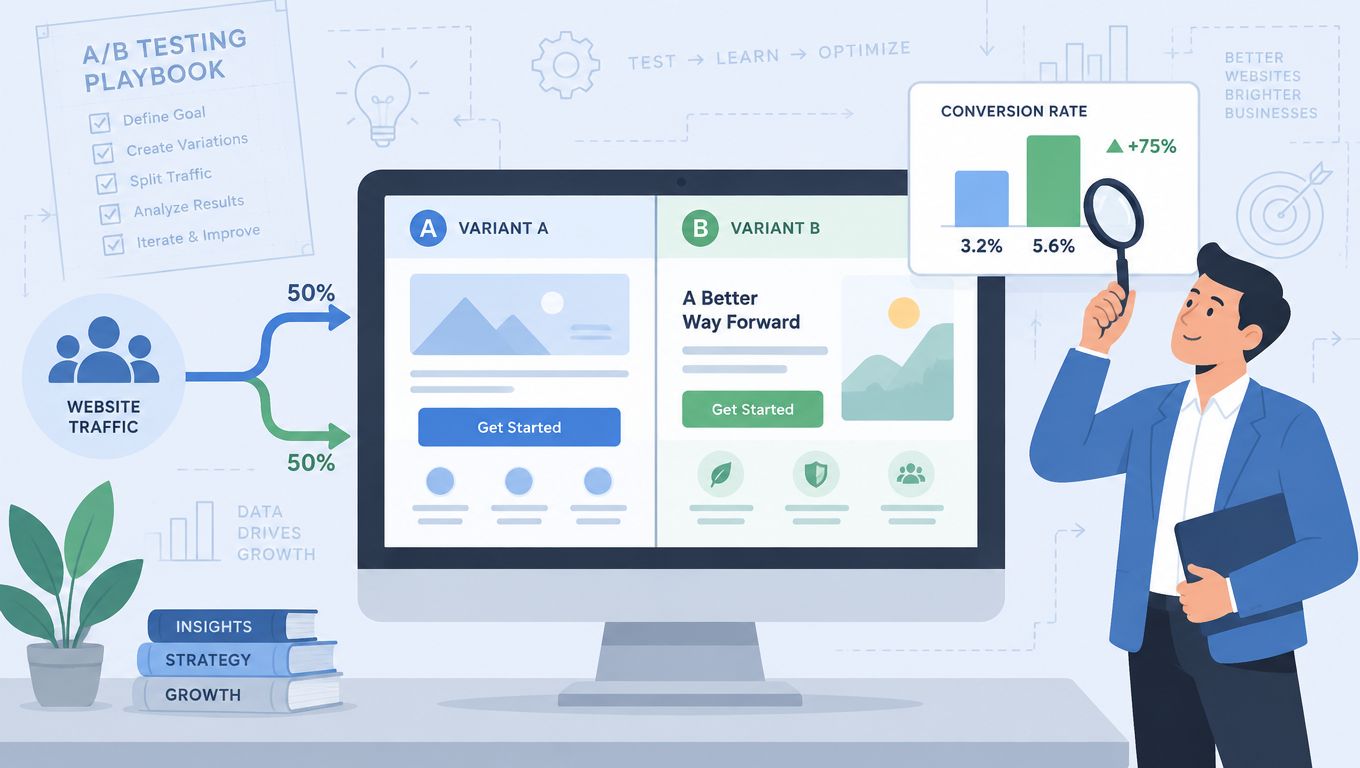
You're staring at a dashboard that looks friendly, maybe even a little smug. The headline change you shipped on Monday is up, the numbers are green, and someone in Slack is already talking about rolling the new version to all traffic before lunch. Three weeks later, the page still feels like the same dusty corridor, and the "winner" has vanished into the fog.
That's the trap with landing page split testing. It's not a trophy hunt, it's spell-crafting, and most of the flashy victories turn out to be statistical ghosts. A real test is a hypothesis cast against a control, with the discipline to accept that the control may survive.
Table of Contents
- Why Most Landing Page Tests End in Self-Deception
- Writing a Hypothesis Your Future Self Can Actually Lose
- Allocating Traffic Without Breaking the Experiment
- Reading Results Without Lying to Yourself
- The Quality-Adjusted Winner and Why the Headline Metric Lies
- A Low-Traffic Protocol When the Numbers Are Against You
- Building a Test Backlog That Compounds
Why Most Landing Page Tests End in Self-Deception
A challenger rises on the dashboard. Someone checks again tomorrow, sees the gap widen, and prepares the rollout. A week later, the lift has vanished. The page did not necessarily fail. The team mistook an early fluctuation for a durable effect, treating an experiment like a horoscope instead of a controlled comparison.

A Google Website Optimizer case study shows the difference between a promising glance and a documented result. One experiment ran for about two weeks with roughly 7,500 unique visitors and just under 2,000 conversions. The simplified page converted at 29.6%, compared with 24.4% for the original, an observed 21.1% relative improvement tim.blog case study. A follow-up test ran for about a week with nearly 6,000 unique visitors and about 1,400 conversions. Its winning variation beat the original by 16.2%, with reported confidence above 99% and an absolute conversion-rate difference of 3.7 percentage points, as reported in the same tim.blog case study.
Those figures describe completed tests with defined traffic and outcomes. They do not make every early lead credible.
Practical rule: if you cannot explain how the control could still be right, you are auditioning excuses, not testing.
The self-deception loop
The dashboard shows a challenger ahead, so the team promotes it. The apparent gain later flattens because the initial lead reflected sampling noise rather than a durable change. Sample size, baseline rate, minimum detectable effect, treatment count, and confidence level determine whether the result deserves action. A page being ahead on one Tuesday proves very little MarketingSherpa guidance.
Traffic constraints make the problem sharper. A high-traffic SaaS team can wait for cleaner evidence, while a solo founder may need to combine longer runtimes, larger practical effects, and quality checks instead of declaring a winner from a thin sample. The headline conversion rate can rise while qualified leads, activation, or revenue quality deteriorate.
A test can therefore be technically ahead and commercially useless. Treat every apparent winner as a spell awaiting inspection: preserve the control, define the stopping conditions, and check whether the gain survives beyond the first bright flash. Landing page split testing rewards patience and a willingness to learn from ugly outcomes.
Writing a Hypothesis Your Future Self Can Actually Lose
A new hero section looks promising in the first few hours. Signups rise, the team celebrates, and the challenger replaces the control before anyone checks whether the difference can survive another traffic cycle. A disciplined test starts earlier, with a hypothesis that gives the control a fair chance to win.
Choose one variable: a headline, hero image, CTA, form length, or price framing. A full page makeover changes too many inputs to explain the outcome. “Let's improve the landing page” is an intention, not a testable claim.
A useful hypothesis names the change, the mechanism, and the expected direction. “Changing the headline from X to Y will lift signups because it addresses the objection about complexity” gives the test a reason to succeed and a clear way to fail. If the result is flat or negative, the hypothesis has done its job by narrowing what to learn.
Lock the three numbers before launch
Set the measurement rules before the first visitor sees the challenger:
- Baseline conversion rate, the current performance of the control.
- Minimum detectable effect, the smallest improvement worth acting on.
- Confidence level, usually 95%, which means you're accepting about a 5% chance that the observed difference is random under the test assumptions. Optimizely confidence-level guidance
These inputs determine how demanding the test will be. A large expected lift can require less traffic than a small one. A low baseline rate, a longer decision cycle, or several treatments makes the evidence harder to interpret because each branch receives fewer useful observations.
Write the decision rules where the team can see them:
- Primary metric: the business outcome the page should move.
- Secondary guardrails: measures that reveal harm, such as lead quality or activation.
- Hypothesis: the precise change and the reason it should help.
- Baseline: what the control does before launch.
- Minimum detectable effect: the smallest result worth shipping.
- Confidence threshold: the evidence required for a decision.
- Traffic source: the audience entering the test and any meaningful differences between sources.
- Stop rule: the conditions that end the test, including what does not justify stopping early.
| Hypothesis Categories Worth Testing | Example Change | Typical Lift Range | Evidence to Capture |
|---|---|---|---|
| Message match | Rewrite the headline to mirror ad intent | Modest to meaningful | Conversion rate, bounce behavior, support questions |
| Friction reduction | Shorten the form or remove a field | Often clearer on low-friction pages | Completion rate, abandonment points, lead quality |
| Trust reinforcement | Add proof near the CTA | Can be subtle or strong | Scroll depth, click-through, downstream quality |
| Offer framing | Repackage the value proposition | Sometimes large, sometimes none | Revenue per visitor, qualified conversions |
| Visual hierarchy | Reorder sections or CTA placement | Often mixed | CTA interaction, time to first action |
Treat each test like a spell cast against a control. The hypothesis supplies the incantation, the primary metric checks the immediate effect, and guardrails expose harmful side effects. A result that cannot lose is a preference wearing a lab coat.
For execution, keep the page builder separate from the experiment logic. Web Mage's A/B testing workflow shows one practical way to create variants and track outcomes without turning every design decision into a sprawling technical project.
Allocating Traffic Without Breaking the Experiment
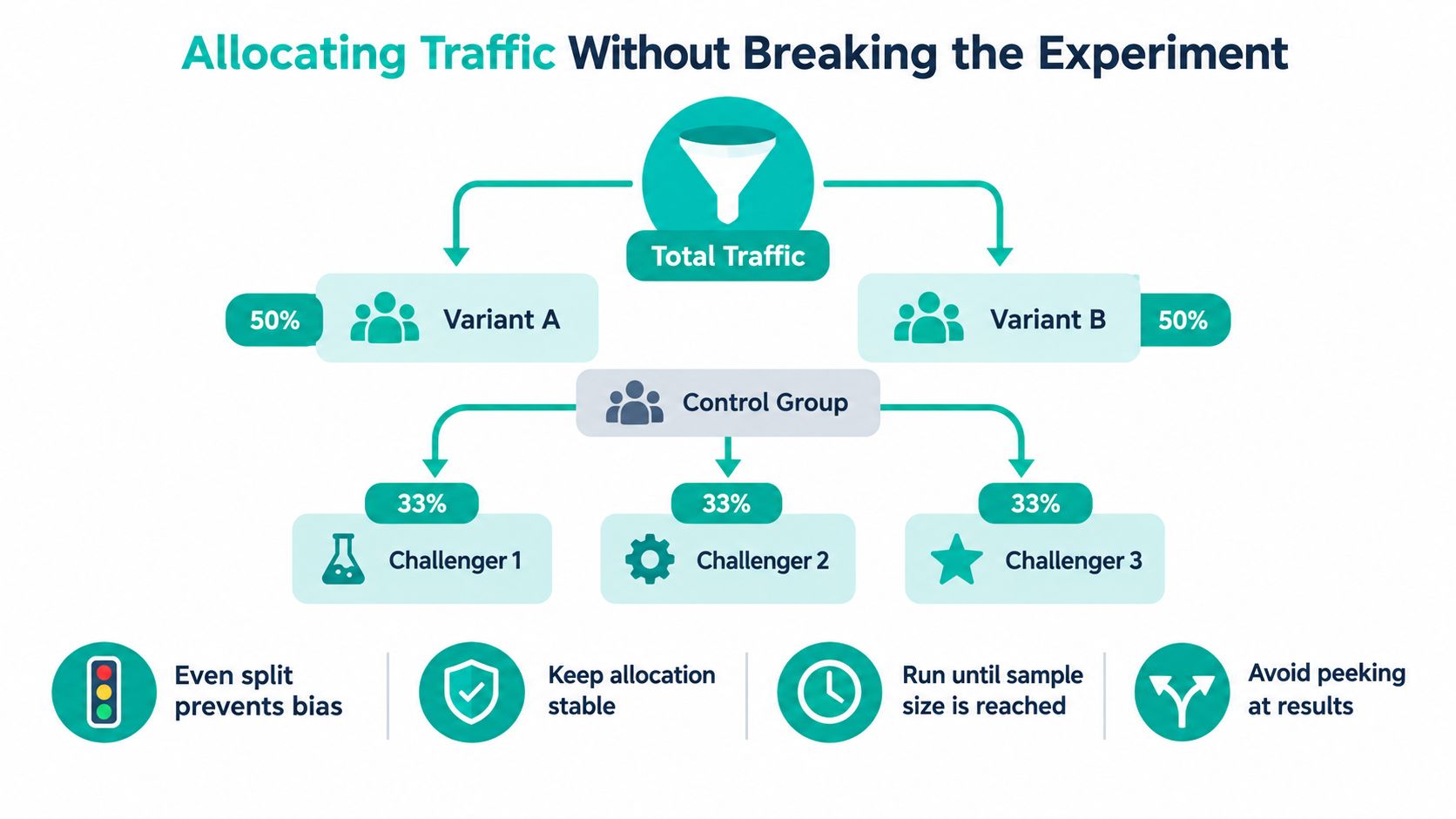
The default for a two-variant test is still the cleanest setup, half the eligible visitors see the original, half see the challenger. Equal allocation makes the comparison easier to read and protects you from the illusion that one side won because it got more eyeballs. If you test multiple variants, split the eligible traffic evenly across them instead of starving one branch and pretending the math will forgive it.
The low-volume founder problem
Say a founder gets around 800 daily visitors and wants to test a new hero section. If the test eats the whole audience, every visitor is exposed to the risk of the unproven change. If the system only sends 50% of total traffic into the experiment and splits that experimental pool 50/50, the founder still gets a meaningful read while insulating the other half of the audience from the challenger.
That insulation matters when revenue is tight or the page is business-critical. It's also why holdout groups belong in long-cycle decisions, where the question isn't "did the form fill increase today?" but "did this change improve downstream outcomes over time?" A holdout keeps a baseline alive so you can compare the new spell against the old one after the novelty wears off.
Uneven splits sound cautious, but they usually just slow learning. They don't erase risk, they prolong it. The same logic applies when teams let automated allocation shift too early, because the traffic pattern itself starts nudging the result before the evidence has settled.
Keep the allocation stable, then let the sample size speak. If you keep moving the goalposts, the experiment can't tell you which spell worked.
Reading Results Without Lying to Yourself
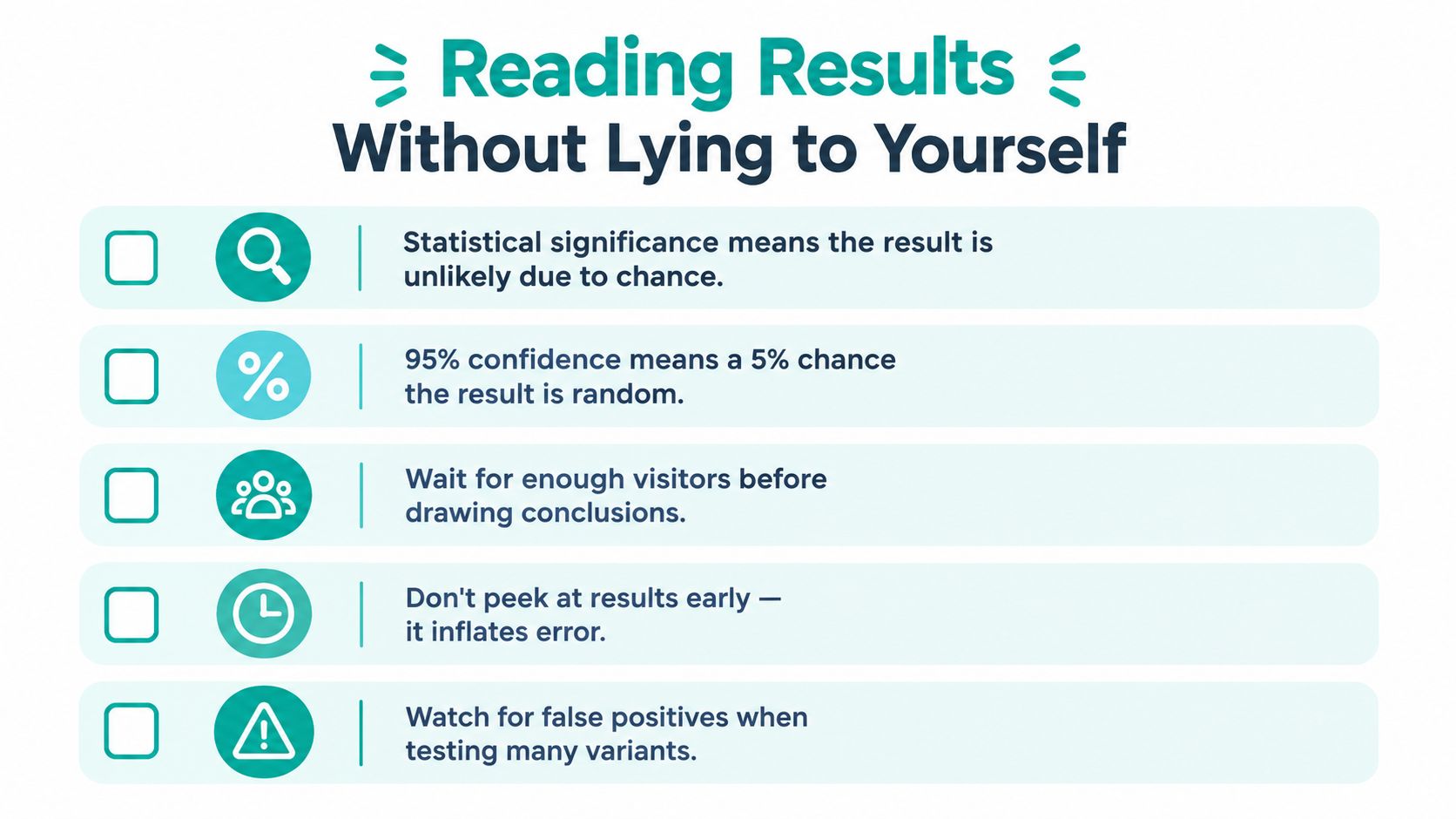
A challenger can lead for an afternoon and still be a statistical ghost. Statistical significance means the observed difference is unlikely to be random under the test assumptions. It does not make the variant permanently superior or prove that shipping it is worthwhile. A 95% confidence threshold is common because it implies about a 5% chance of a false-positive conclusion under those assumptions MarketingSherpa guidance.
Significance and usefulness are different beasts
A statistically significant result can still be a poor business decision. Practical significance asks whether the lift is large enough to justify shipping, maintaining, and explaining the change. Set the smallest worthwhile improvement before launch, while preference for a favorite variant cannot influence the threshold.
Traffic and detectable lift have an unforgiving relationship. Smaller effects require sharply more traffic and longer observation. A historical testing example shows how a tiny 0.14% difference could require more than 4,000 days of testing to establish validity. Treat that kind of result as a warning about test economics, not as a spell worth casting. If the audience is not enormous, focus on changes with a meaningful minimum detectable effect.
A low-traffic team needs stricter discipline. Pre-register the primary metric, choose a practical effect threshold, and resist stopping when the challenger briefly leads. Web Mage can help organize experiment records and results, but no dashboard can repair an underpowered test.
Conversion lag, day-of-week patterns, and late-arriving outcomes can distort an early read. Run the experiment long enough to cover normal behavior, then inspect whether the result holds across the relevant cycle. If the numbers remain close, call the test inconclusive and preserve the control rather than crowning noise.
Questions to ask before you crown a winner
- Was the sample size preplanned?
- Did the test run through a full business cycle?
- Did the primary metric settle, or just wobble?
- Did any secondary metric move the wrong way?
- Did the lead persist, or only appear after peeking?
The Quality-Adjusted Winner and Why the Headline Metric Lies
A higher form-fill rate can be a trap. If the new headline attracts people who are easier to convert but worse for revenue, the dashboard looks prettier while the pipeline gets hollower. The same thing happens when a checkout page boosts starts but reduces completed orders, or when a page improves lead volume while sales teams complain about fit.

Build the winner around quality, not just volume
Pick one primary metric, then add guardrails that can catch the damage. Revenue per visitor, qualified-lead rate, refund rate, and retention are common candidates, depending on the funnel. The key is to delay judgment long enough for the actual business effect to show up, not just the first conversion event.
This matters even more when you're testing multiple variants or slicing the data by segment after the fact. Every extra comparison raises the odds that something noisy will look impressive by accident, so the confidence threshold should be treated as a decision rule, not a ceremonial badge. Adobe's experimentation guidance makes the same basic point, small samples can produce apparent wins by chance, and multiple comparisons need stricter interpretation Adobe experimentation guidance.
For teams using AI-generated copy, automatic promotion should be conservative. The system should wait for minimum exposure, watch the guardrails, and know when to roll back if the challenger wins the headline metric but loses the business. If you want a tool example, Web Mage's AI landing-page copy workflow can draft variants, but the decision still needs quality checks before anything gets crowned.
Paste this into your next test brief
- Primary metric: one outcome that represents business value.
- Guardrails: the one or two metrics that would invalidate a shallow win.
- Evaluation window: long enough to catch delayed conversions.
- Segment rule: only preplanned cuts, never opportunistic fishing.
- Promotion rule: only promote when the business impact is real, not just statistically shiny.
A Low-Traffic Protocol When the Numbers Are Against You
Low traffic doesn't mean no testing, it means fewer, sharper bets. The winning move is to test a big behavioral change instead of five tiny ones, because subtle tweaks are the easiest to drown in noise. If the page only sees a modest stream of visitors, the experiment needs to earn its keep quickly.
One analysis estimates that a page receiving 1,000 daily visits at a 2% conversion rate could require 103 days to detect a 10% relative improvement, while a 20% improvement could be detected in about seven days Seer Interactive analysis. That's the whole decision tree for low-volume teams in one sentence, small lifts take forever, bigger swings surface much faster.
What to do when patience is the bottleneck
Use qualitative evidence before you commit months of traffic to a weak idea. Session replays, comments, and support tickets can tell you whether the hypothesis is worth the wait, even when the numbers are still murky. If the page spans a full business cycle, let the test run through that cycle, because one weird week can make a sensible change look haunted.
A “no statistically significant winner” result is often useful. It may mean the change was too subtle for your traffic, not that the idea was bad. In that case, shift to a stronger hypothesis, consider sequential or Bayesian decision rules, or use a pre/post comparison with clear caveats rather than pretending the sample has spoken louder than it has.
The practical rule is simple. Define the minimum worthwhile uplift before launch, test one high-impact hypothesis, and don't auto-promote a winner unless the evidence survives the full exposure window. Tiny samples can let one or two conversions distort the whole result, which is why minimum exposure and rollback triggers matter more than flashy dashboards.
Building a Test Backlog That Compounds
The best programs don't feel like random experiments, they feel like an accumulating spellbook. Each test should sharpen the next one, and every lost test should leave behind a note about what the page taught you. That's how a team stops repeating the same incantation with new fonts.
A useful backlog is tied to funnel stages and objections, not just page elements. If signups are weak, the backlog should include message match, trust, and form friction. If revenue is weak, the backlog should move downstream and stop obsessing over vanity clicks.
| Cadence | Owner | Outcome |
|---|---|---|
| Weekly peek | CRO lead or founder | Spot risky swings and keep tests honest |
| Monthly portfolio review | Growth team | Re-rank hypotheses by evidence and effort |
| Quarterly funnel audit | Marketing and product | Rebuild the backlog around real bottlenecks |
| Annual experimentation retrospective | Leadership | Decide what the testing program should become next |
A short retro template
- What changed? Keep the description plain.
- What happened? Report the primary result and any guardrail movement.
- What surprised us? Capture the weird part before memory smooths it out.
- What should we test next? Turn the learning into a sharper hypothesis.
- What must never repeat? Write down the failure mode while it's fresh.
If you want a broader CRO reference for that operating rhythm, Web Mage's conversion optimization guide fits well with this kind of backlog discipline. The point isn't to run more tests for sport, it's to build a system where each result improves the next decision.
Treat each test like a spell added to a growing book, not a one-time gamble. The real win is the next hypothesis getting smarter.
Web Mage builds landing pages, drafts variants, allocates traffic, and promotes winners with built-in split testing, so teams can keep the experiment loop moving without stitching together a dozen tools. If you want a system that connects page creation, testing, and optimization in one place, visit Web Mage and see how it handles the next round of landing page split testing.