
You've built the offer, polished the website, and perhaps even summoned a few promising visitors. Yet they arrive, glance around, and vanish like pixies through a keyhole. The problem may not be your product. It may be that your visitors have no clear enchanted path from first curiosity to confident purchase.
A sales funnel gives that journey shape. It turns scattered attention into a sequence of meaningful steps, from discovery and education to evaluation, action, and what happens after the sale. Learning how to build a sales funnel means learning how to guide people without pushing them, measure where they hesitate, and remove the obstacles that make good prospects disappear.
Table of Contents
- The Art of Building a Sales Funnel for Modern Magicians
- Creating Your Magical Funnel Blueprint with Web Mage
- Hiring Your Team of Conversion Creatures
- Measuring Your Spell's Power and Fixing Leaks
- Avoiding Common Magical Mishaps and Curses
- Your Ready-to-Cast Funnel Starter Kit
The Art of Building a Sales Funnel for Modern Magicians
The classic wizard's dilemma is familiar. You spend days crafting a powerful spell, place it on a beautiful page, and wait for the crowd to gather. Instead, visitors scroll past, fail to understand the offer, or leave before discovering what the spell can do.
A funnel solves this by treating the customer journey as an enchanted path rather than a single webpage. Each stage has a job. Attention attracts the right people. Interest gives them a reason to stay. Desire builds preference through relevance, proof, and value. Action makes the next move simple.

The old spell behind the modern funnel
This sequence comes from the AIDA framework. In 1898, advertising pioneer Elias St. Elmo Lewis described a progression built around attracting attention, maintaining interest, and creating desire. The explicit four-stage formulation later became associated with Edward K. Strong Jr.’s 1925 book, The Psychology of Selling and Advertising. William H. Townsend connected the sequence to the funnel metaphor in his 1924 book, Bond Salesmanship, describing how many prospects begin with awareness while fewer continue toward purchase. You can explore this history in the documented account of the AIDA model.
The lesson is practical. Don't measure only the final sale. Give every stage a visible milestone:
- Attention: An ad impression, search visit, or organic landing.
- Interest: Engagement with a page, email signup, or useful download.
- Desire: Product-page activity, webinar attendance, comparison research, or a booked call.
- Action: Checkout completion, signed agreement, or another defined purchase event.
When prospects vanish between two stages, you've found a leak. Perhaps the message promises one spell while the landing page presents another. Maybe the offer lacks proof, the form asks for too much, or the next action is hidden behind unnecessary navigation.
Practical rule: Give every stage one primary conversion event. A funnel becomes easier to improve when you know exactly what counts as progress.
Build the path before decorating the castle
Start with a simple sequence: acquisition source, relevant landing page, one conversion action, qualification or checkout, confirmation, and follow-up. A search visitor looking for a pricing answer shouldn't land on a general homepage filled with unrelated doors. A webinar attendee may need a different invitation from someone meeting your brand for the first time.
Small businesses often benefit from a clear funnel builder rather than a pile of disconnected pages. A practical guide to what a funnel builder does can help you distinguish a page collection from a connected conversion journey.
Your first funnel doesn't need elaborate enchantments. It needs a well-defined audience, a believable promise, a focused page, and a measurable next step. Once those pieces work together, you can add nurture emails, qualification, checkout improvements, and post-purchase experiences without losing the thread.
Creating Your Magical Funnel Blueprint with Web Mage
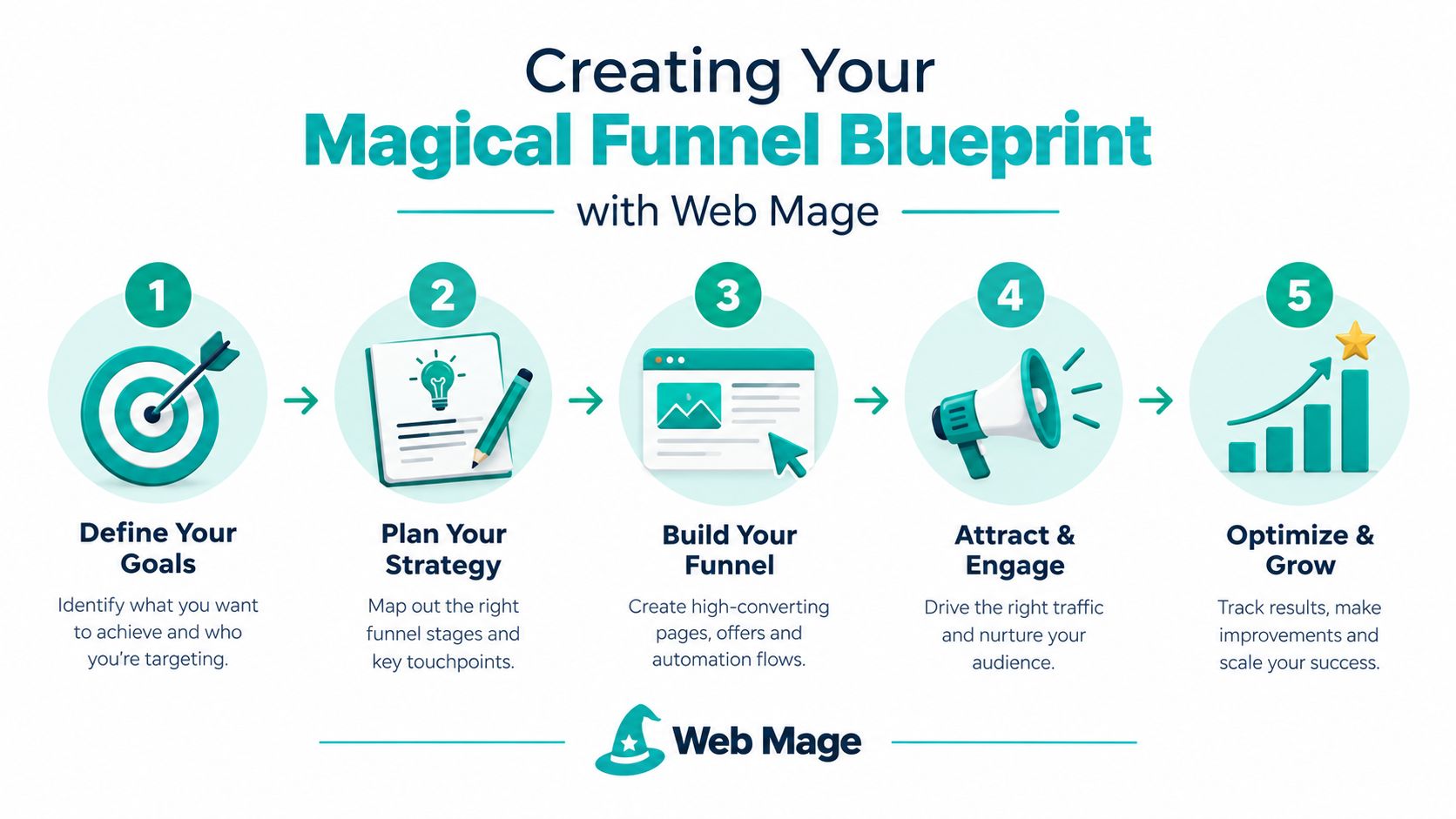
A powerful ritual begins with a precise incantation. Before writing copy or choosing colors, write down who enters the funnel, what they want, and what must happen before they move forward.
Suppose you sell a course for independent consultants. Your awareness message might address the difficulty of turning expertise into a repeatable offer. The interest stage could offer a practical planning guide. Desire might develop through a lesson preview, curriculum page, or live session. Action could be a course purchase, followed by onboarding that helps the new student begin quickly.
Map each chamber of the funnel
Use one clear purpose for each page:
- Discovery page: Match the promise of the ad, search result, referral, or email.
- Education page: Explain the problem and show why your approach is relevant.
- Evaluation page: Present proof, features, comparisons, FAQs, implementation details, or risk information.
- Checkout page: Ask only for information needed to complete the transaction.
- Confirmation page: Confirm what happened and provide the next useful action.
That structure can also serve B2B offers, where the final action may be a booked conversation rather than an immediate purchase. Buyers often need material they can circulate internally, such as an implementation outline, business case, comparison page, or security explanation. A funnel for committee decisions must help several people agree, not merely persuade the first visitor who arrives.
Write prompts that produce useful pages
A good prompt gives the builder the ingredients a copywriter, designer, and strategist would need:
- Audience: “Independent consultants who have expertise but no repeatable offer.”
- Pain: “They struggle to explain their value and convert discovery calls.”
- Promise: “Help them shape one clear service package.”
- Proof: Testimonials, process details, sample outcomes, or qualifications you can verify.
- Action: “Download the planning worksheet” or “Book a fit call.”
- Tone: Calm, practical, and reassuring rather than aggressive.
A natural-language platform such as Web Mage can turn a prompt into page structure, copy, imagery, and styling. Its funnel workflow can assemble landing, checkout, upsell, and thank-you pages, then connect those steps into one route. Chat-based editing lets you request changes across the experience without manually rebuilding every layout.
The magic still depends on your judgment. Review every claim, replace generic proof with real evidence, and make sure the headline on the landing page keeps the same promise that brought the visitor there.
Keep the checkout and upsell sequence natural. An upsell should extend the original solution, not ambush the buyer with an unrelated offer. A consultant buying a positioning course might reasonably see a workshop template or implementation session. The offer should feel like the next room in the same castle.
Hiring Your Team of Conversion Creatures
A funnel rarely fails because one person forgot to change a button color. It fails because several small jobs go unattended. Search visibility slips, pages slow down, analytics remain unread, and promising experiments never reach a conclusion.
Think of your support team as a retinue of creatures, each with a defined duty.
The scouts and guardians
The SEO Seer watches how search engines encounter the site. It can review metadata, identify broken links, and surface opportunities for additional keyword targeting. Its role belongs near the attention stage, where discoverability determines who enters the path.
The Speed Sprite guards the gateway. It compresses assets, lazy-loads media, and removes unnecessary bloat so visitors can begin reading instead of waiting. Performance isn't decorative. Google's mobile-site-speed guidance reports that 53% of visitors leave a mobile site when it takes more than three seconds to load. The same guidance cites SOASTA research reporting that mobile pages loading one second faster achieved up to a 27% increase in conversion rates, while bounce rates averaged 13% for loads under three seconds and approached 60% at longer load times. Those figures appear in Google's mobile site speed playbook.
The interpreters and experimenters
The Analytics Oracle studies visitor behavior. It can reveal which sources bring qualified people, where prospects abandon a form, which sections attract attention, and which devices struggle with the experience. That information turns “the funnel feels weak” into a more useful question, such as “Why do paid mobile visitors start the form but fail before completion?”
The Conversion Alchemist creates alternative versions of key pages and compares them against a defined success event. It shouldn't celebrate more form submissions if those submissions produce fewer qualified opportunities, lower activation, or weaker retained revenue.
The creatures work best when they serve one operating principle: automate observation and repetition, but keep humans responsible for strategy, ethics, positioning, and the meaning of the offer. Automation can find a broken bridge. It can't decide whether the bridge leads somewhere your customers actually want to go.
Measuring Your Spell's Power and Fixing Leaks
A master mage doesn't throw more ingredients into a cauldron every time the potion looks cloudy. They identify the failed reaction. Funnel measurement works the same way.
Track a sequence such as visitor, qualified lead, booked call, purchase, refund, and repeat purchase. Capture the source with consistent UTM conventions, ask new leads how they found you, and respect consent choices. When identity resolution is incomplete, a smaller revenue-linked model can be more trustworthy than a dazzling dashboard built on unreliable assumptions.
Read the funnel stage by stage
For each stage, calculate completions divided by unique entrants. Then compare adjacent stages and segment the results by source, campaign, device, geography, and new versus returning visitor. An email audience may look healthy because it already contains people with strong intent, while paid acquisition struggles to create qualified demand.
A landing page benchmark can provide orientation, not a target. A large dataset covering 41,000 landing pages, 464 million visits, and 57 million conversion actions reported a cross-industry median landing-page conversion rate of 6.6%, with ecommerce pages at 4.2%. Traffic intent, offer type, device mix, and industry change the meaning of any benchmark, as explained in Unbounce's landing-page conversion-rate analysis.
Diagnostic question: Is the leak caused by the message, the offer, the proof, the interaction, or the audience?
If visitors arrive but don't engage, inspect relevance and clarity. If they engage but don't submit, examine the value exchange and form friction. If leads book calls but don't buy, review qualification, decision-maker access, pricing clarity, and the evidence supporting the promise.
Test one major spell at a time
Before changing traffic allocation, establish the baseline, minimum detectable effect, confidence level, and statistical power. A conventional design uses 95% confidence and 80% power. At a 5% baseline, detecting a 20% relative lift, from 5% to 6%, requires roughly 15,000 visitors per variation. Detecting only a 10% relative lift, from 5% to 5.5%, requires approximately 30,000 visitors per variation. These examples and the cautions around repeated result-checking are detailed in Kissmetrics' A/B testing guidance.
Pre-register the primary metric and choose a guardrail such as revenue per visitor. Run the test through at least one complete business cycle, often seven days, even if the nominal sample arrives earlier. Don't stop at the first sparkling result. A 0.05 significance threshold still permits about a 5% Type I error rate under the stated model.
For deeper experimentation guidance, Web Mage's A/B testing tools overview is a useful place to examine how variants, traffic allocation, and promotion decisions fit together.
Avoiding Common Magical Mishaps and Curses
Many funnels are cursed by distraction, not ugliness. A page can look polished and still send visitors toward five competing actions, hide the value exchange below the fold, or demand an account before the buyer understands why registration matters.
Checkout is where this becomes expensive. Baymard Institute's benchmark places average online cart abandonment at 70.19% across its research. Its quantitative survey found that 17% of U.S. online shoppers had abandoned an order because checkout was too long or complicated. Baymard also notes that many checkouts could reduce the default number of form elements by 20% to 60%, creating a concrete target for simplification. See Baymard's checkout usability research.
Break the most common curses
The many-door curse appears when the page header, footer, sidebar, pop-up, and body all compete with the intended action. Remove navigation that doesn't support the current decision, especially on focused landing pages.
The mismatched-incantation curse appears when an ad promises a worksheet but the landing page leads with a broad brand statement. Repeat the source promise in the headline and explain the value exchange immediately.
The endless-form curse asks for information you don't need yet. Request the minimum required for the current stage, then collect additional context when the relationship earns it.
The account-first curse makes registration a condition of purchase. Baymard reports that 18% of surveyed U.S. online shoppers had abandoned an order because they didn't want to create an account, while 62% of sites failed to make guest checkout the most prominent option. Present guest checkout clearly, then offer account creation as an optional benefit after purchase. Those findings are documented in Baymard's current checkout UX research.
Don't optimize the wrong victory
A cheap lead isn't automatically a valuable customer. For a B2B service, a booked call that never reaches the buying committee may matter less than a slower opportunity with clear authority, timing, and implementation fit. For ecommerce, a completed order followed by a refund or poor repeat experience deserves scrutiny rather than celebration.
A funnel is healthy when it produces customers who succeed, not merely visitors who click.
Review post-purchase signals such as onboarding completion, activation, retention, referrals, refunds, and expansion. The final ritual isn't the payment confirmation. It's the moment the buyer receives enough value to stay.
Your Ready-to-Cast Funnel Starter Kit
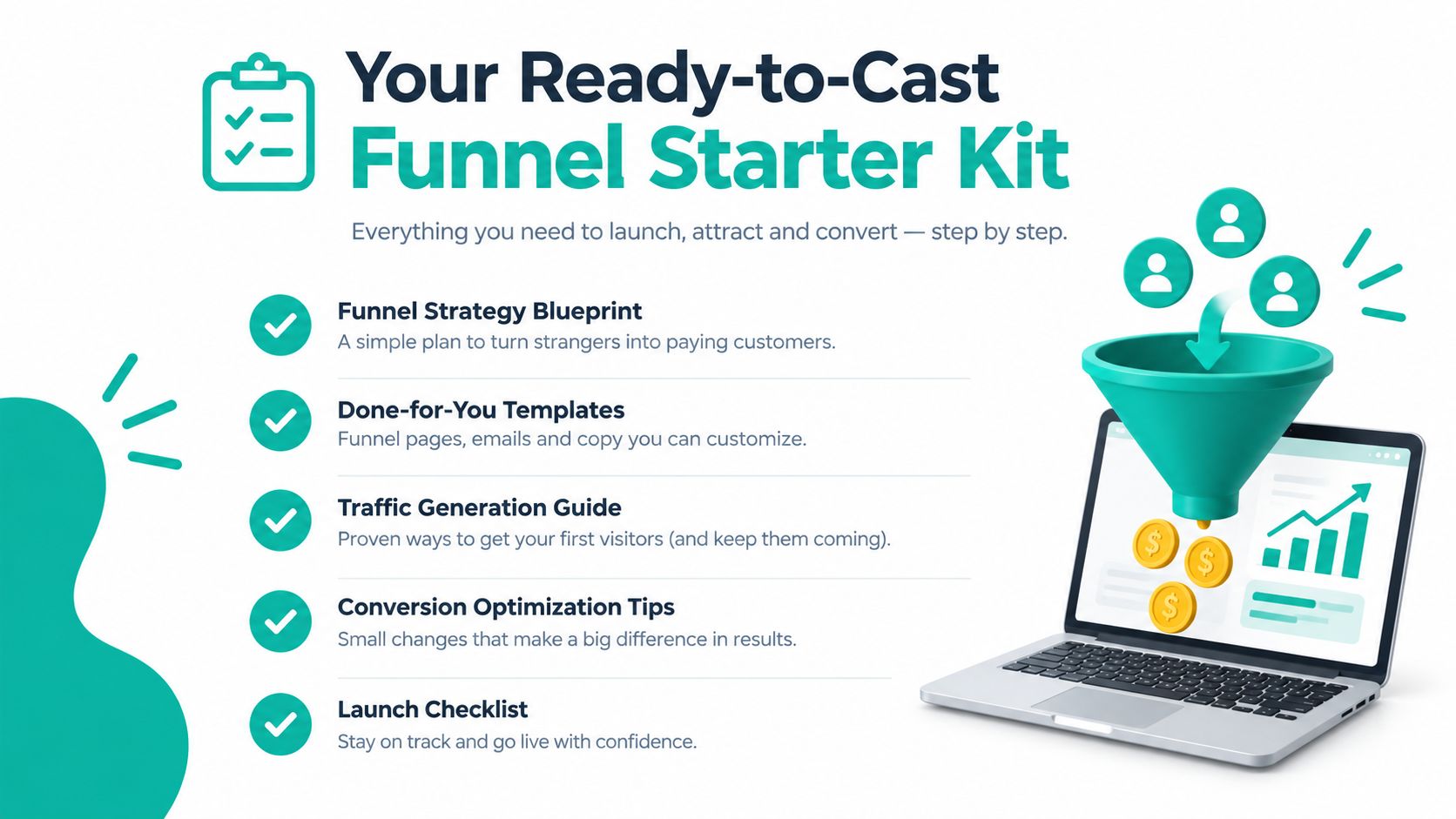
You can begin with a modest spellbook and improve it as evidence accumulates. The first version should connect one audience, one problem, one promise, and one action. Complexity belongs after the basic route works.
Start with this landing-page prompt:
“Create a focused landing page for [audience] who struggle with [specific problem]. Present [offer] as a practical way to achieve [specific outcome]. Match the headline to visitors arriving from [source]. Include [proof], answer [three objections], and use one primary action: [CTA]. Keep the tone [tone] and request only [essential form fields].”
For a checkout page, use a different incantation:
“Create a checkout page for [offer]. Summarize what the buyer receives, show the next steps after payment, make guest checkout prominent, remove unnecessary fields, include support and refund information, and keep one clear purchase action.”
For the post-purchase path:
“Create a confirmation and onboarding sequence for [offer]. Confirm the transaction, explain the first action, provide access instructions, invite the buyer to complete setup, and present [relevant optional extension] only after the core purchase is clear.”
Turn the kit into a working ritual
Use a short launch checklist:
- Audience: Name the specific person or buying group.
- Promise: Match the first headline to the acquisition source.
- Proof: Add only evidence you can verify.
- Action: Assign one primary conversion event.
- Measurement: Track visitors, starts, completions, refunds, and meaningful downstream outcomes.
- Experiment: Choose one major hypothesis and one guardrail metric.
- Follow-up: Define what happens after submission, booking, purchase, or abandonment.
An AI writing assistant can help generate variations, but your review remains essential. An AI landing-page copy generator can support headline, section, and CTA exploration, while you supply the customer truth that generic language can't invent.
For teams that want the mechanics connected, Web Mage can generate complete pages and funnel flows from plain-language prompts, apply edits through chat, and support autonomous SEO, performance, analytics, and conversion work through its resident agents. Treat it as a builder and automation layer, not a substitute for audience research, offer judgment, or responsible measurement.
Cast the first version, watch where people hesitate, and fix the largest meaningful leak before adding another spell. A simple funnel with reliable signals will teach you more than a grand castle filled with unmeasured corridors.
Build your first connected funnel with landing, checkout, upsell, and thank-you pages, then refine the journey through chat-based edits and conversion experiments. Visit Web Mage to turn your plain-language funnel idea into a working digital path and begin measuring where your prospects become customers.