
You're staring at a half-finished homepage at midnight. The logo looks great. The dragon illustration is adorable. Traffic is trickling in. Inquiries aren't.
That gap usually isn't a design problem. It's a words problem. People land, skim, feel vaguely unsure, and leave to check a competitor who explained things more clearly.
Table of Contents
- Why Good Copy Still Works Like Magic for Small Businesses
- Plan Your Copy Before Writing a Single Line
- Write Headlines, Page Blocks, and Meta Tags That Convert
- Edit Copy for Skimmers, Screen Readers, and Slow Connections
- Compare AI Copy Options and Where Web Mage Fits
- Cast Your First Copy Spell This Week
Why Good Copy Still Works Like Magic for Small Businesses
A founder with wizards on the homepage and pixies in the footer can still lose the sale in plain text. If your hero says you're passionate and customer-focused, you've said what every rival says. You haven't answered the visitor's real questions. What do you fix, who is it for, what happens next, and why should anyone trust you?
That's the actual job of copywriting for small business. Your pages, emails, landing pages, and calls to action explain the offer before a human ever gets on a call. Good copy does the early sales conversation while you're asleep, on a job site, or elbow deep in orders.
Educational copy earns trust before the pitch
Small brands don't have name recognition to borrow. You have to demonstrate expertise in the open, on the page. Answer practical questions. Name the problem in the customer's words. Explain the outcome, handle the obvious objection, then give one logical next step.
The association is strong in the research. Consumers who consumed educational content from a brand during early research were up to 131% more likely to buy from that brand, and 64% considered brands producing educational content trustworthy, according to Conductor research summarized by Fit Small Business. That's not a guarantee for your shop. It is a solid reason to stop treating copy as filler around the photos.
Practical rule: If a page could belong to any competitor by swapping the logo, it isn't selling yet. Add your specific process, your specific customer, and your specific proof.
Every page has a different spell to cast
Think in journey stages, not isolated pages. An introductory article explains the category in plain terms. A service or comparison page reduces uncertainty about price, timing, and fit. A conversion page turns that understanding into a call, booking, or checkout.
That shift toward self-guided research is why written content keeps working after you publish it. 70% of people prefer receiving information from blogs over traditional advertisements, adding a blog can increase website visitors by 55%, and content marketing is reported to generate more than three times as many leads as outbound marketing while costing 62% less, per small business marketing benchmarks compiled by Thrive Themes. Treat those as directional averages, not promises. A useful local guide can keep attracting search traffic for months. A paused ad stops the day the budget stops.
What follows is built for that reality. You'll get a planning routine, reusable headline and page formulas, an editing pass for real readers, a review loop for AI drafts, and one small spell to cast this week.
Plan Your Copy Before Writing a Single Line
Writing first and figuring out the goal later is how you get pretty paragraphs that convert nobody. Brew in order. Gather the ingredients, then start stirring.
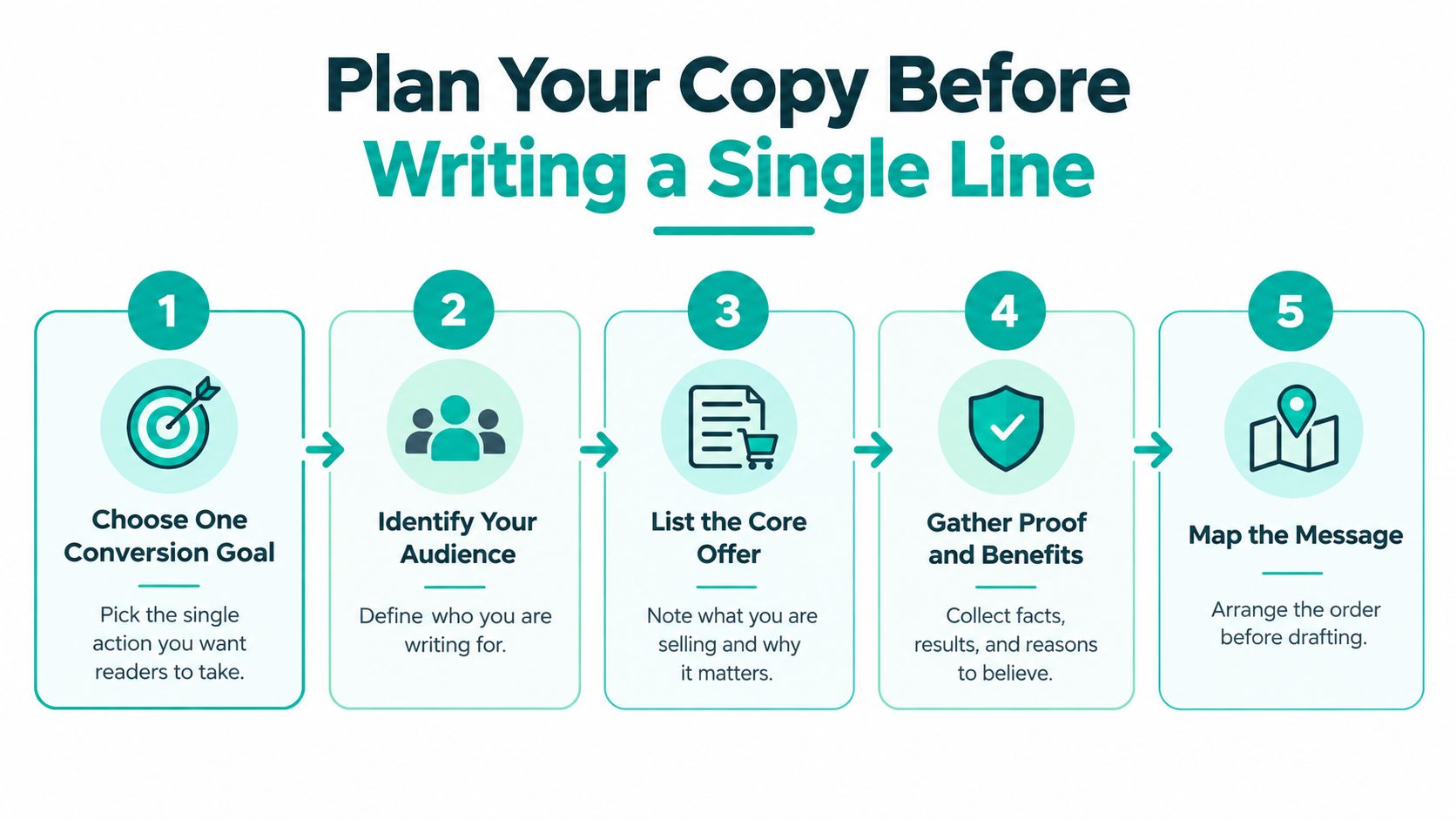
The five step planning workflow
- Choose one conversion goal: Pick the single action this page exists to drive, such as a quote request, booking, purchase, or email signup.
- Baseline it before you rewrite: Record your current conversion rate, cost per acquisition, revenue per visitor, email clicks, or tracked calls so you can tell whether new copy helped.
- Map the reader: Write down their problem, desired outcome, top objections, and awareness level. A first time buyer needs education. Someone comparing two quotes needs proof and clear differences.
- Lead with the benefit: Draft the headline and value proposition before listing features, so every later section supports one promise.
- Structure for scanning and test one change: Use short paragraphs, descriptive subheads, bullets, proof, objection handling, and one primary CTA, then run a controlled A/B test on the headline, offer, or CTA.
That sequence comes from a conversion copywriting workflow described by Rob Palmer, which also notes that small business landing pages commonly target roughly 3 to 10% conversion, that tests with only 50 conversions per variation are generally too weak for dependable conclusions, and that trustworthy experiments often require hundreds or thousands of conversions per variation.
Watch it work for a bakery
Say a bakery wants more wedding cake inquiries. Not more followers. Not more vague awareness. Inquiries through the contact form, from couples with a date and a guest count.
That one goal changes everything. The headline stops being "Baked With Love Since 2012" and becomes "Wedding cakes in Austin, tastings booked in one click." The proof section shows real weddings, serving sizes, and lead times. The objection block answers the question every couple asks about delivery and setup. The button says Check Your Date, not Submit.
- Goal: Wedding inquiry form completions
- Baseline: Current inquiries divided by wedding page visitors
- Reader problem: They need a cake that looks right, feeds everyone, and arrives intact
- Biggest objection: Will you be available, and what will it cost?
- Primary CTA: Check Your Date
Notice what got cut. The wholesale menu, the cooking classes, and the holiday preorders don't belong on this page. They compete with the goal. One page, one job, one wand pointed in one direction.
Don't chase an industry average. Your own baseline is the control that tells you whether a rewrite worked for your traffic, your offer, and your prices.
The trap that wastes your testing budget
The most common planning mistake is declaring a winner too early. A headline jumps ahead on a tiny sample, you promote it, and random fluctuation gets mistaken for persuasive genius. Low traffic doesn't mean you can't test. It means you should test bigger, clearer changes, run them longer, and judge them against tracked calls or inquiries rather than vanity clicks.
Fill in the checklist above before you draft a sentence. It takes twenty minutes with a coffee. It saves you from rewriting the same unfocused page three times.
Write Headlines, Page Blocks, and Meta Tags That Convert
Planning tells you what the page must do. Now you need blocks you can type. Steal these patterns, swap in your specifics, and keep the pixie dust in the examples, not in vague claims.
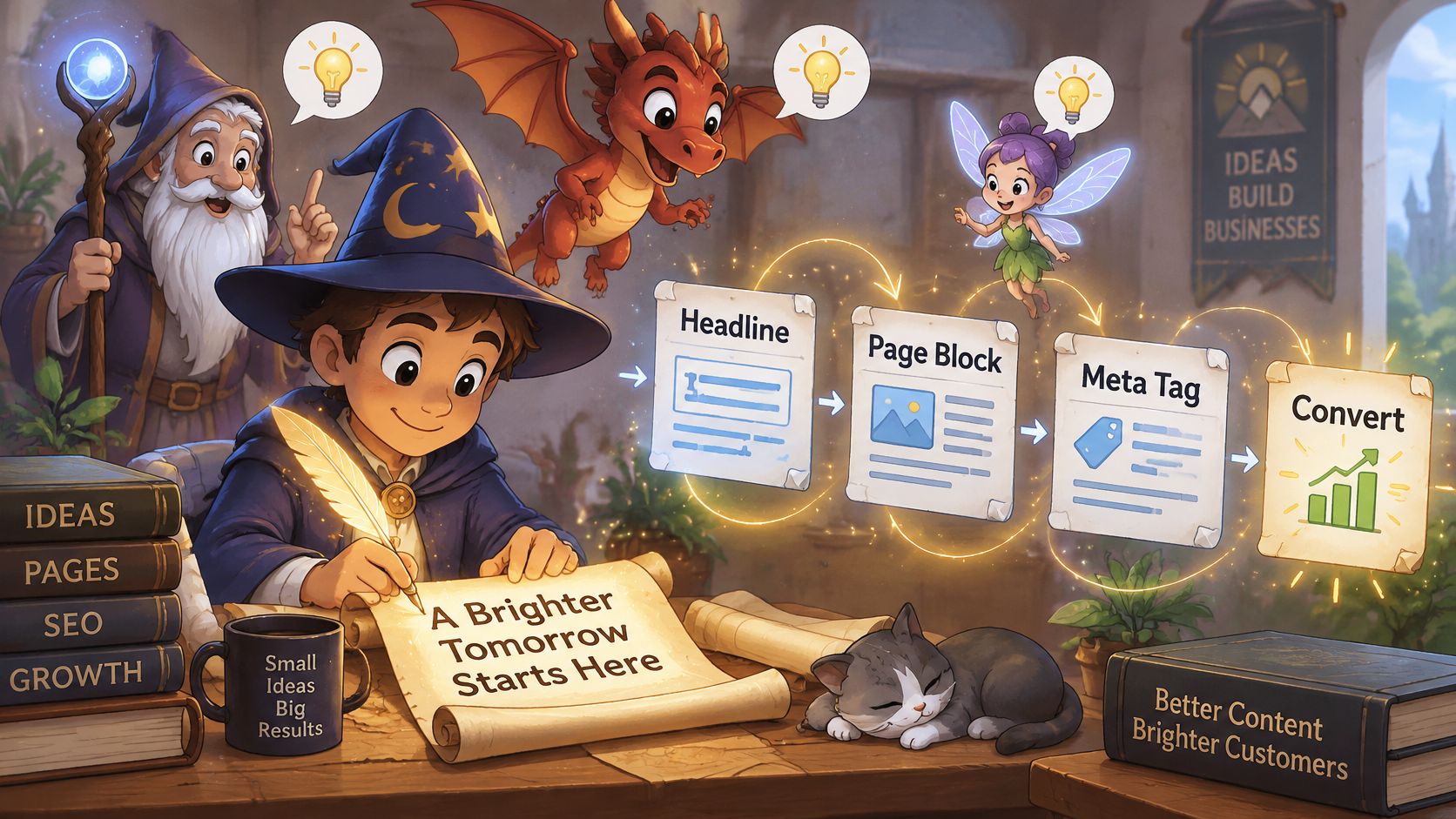
Headline formulas you can fill in today
Start with the outcome, not your company history. Readers care about the result first and your method second.
- Outcome plus audience: [Desired result] for [specific customer] without [pain they hate]. Example: "Booked out grooming appointments for busy dog owners, without phone tag."
- Problem flip: Turn [frustrating situation] into [better situation] in [concrete step]. Example: "Turn your messy inbox into confirmed bookings with one intake form."
- Magic themed, still clear: Keep the creature, keep the clarity. "Dragon strong bookkeeping for founders who'd rather be building" works because the service and audience survive the metaphor. "Unleash your inner magic" fails because nobody knows what you're selling.
- Local and specific: [Service] in [place], [proof or reassurance]. Example: "Emergency plumber in Leeds, upfront pricing before we start."
Write five versions before you judge any of them. The first draft is usually you describing yourself. By version four you're describing the customer's life after buying.
Page blocks by funnel stage
Each stage needs a different job done. Don't ask a thank you page to do a landing page's work.
Landing page hero. Benefit led headline, one sentence on how it works, one primary CTA. A potion shop selling sleep tea might write, "Fall asleep faster with a caffeine free night blend. Brew one cup 30 minutes before bed. Shop the Night Blend." The workbook offer and the wholesale pitch live elsewhere.
Middle of page proof and objections. Put specific proof next to the claim it supports, not in a lonely testimonial graveyard at the bottom. A dragon themed coaching brand claiming structured support should show the session format, who it's not for, and what happens between calls. Then answer the largest objection directly, whether that's price, time, or "will this work for someone like me?"
Checkout reassurance. Short lines do heavy lifting here. State delivery timing, returns, guarantees, and what happens after payment. Uncertainty at checkout isn't a branding issue. It's missing information.
Upsell description. Explain who the add on helps and when to skip it. "Add the tasting box if you're choosing between flavors for more than 100 guests" beats a pushy "Complete your experience." Honest fit language protects trust.
Thank you message. Confirm the action worked and name the next step with timing. "You're booked. Your confirmation is on its way, and we'll call the day before your appointment" closes the loop. Silence makes people email you to check.
If you want layout inspiration while you assemble these blocks, browse business website examples with clear page structures and note where each example places proof relative to its CTA.
Meta tags are copy too
Your title tag and meta description are the tiny scroll a searcher reads before deciding to click. Google says every page should have a distinct, descriptive, and concise title element, avoiding keyword stuffing, repeated boilerplate, and vague wording, and that a useful meta description should be short, unique to the page, and focused on its most relevant points, per Google's SEO starter guide.
So don't stamp your brand name across every page and call it done. A pricing page promises clarity about cost. A webinar page promises a topic and a date. A product page promises a specific item and benefit. Write each title around that page's actual promise and the words a searcher would type.
- Pricing page title pattern: [Service] Pricing in [Place], Packages and What's Included
- Webinar title pattern: [Specific Topic] Webinar for [Audience], Save Your Seat
- Product title pattern: [Product Name], [Key Benefit] for [Use Case]
Match the meta description to the same promise in one or two short sentences. If the search result promises pricing and the page hides it, visitors bounce and you've paid for that click in trust.
Edit Copy for Skimmers, Screen Readers, and Slow Connections
Most founders edit for how copy sounds read aloud at a desk. Your customers read on a phone, half distracted, possibly with a screen reader, possibly on a weak connection. Edit for them.
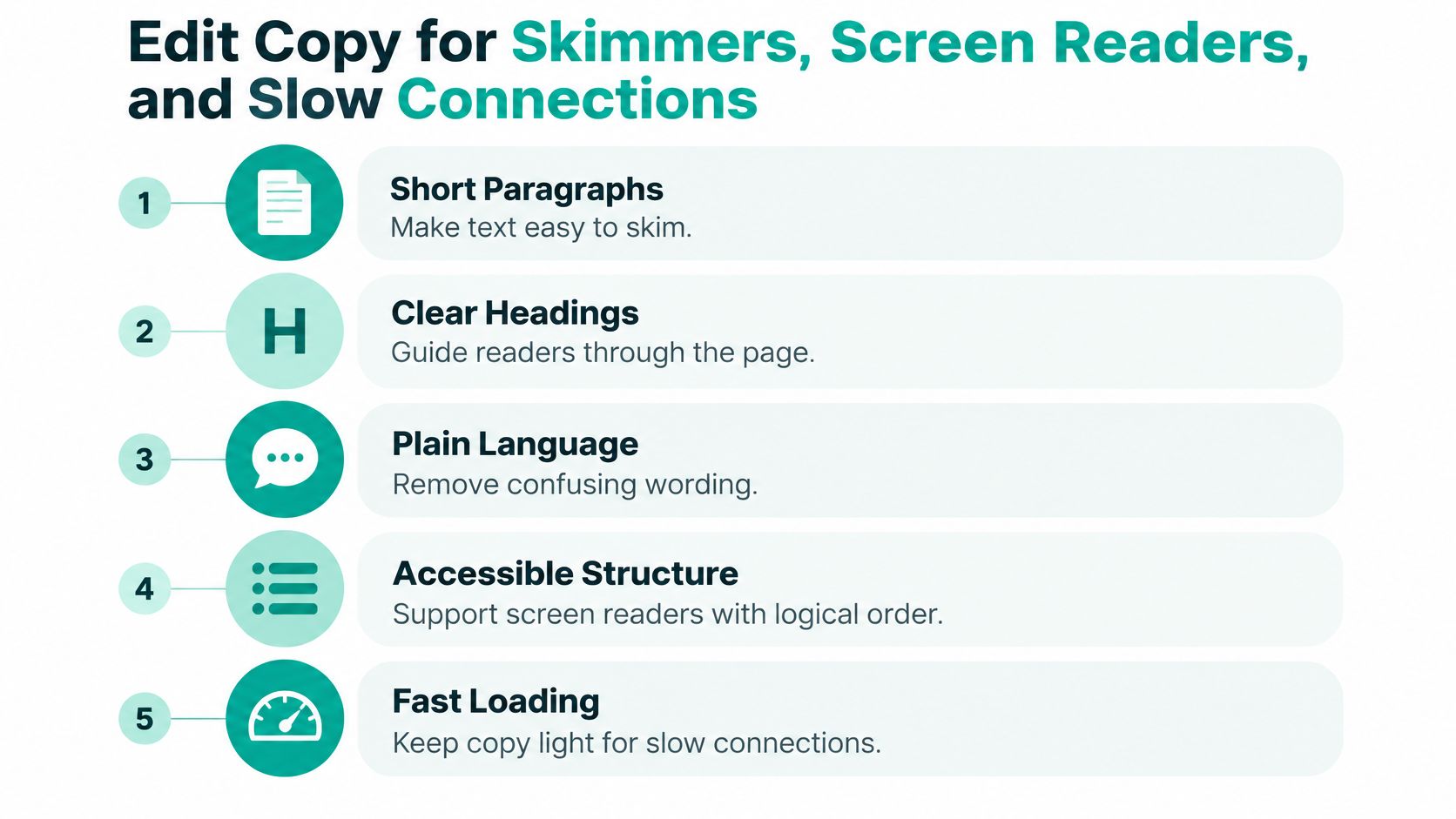
Plain language is a conversion lever
Landing page evidence reports approximately 11.1% conversion for copy at a 5th to 7th grade reading level versus 5.3% for professional level writing, and one analysis reports that 73% of users skim rather than read every word, according to copywriting statistics compiled by KhrisDigital. A Flesch Reading Ease score around 60 to 70 is a useful general target from that same body of evidence. Treat these as directional benchmarks and validate them on your own traffic by device and source.
That doesn't mean dumbing anything down. It means the clearest customer outcome goes in the headline, the mechanism gets explained in short sections, and no benefit hides inside a dense paragraph guarded by jargon goblins.
Before: "Our thorough onboarding solution uses efficient methodologies to optimize your client acquisition infrastructure." After: "We set up your booking page, intake form, and reminder emails. You get confirmed appointments without chasing people by phone."
Try this editing prompt in any chat tool: "Rewrite this paragraph at a 6th grade reading level. Keep every factual claim exactly as written. Use short sentences, one idea per paragraph, and replace jargon with plain words. Show me what you changed."
Accessibility checks that also help skimmers
Only 41% of small and medium business websites meet WCAG 2.2 standards, despite improvement from 18% in 2022, per 2025 small business website statistics from DebTech. Copy carries much of that burden, because headings, links, and form labels help assistive technology interpret your offer.
- Meaningful headings: "Delivery and setup costs" helps a screen reader user jump straight to pricing. "More info" helps nobody.
- Descriptive buttons and links: Swap Click Here and Submit for "Download the price list" or "Book my tasting." The label should make sense read on its own.
- Explicit conditions: State pricing, deadlines, and eligibility in the open instead of burying them after signup.
- One idea per paragraph: Dense blocks punish readers with limited time, limited English proficiency, or cognitive load from a long day.
For a deeper walkthrough of the mechanics, see how to edit website text step by step and run your highest traffic page through it first.
Speed decides whether anyone reads at all
Your hero copy can't persuade while it's still loading. Google classifies Largest Contentful Paint within 2.5 seconds at the 75th percentile of visits as good, and above 4 seconds as poor, per Google's page experience documentation. Keep hero sections concise, size images properly, and check real mobile traffic instead of trusting one fast test on office wifi.
Compare AI Copy Options and Where Web Mage Fits
You have four realistic ways to produce copy. Each one trades speed, control, and maintenance differently. Pick based on your bottleneck, not on hype.
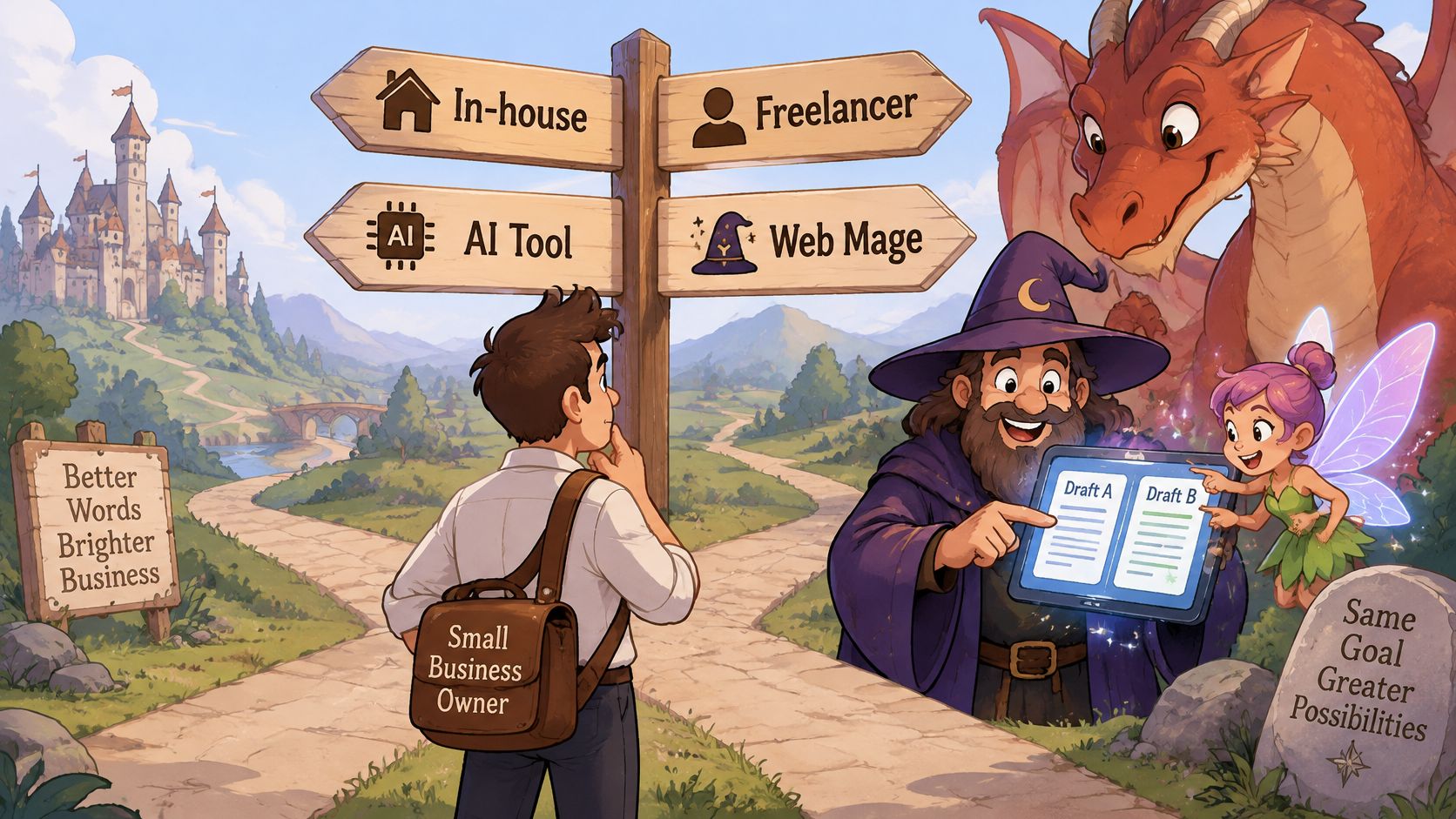
The four options side by side
| Option | Speed | Voice control | Testing and upkeep |
|---|---|---|---|
| Write in house | Slow, depends on your calendar | Highest, it's literally you | Manual, often skipped |
| Hire a freelancer | Moderate, briefs and revisions take time | High with a good brief and samples | You still own testing and updates |
| Standalone AI writer | Fast drafts | Varies, needs voice examples and editing | You paste, format, and test elsewhere |
| AI driven builder | Fast, pages and copy together | Needs a clear prompt and review pass | Built in variants and checks, less manual wiring |
In house writing wins when your voice is the product and you have the hours. A freelancer wins for a major repositioning or a flagship sales page where strategy matters more than volume. A standalone AI writer wins for drafts, outlines, and email variations when you already have a site you're happy with. If you're exploring that route for a single page, an AI landing page copy generator overview shows what these tools typically draft well and where they need your input.
Trust is the real constraint on AI copy
Adoption is racing ahead of confidence. A 2025 global survey of 2,500 small business decision makers found 48% use AI in marketing and 37% use it for writing email and social copy, while 31% cited trust in AI produced content, 26% cited inconsistent brand voice, and 35% cited data privacy as concerns, and a separate 2025 B2B benchmark found 81% of marketers use generative AI but only 4% report high trust in its output, per Constant Contact's 2025 small business marketing report.
So the useful question isn't how to generate faster. It's what review loop makes a draft safe to publish. Check every claim against your own evidence. Read it aloud against two or three samples of your real voice. Delete any statistic, testimonial, or guarantee you can't document. Then decide deliberately whether to accept, edit, or reject each section.
Editor's rule of thumb: AI drafts the potion. You check the ingredients list before anyone drinks it.
Where an integrated builder changes the workflow
The video below shows the prompt to page approach in action, so you can judge the workflow rather than the marketing around it.
Web Mage fits the fourth row of that table. It's an AI driven website and funnel builder that generates pages and copy from a plain language prompt, assembles landing, checkout, upsell, and thank you pages from one sentence, and accepts chat edits across pages. Its Conversion Alchemist drafts A/B variants and promotes winners, while nightly SEO and analytics checks flag metadata and drop off issues. That integration removes the paste and format step. It doesn't remove your review loop, and any tool that claims otherwise is selling you a cursed shortcut.
Cast Your First Copy Spell This Week
Don't rewrite your whole site. One page, seven days, one measurable change. Small spells cast consistently beat grand rituals you abandon by Thursday.
Your seven day routine
- Day 1, pick and baseline: Choose your highest traffic service or landing page. Write its one conversion goal and record the current rate, tracked calls, or inquiry count.
- Day 2, map the reader: List their problem, desired outcome, and top two objections in their words, lifted from real emails and reviews.
- Day 3, draft headlines: Write five versions using the outcome plus audience formula. Pick the clearest, not the cleverest.
- Day 4, rebuild the blocks: Rewrite the hero, move proof next to claims, answer the biggest objection, and keep one primary CTA.
- Day 5, run the readability audit: Shorten sentences, split dense paragraphs, rename vague buttons, and read the page on your phone.
- Day 6, verify every claim: Check each promise, price, and proof point against your own evidence. Cut anything you can't document.
- Day 7, publish and test: Ship it, then test one variable, usually the headline, against your baseline. Let it run long enough to mean something.
Three prompts for common fixes
Tighten a hero: "Rewrite this hero in under 25 words. Lead with the customer outcome, name the audience, keep my playful tone, and don't add claims that aren't in my draft."
Fix a vague button: "Give me ten descriptive alternatives to 'Submit' for a wedding cake inquiry form. Each should make sense read alone by a screen reader."
Soften an overpromise: "This sentence promises more than I can prove. Rewrite it to say exactly what I deliver, keep it confident, and flag any word that implies a guarantee."
That last prompt matters more than it looks. Half the trust problem with AI assisted copy is invented certainty. A warlock who promises every spell works on everyone gets run out of the village. A business that states conditions clearly keeps its customers.
Publish the clearer page, watch the one number you baselined, and let real visitors tell you whether the spell worked.
Pick the page tonight. Not the whole kingdom, just one page where money or inquiries are supposed to happen. Run the routine, keep your voice samples and evidence beside you while you edit, and compare the result against the baseline you wrote down on day one. That's copywriting for small business as a practice instead of a hope. Your next customer is already reading someone's page. Make sure yours is the one that finally makes sense.
Ready to turn one clear sentence about your business into a full page with copy, checkout, upsell, and thank you blocks already wired together? Web Mage generates the pages and wording from a plain language prompt, then keeps testing headlines and checking SEO nightly while you run the business. Start your first page today and review every line like the careful mage you are.