
At midnight, a founder is staring at a document full of half-finished headlines, three competitor funnels pinned in browser tabs, and a checkout that hasn't been touched since launch. The landing page looks acceptable, but the thank-you page is an afterthought, the mobile layout feels cramped, and nobody knows whether the headline or the offer is losing customers.
An AI funnel builder promises to take that messy spellbook and turn it into a working customer journey. It can generate pages, write copy, connect steps, interpret analytics, and suggest or run experiments from plain-language instructions. But speed alone isn't magic. A trustworthy funnel also needs accessibility checks, meaningful statistical evidence, and concrete performance targets.
This guide treats every promise as a spell with a counterspell. You'll see what an AI funnel builder does, where autonomous agents help, why low-traffic tests need restraint, and how to evaluate a platform before handing it your checkout.
Table of Contents
- The Spellbook That Builds Your Funnel While You Sleep
- What an AI Funnel Builder Actually Does
- AI Funnel Builders vs Template Builders
- The Resident Agents Behind the Curtain
- The Two Spells Most Posts Skip
- A Buyer's Checklist for Evaluating Any AI Funnel Builder
- Three Funnels You Could Cast This Week
- Your First Week With an AI Funnel Builder
The Spellbook That Builds Your Funnel While You Sleep
The founder at midnight doesn't have a single problem. They have a chain of small problems. The hero copy needs a sharper promise, the product image is too large, the checkout asks for information nobody needs, and the follow-up page offers no sensible next step. A traditional builder can provide the canvas, but the founder still has to perform every task manually.
An AI funnel builder changes the starting point. Instead of opening a blank page and assembling sections one by one, the founder might write: “Create a funnel for a compact home coffee course, with a benefit-led landing page, a checkout, a post-purchase offer, and a thank-you page.” The system can translate that instruction into structure, copy, visual direction, and connected steps.
Why this category exists now
The timing isn't accidental. Stanford's 2025 AI Index report recorded AI use among surveyed organizations at 78% in 2024, up from 55% in 2023. The share using generative AI in at least one business function rose from 33% to 71% over the same period.
That shift makes the conversational builder commercially plausible. Copy generation, page creation, analytics interpretation, search optimization, and conversion experimentation no longer have to live in separate specialist tools. A business can ask one system to perform related jobs inside the same workflow.
The commercial channel is substantial too. The U.S. Census Bureau estimated 2025 U.S. retail e-commerce sales at $1.2337 trillion, up 5.4% from 2024, with online sales representing 16.4% of total U.S. retail sales. The Census Bureau e-commerce release shows why a small improvement to a landing page or checkout can matter to a business operating online.
Practical rule: Treat the builder as an apprentice that handles repetitive craft, not as a wizard whose first draft deserves automatic trust.
The useful distinction from drag-and-drop software is what happens after publication. A template builder gives you a room and tools. An AI funnel builder can keep reading the room, identify friction, propose changes, and in some cases apply them. That creates power, but it also creates responsibility. You still need to know what the agent changed, what evidence it used, and whether the result works for every visitor.
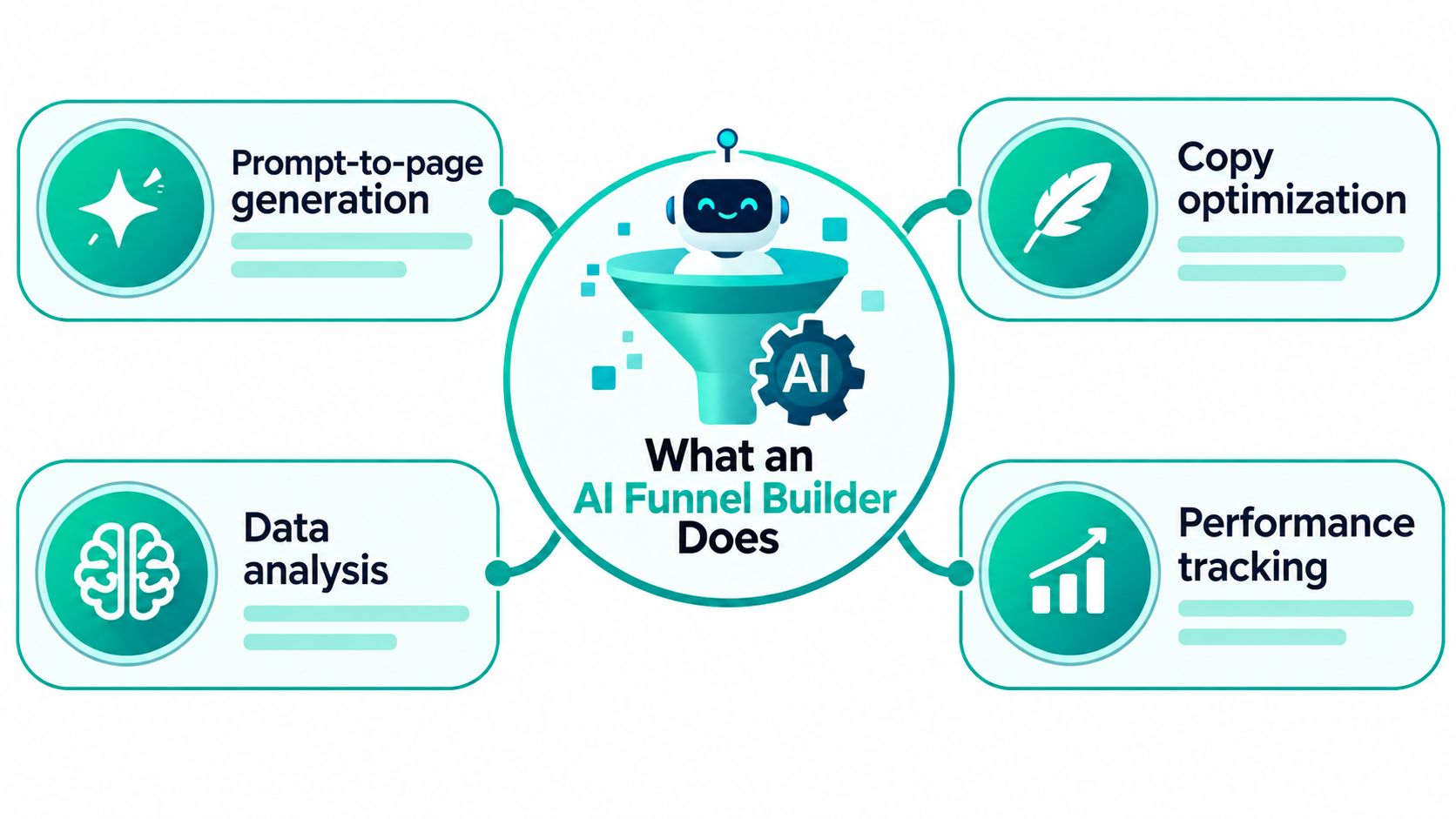
What an AI Funnel Builder Actually Does
The easiest way to understand the category is to follow one instruction through four capabilities. Suppose a coach wants to sell a guided meal-planning program. The builder should do more than produce a pretty page. It should create a connected path from first impression to purchase and help the coach maintain that path afterward.
Prompt-to-page generation
The first spell turns a short description into a page. The coach supplies the audience, offer, tone, and main promise. The system creates a page structure with a hero section, benefits, proof, objections, call to action, imagery, and styles.
That doesn't mean the copy is automatically accurate. The coach still checks claims, testimonials, product details, and the relationship between the headline and the actual offer. Generation removes blank-page friction. It doesn't remove editorial judgment.
Funnel wiring
The second capability connects the journey. A single instruction can request a landing page, checkout, upsell, and thank-you page. The builder's job is to preserve context between those steps, so the upsell follows the purchase and the thank-you page reflects what the buyer just did.
This connected approach matters because a funnel isn't a collection of isolated designs. Baymard's checkout usability research reports that roughly 70% of ecommerce shoppers abandon their carts, with one research summary giving a tracked global average of 70.19%. The same research says checkout design and flow can be the sole cause of abandonment, and its broader assessment found 65% of sites at a mediocre level or worse, while only 2% were rated good.
Chat-based editing
The third capability replaces a long sequence of layout actions with a clear instruction. Instead of hunting through panels, you might type, “Make the hero image darker, shorten the subheadline, and move the guarantee below the primary button.”
The quality test is precision. A useful system changes the intended elements without rearranging unrelated sections behind your back. You should also be able to inspect or undo the result.
Autonomous optimization and A/B automation
The fourth capability begins after launch. An agent can examine traffic patterns, identify a weak step, draft an alternative headline, and route visitors between versions. But an experiment needs more than random traffic and a winner badge. It needs a defined success event, a decision rule, enough evidence, and guardrails for business outcomes.
For a broader overview of connected funnel workflows, see this guide to an online sales funnel builder.
AI Funnel Builders vs Template Builders
A template builder and an AI funnel builder can both produce a landing page. The difference appears when you ask who does the work before launch, who maintains the funnel afterward, and where experimentation happens.
A template tool usually starts with a library or blank canvas. You choose a design, place sections, write copy, connect integrations, and review the result. That model gives you close control, which is valuable for a brand with a detailed design system or unusual interaction requirements.
An AI funnel builder starts with intent. You describe the offer and audience, then refine the generated result. Its advantage is not necessarily visual novelty. It's the attempt to combine production, maintenance, analytics, and experimentation in one operating loop.
| Dimension | Template Builder | AI Funnel Builder |
|---|---|---|
| Production | Choose a template and assemble sections manually | Describe the offer and refine generated pages |
| Optimization | Review analytics and make changes yourself | Agents can surface issues and propose or apply changes |
| Testing | Configure experiments manually or add another tool | Variants and routing may be handled in the same platform |
| Pricing | Often combines builder fees with add-ons or plugins | May bundle hosting, automation, analytics, and usage credits |
The real trade-off
Templates provide predictability. You know what the canvas can do, where each control lives, and how much of the design remains under your hand. AI generation provides speed and breadth, but the first result may need fact checking, brand editing, and accessibility repair.
Pricing deserves careful reading. A low subscription can still become expensive if routine edits consume credits, if testing requires an add-on, or if hosting and analytics sit elsewhere. Ask whether credits reset, whether purchased credits expire, and which actions count as AI work.
The important question isn't “Which builder makes the prettiest page?” It's “Which system will still help when the page needs maintenance next week?”
Solo founders and agencies often benefit from reducing repetitive production. A team with a highly bespoke design system may prefer a canvas, especially when unusual components must behave exactly as specified. The right choice depends less on the label and more on how much control, automation, and operational responsibility you want the tool to own.
The Resident Agents Behind the Curtain
Autonomous optimization works best as a small guild, not as one mysterious creature. Each resident agent should have a defined input, a limited job, and a success signal you can inspect.
Four specialists, four responsibilities
SEO Seer crawls the site for search-related maintenance. It can rewrite metadata, repair broken links, and identify opportunities to target relevant terms. The useful output isn't “more SEO.” It's a visible list of repaired links, changed metadata, and pages that need review.
Speed Sprite works on the resources that slow the page. It can compress images, lazy-load media below the fold, and remove unnecessary code. Its most useful metric is not a vague claim that the page feels faster. Google defines Largest Contentful Paint as the time required to render the largest visible content element. Google classifies 2.5 seconds or less as Good, results above 2.5 and up to 4 seconds as needing improvement, and results above 4 seconds as Poor.
That gives the sprite a concrete target. If the main offer remains hidden behind a heavy image or bloated script, the agent hasn't finished its spell.
Analytics Oracle reads traffic and behavior signals. It can surface drop-offs, popular sections, and pages that deserve attention. Its value comes from prioritization. A funnel may have many possible edits, but the oracle should help identify the step most likely to affect the business goal.
Conversion Alchemist drafts variants and routes traffic between them. It might create a shorter headline, a different button label, or a revised offer explanation. The alchemist should also record the baseline, traffic assigned to each version, conversions, and the rule used to decide whether a winner exists.
For a practical look at AI-generated page copy, explore this resource on an AI landing page copy generator.
The daily rhythm matters more than a dramatic overnight rewrite. One repaired link, one compressed asset, and one carefully reviewed headline can keep a funnel healthier than a constant cycle of untracked redesigns.
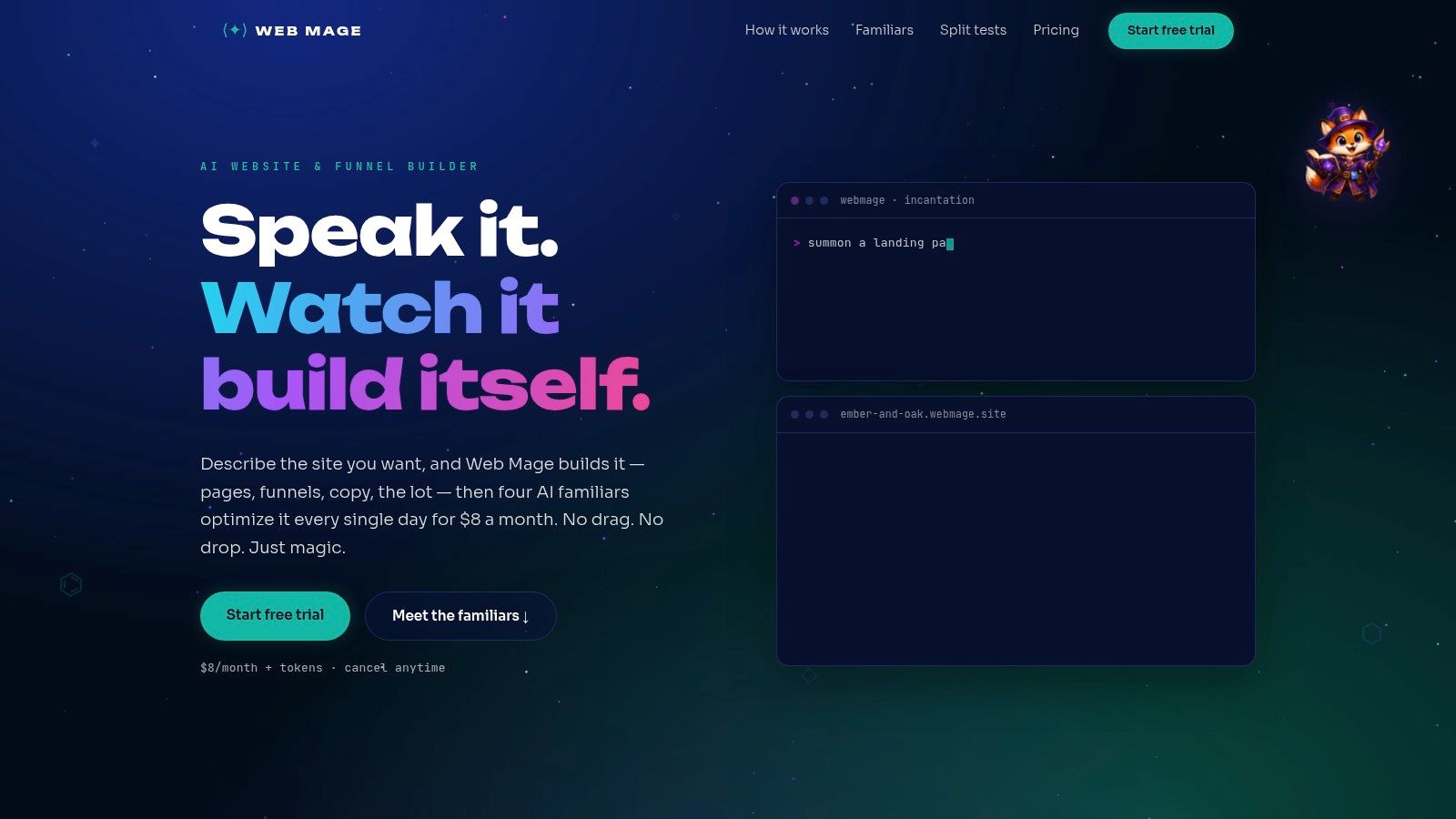
A platform such as Web Mage can generate pages, copy, imagery, and styling from plain-language prompts, then provide resident agents for SEO, performance, analytics, and conversion work. Evaluate those capabilities by their logs and controls, not by the theatrical quality of a demo.
The Two Spells Most Posts Skip
The first overlooked spell is accessibility. A page can look polished and still fail visitors who use a keyboard, screen reader, zoom, or other assistive technology.
A 2025 study of six AI-generated websites identified 308 accessibility errors, including contrast failures, inadequate alternative text, and unlabeled form controls, according to the reported accessibility research. The study classified 52.93% as cognitive-accessibility issues and 47.08% as WCAG 2.2 violations. A systematic review also reported that none of three tested AI-generated sites, made with Durable, Hostinger, and Framer, was fully accessible to screen-reader users.
Accessibility needs a launch gate
An accessibility-aware workflow checks more than whether a contrast scanner turns green. Before publishing, inspect the critical path:
- Keyboard navigation: Can a visitor reach, understand, and activate every important control without a pointer?
- Form structure: Does each input have a meaningful label, and do errors explain how to recover?
- Screen-reader output: Do headings, buttons, menus, pop-ups, and status messages make sense when read aloud?
- Cognitive load: Does the page avoid confusing instructions, surprise movement, and unclear next steps?
- Media alternatives: Do meaningful images have useful alternative text, while decorative images stay out of the reading flow?
An accessibility-focused prompt can help, but it isn't proof of compliance. One 2025 evaluation found that an accessibility-focused prompt produced worse compliance than the baseline in its dataset. The agent needs automated scanning, keyboard and screen-reader checks, human review of checkout and forms, and an audit trail showing what changed.
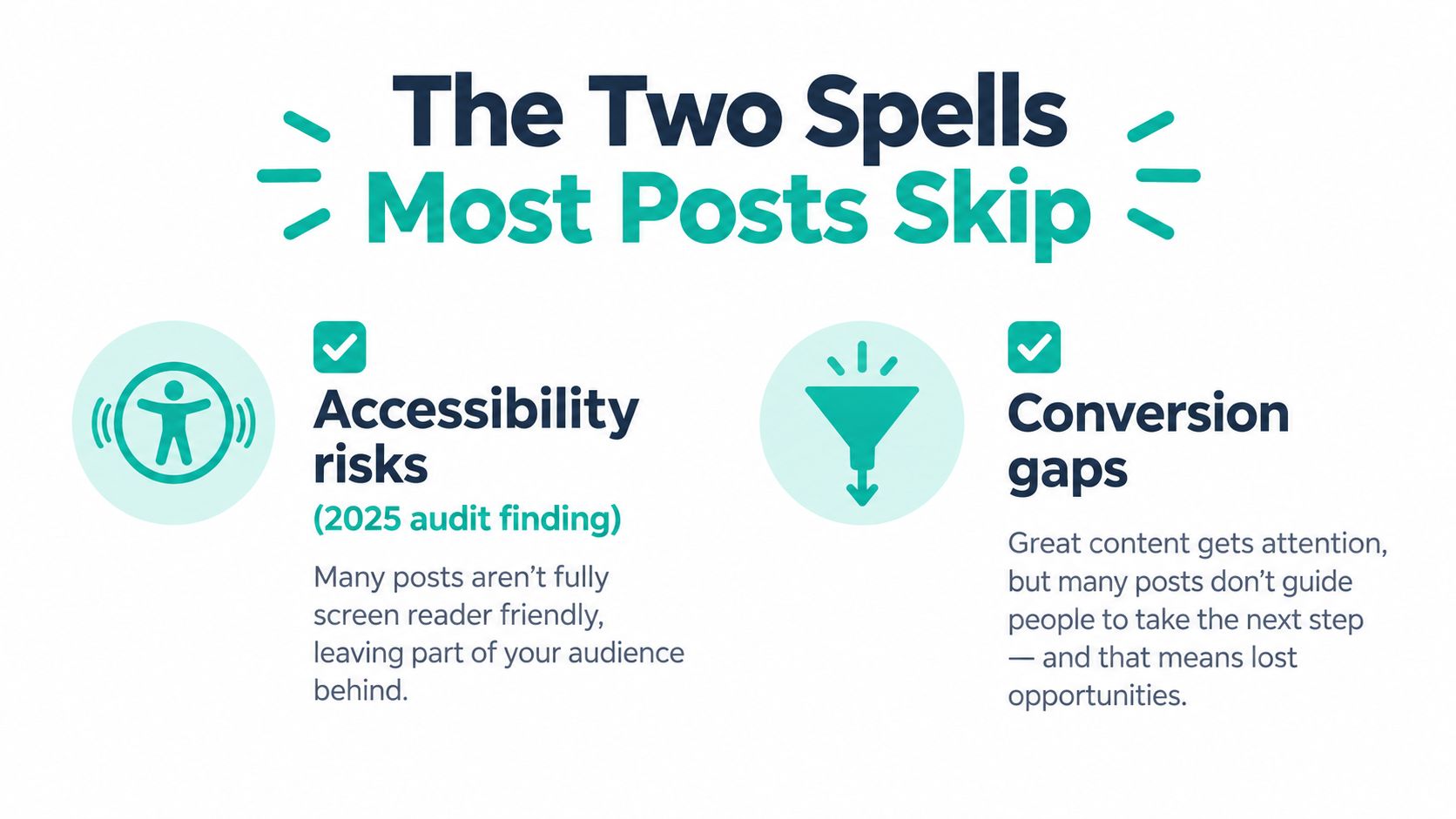
The second spell is statistical restraint
Automatic A/B promotion can be risky when traffic is thin or uneven. A variant may appear to win because of chance, a temporary audience mix, seasonality, novelty, or an attribution window that hasn't finished.
Optimizely's sample-size guidance identifies sample size and effect size as central to reliable comparisons. It describes statistical significance as the likelihood that a result isn't caused by random chance, while its guidance commonly uses a 0.05 significance level, or 95% confidence. Its separate Stats Engine workflow describes a default 90% significance setting, which shows why a vendor must state its exact rule instead of hiding it behind “AI confidence.”
Require a no-decision state for insufficient data, transparent uncertainty, holdout traffic, and guardrail metrics such as refunds, lead quality, or customer value. A statistically significant result can still be commercially harmful, and a commercially meaningful improvement can remain uncertain until the funnel gathers stronger evidence.
A Buyer's Checklist for Evaluating Any AI Funnel Builder
A polished demo tells you how quickly a tool can cast the first page. A buyer's checklist tells you whether the spell survives contact with real visitors.
Start by scoring each dimension from 1 to 5. Use the same prompt, offer, and acceptance criteria with every vendor. Ask to see the generated funnel, the edit history, the analytics view, the accessibility results, and the experiment settings.
| Dimension | What to Look For | Weight | Score (1-5) |
|---|---|---|---|
| Production quality | Accurate copy, coherent page structure, useful imagery, mobile-ready output | High | |
| Optimization autonomy | Clear agent tasks, change logs, rollback, human approval options | High | |
| Testing rigor | Sample-size logic, effect-size reporting, stopping rules, guardrails | High | |
| Accessibility | Contrast, labels, keyboard flow, screen-reader checks, audit history | High | |
| Integration | Analytics, payments, email, CRM, export and ownership options | Medium | |
| Cost | Subscription, credit rules, hosting, add-ons, support, usage visibility | Medium |
Questions that expose weak spells
Ask the vendor to generate a funnel from a specific product description, then deliberately request a correction. Can you edit the headline directly, or must you spend another prompt? Can you roll back a change? Does the system preserve your brand rules across pages?
For optimization, ask what the agent can change without approval. Request an example of a failed experiment and look for uncertainty reporting rather than a carefully selected victory.
For accessibility, ask for the last audit report. A serious answer should include more than a claim that the system “follows WCAG.” Ask how it tests keyboard navigation, form errors, pop-ups, contrast, alternative text, and screen-reader behavior.
Weight evidence, not promises
A scorecard works only when you attach evidence to each score. Give a high production score because the funnel handled your real offer accurately, not because the demo looked smooth. Give a testing score only when the platform exposes its statistical method and refuses to auto-promote when the audience is too small.
Buyer's safeguard: Never let a vendor's automation replace your acceptance criteria. Write down what must be true before launch, then test it in the product.
Three Funnels You Could Cast This Week
The right funnel depends on the person holding the wand. A solo founder, an agency owner, and a course creator can all use an AI funnel builder, but they shouldn't ask it to solve the same problem.
The solo founder's compact launch
A founder selling a downloadable planning guide can request three connected steps. The first captures an email address and explains the guide. The thank-you page delivers the resource and presents one related offer. A nightly SEO review checks metadata and broken links while the founder focuses on fulfilment and promotion.
The first review should watch form completion, checkout progression, the performance of the thank-you offer, and any technical issues that block the path. Don't add multiple experiments immediately. Establish a clean baseline first, then change one meaningful element.
The agency owner's repeatable retainer
An agency can use a shared workflow for client funnels without making every client look identical. The team starts with a client-specific prompt, applies brand details through chat-based edits, and reviews agent activity before presenting changes.
A useful agency scorecard tracks revision time, approval time, client-request turnaround, lead quality, and the number of changes that required human correction. The point isn't to remove the strategist. It's to reserve strategist time for positioning, offer design, and interpretation instead of repetitive layout work.
The course creator's webinar path
A course creator might build a registration page, confirmation page, replay page, and enrollment offer. The first experiment could compare two registration headlines while leaving the form, schedule, and offer unchanged.
Track registration completion, attendance or replay engagement, enrollment progression, and refunds. A headline that increases registrations but attracts poorly matched prospects may look victorious at the top of the funnel while weakening the business further down.
For the mechanics behind connected offers and launch planning, use this practical guide on how to build a sales funnel. The shared lesson across all three scenarios is restraint. A smaller funnel with clear events and visible ownership is easier to improve than a sprawling maze of automated changes.
Your First Week With an AI Funnel Builder
Treat the first week as a controlled apprenticeship, not a grand summoning.
Day one: Write the prompt with the audience, offer, proof, objections, tone, and desired action. Generate the landing page, then check every factual claim and replace generic imagery where your brand needs something specific.
Day two: Wire the funnel. Test the landing page, checkout, upsell, thank-you page, forms, analytics events, and mobile layout as one visitor journey. Create the first experiment only after the path works.
Days three through five: Use chat edits for focused changes, then review the nightly agent log. Look for rewritten metadata, repaired links, compressed assets, surfaced drop-offs, and proposed copy variants. Keep a record of which changes you accepted and why.
Day six: Run the accessibility review. Test keyboard navigation and screen-reader behavior on the critical path, then inspect form labels, error messages, contrast, pop-ups, and image alternatives. Review the A/B guardrails and confirm that the system can decline to promote a variant when evidence is weak.
Day seven: Measure the funnel as a system. Choose the agent that needs tuning based on evidence. If visitors reach checkout but fail to complete it, investigate friction there before polishing a headline at the top.
Three questions new users ask
How long do results take? Page generation can be quick, but business evidence takes longer. Give the funnel enough relevant traffic and a defined observation window before judging an experiment.
Can credit-based pricing balloon? It can if every small edit requires an AI action. Ask which actions consume credits, whether monthly credits reset, whether purchased credits expire, and whether manual edits are available.
What if an auto-promoted winner later underperforms? Keep rollback available, monitor downstream metrics, and restore the earlier version when the broader business result deteriorates. A winner is a decision under evidence, not a permanent enchantment.
Web Mage generates complete websites and connected funnels from plain-language prompts, including pages, copy, imagery, and styling, then supports ongoing SEO, performance, analytics, and conversion work through autonomous agents. Test the workflow against your own offer and guardrails by visiting Web Mage.