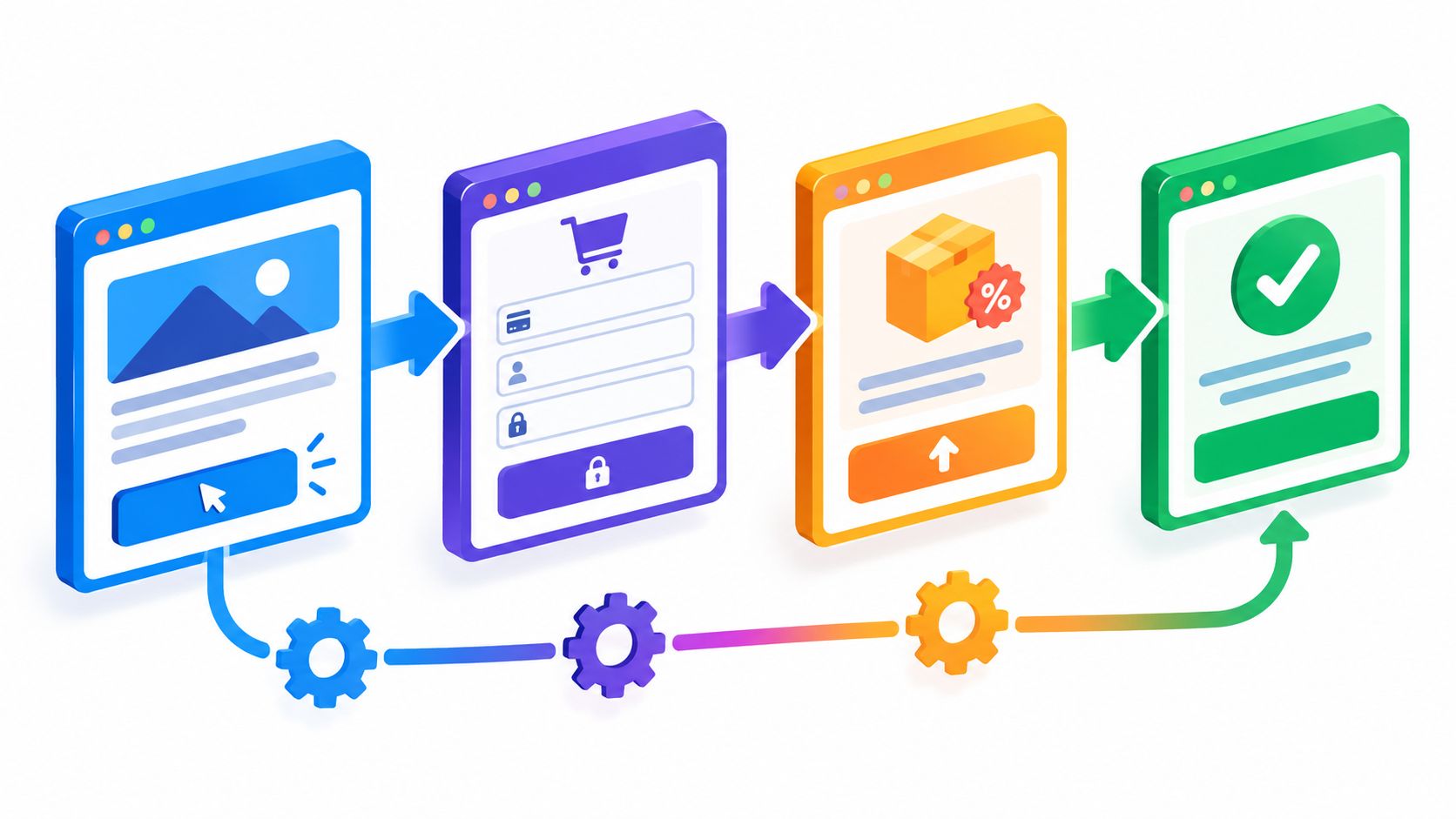
A funnel that launches in minutes can still lose nearly every visitor. One compiled B2B benchmark puts typical website visitor-to-lead conversion at just 1% to 3%, while lead-to-customer conversion averages 2% to 5%, meaning that 97% to 99% of initial traffic may disappear at the first stage. Ortto's funnel benchmark overview makes the uncomfortable point clear: the builder is only the opening spell. The actual work happens after launch, when teams test, measure, govern, and improve every step.
That's why an online sales funnel builder should be judged by more than attractive templates or how quickly it produces a landing page. The useful question is whether it helps you find leaks, run trustworthy experiments, recover abandoned purchases, and increase the value of the traffic you already paid to attract.
Think of the builder as a Web Mage's workshop. The pages are the visible spellbook, but the machinery underneath determines whether your funnel summons customers or merely produces another handsome website.
Table of Contents
- Why Funnel Builders Have Quietly Become Marketing Operating Systems
- From Town Criers to Funnels, A Brief History of the Customer Journey
- Anatomy of an Online Sales Funnel Builder and What Each Piece Does
- Prompt to Funnel, How AI Generation Is Rewriting the Builder Playbook
- The Optimization Loop That Actually Moves Revenue
- A One Sentence Funnel in Action, Building With Web Mage
- The Governance Question Most Funnel Builder Reviews Skip
- Choosing Your Online Sales Funnel Builder, A Practical Decision Guide
Why Funnel Builders Have Quietly Become Marketing Operating Systems
Online sales funnel builders have outgrown their original job. They used to resemble digital page assemblers, with a landing page editor on one side and a checkout form on the other. Modern systems increasingly connect the full customer journey, from traffic routing and lead capture to offer sequencing, payment recovery, post-purchase follow-up, and additional purchases.
That distinction matters because a funnel isn't a collection of pages. It's a chain of decisions. A visitor arrives from an advertisement, search result, email, or referral. They decide whether the promise feels relevant, whether the next step feels safe, whether the form asks too much, and whether the checkout experience deserves their trust. Software that only builds the pages leaves the operator to stitch together the rest with email tools, payment services, analytics platforms, and improvised spreadsheets.
The builder is now the control room
A capable platform can bring several operating layers into one workspace:
- Page creation: Landing pages, opt-in forms, sales pages, checkout screens, and thank-you pages.
- Journey automation: Email sequences, SMS reminders, tagging, lead scoring, and behavioral triggers.
- Revenue mechanics: Order bumps, one-click upsells, downsells, subscriptions, and payment recovery.
- Measurement: Attribution, stage-by-stage conversion rates, event tracking, and revenue-per-visitor analysis.
- Experimentation: Variant creation, traffic allocation, significance checks, and winner promotion.
- Content assistance: AI-generated copy, imagery, layouts, metadata, and personalization ideas.
The shift is less glamorous than “build a funnel instantly” makes it sound. Launch speed removes one bottleneck, but it doesn't solve weak positioning, slow pages, confusing offers, or unreliable tests. A beautifully generated funnel can still be a very efficient machine for losing prospects.
Operator's rule: Treat launch as the beginning of the funnel's working life, not the finish line.
The rest of the job is disciplined iteration. You need to know where visitors stop, why they stop, which changes deserve a test, and when the evidence is strong enough to ship a winner. That's where the Web Mage metaphor earns its keep. The wizard can conjure the workshop, but someone still needs to read the runes before opening the dragon's gate.
From Town Criers to Funnels, A Brief History of the Customer Journey
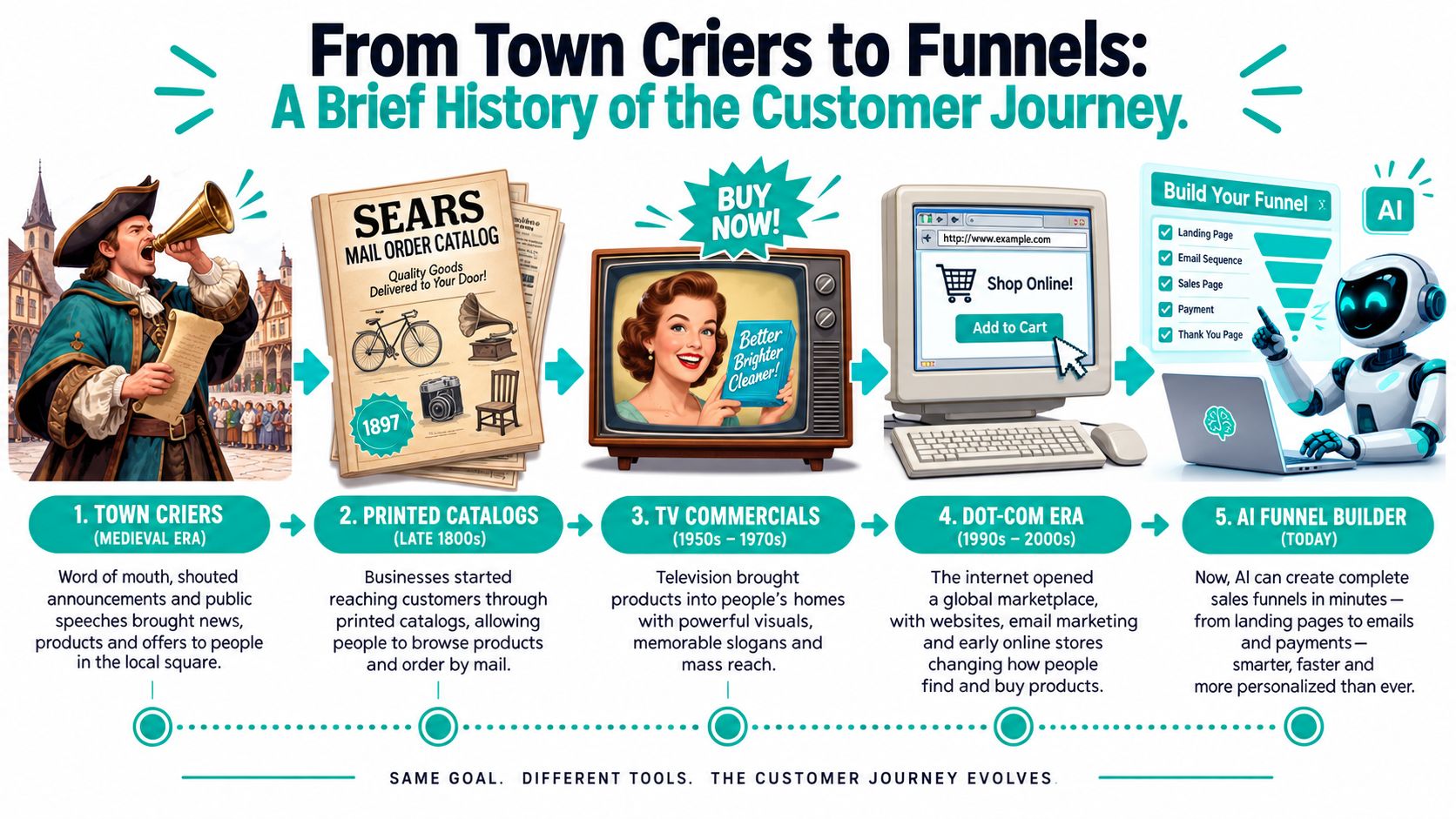
Long before landing pages, a town crier gathered attention in a crowded square. The offer was public, immediate, and broad. Later, printed mail-order catalogs carried carefully arranged promises into private homes, giving sellers more room to create interest, explain desire, and invite action.
The first formal spell in the modern funnel spellbook came from E. St. Elmo Lewis in 1898. His AIDA model described the customer journey as Attention, Interest, Desire, and Action. The model gave marketers a written sequence for moving a stranger from awareness toward a decision.
The old spell gained a funnel shape
The funnel metaphor was later combined with AIDA in 1924 by William H. Townsend, helping define the structure that modern online sales funnel builders still automate. The image is simple: many people enter at the top, fewer continue through consideration, and a smaller group takes action.
That structure survived every change in medium. Direct mail arranged its arguments in sequence. Sales letters stacked proof, objections, offer details, and calls to action. Digital autoresponders turned follow-up into a timed system. Later funnel platforms bundled landing pages, checkouts, and upsells into a single workflow.
The modern era adds a new layer. AI tools can generate the structure, copy, imagery, styling, and connections from a plain-language description. That doesn't erase the old AIDA logic. It compresses the construction process while making the operator's judgment more important.
A generated funnel still needs a clear promise at the attention stage, useful explanation during interest, credible reasons to want the offer, and a low-friction path to action. The magic is in the speed of assembly. The craft remains in deciding whether every stage earns the visitor's next decision.
Anatomy of an Online Sales Funnel Builder and What Each Piece Does
A funnel builder's interface can look like a row of cards and arrows. Underneath, each card represents a decision point where visitors either advance or leak. The right metric depends on the job of that stage, so teams shouldn't judge every page by the same conversion event.
| Funnel Stage | Page Type | Primary Job | Key Metric |
|---|---|---|---|
| Awareness | Landing page | Match the visitor's source and promise | Visitor-to-next-step rate |
| Lead capture | Squeeze page or opt-in form | Exchange a clear benefit for contact details | Form completion rate |
| Consideration | Sales page | Explain the offer and resolve objections | CTA click rate |
| Decision | Checkout page | Turn intent into a completed purchase | Checkout completion rate |
| Value expansion | Order bump or one-click upsell | Present a relevant additional offer | Offer acceptance rate |
| Recovery | Downsell or payment recovery flow | Give hesitant or failed buyers another path | Recovered purchase rate |
| Confirmation | Thank-you page | Confirm the action and direct the next step | Next-action rate |
| Delivery | Members area | Provide access and support retention | Activation or engagement rate |
Front-end pages create the path
The landing page earns attention from a specific source. A squeeze page narrows the goal to one exchange, often an email address or application. A sales page handles explanation, proof, objections, and the call to action. Checkout then has a different responsibility, reducing uncertainty while collecting payment and necessary customer information.
After purchase, the funnel can offer an order bump during checkout, a one-click upsell after the initial transaction, or a downsell when the primary offer isn't accepted. A thank-you page confirms what happened and can direct the customer toward onboarding, delivery, or a relevant next purchase. A members area completes the loop for courses, communities, and gated resources.
The hidden engines keep the pages connected
The visible pages are only one layer. Email automation and SMS can deliver reminders or follow-up based on behavior. Payment processing handles the transaction. CRM tagging records what the person viewed, submitted, bought, or ignored. Analytics attributes activity to sources and stages, while affiliate tracking assigns referrals to the right partner.
A/B testing belongs in the engine room too. It lets teams compare a controlled change, such as a headline or CTA, without confusing a new design with a new strategy. The purpose of the anatomy lesson is practical: if a funnel leaks at checkout, changing the hero image may be theatrical but irrelevant. Diagnose the stage before casting the fix.
Prompt to Funnel, How AI Generation Is Rewriting the Builder Playbook
Traditional builders give you ingredients. You choose a template, adjust the layout, write the copy, connect the form, configure the checkout, add the upsell, and test the links. That workflow suits marketers with design instincts, technical patience, and enough time to make every decision manually.
Prompt-driven systems change the starting point. A marketer can describe the offer, audience, tone, and desired journey in ordinary language. The system can then create a connected sequence rather than a single isolated page. The important shift isn't only that the sequence appears faster. It lowers the barrier for people who previously couldn't launch without a designer, copywriter, or developer.
| Capability | Traditional Builder | Prompt to Funnel AI |
|---|---|---|
| Starting point | Template or blank canvas | Plain-language description |
| Page creation | Manual layout and copy choices | Generated structure, copy, imagery, and styling |
| Journey wiring | User connects pages and integrations | System assembles the requested sequence |
| Editing | Drag, drop, resize, and rewrite | Chat-based instructions plus manual refinement |
| Best fit | Marketers with time and design confidence | Coaches, freelancers, founders, and product makers |
| Main risk | Slow assembly and integration gaps | Plausible but unverified assumptions |
Speed changes who gets to participate
A template approach rewards people who already understand layout hierarchy, form friction, offer architecture, and integration logic. It can provide control, but control becomes a burden when every page needs to be assembled from separate parts.
A prompt-to-funnel approach lowers the floor. A coach can describe a lead magnet and consultation flow. A course creator can request a sales page, checkout, bundle offer, and confirmation path. A freelancer can create a starting structure for a client before polishing brand details and compliance language.
Web Mage turns a descriptive sentence into a connected funnel with landing, checkout, upsell, and thank-you pages, alongside generated copy, imagery, and styling. That approach is discussed in more detail in how to build a website with AI.
The important caveat is that generated structure isn't automatically persuasive structure. AI can remove construction labor, but operators still need to inspect the offer, proof, claims, mobile layout, tracking events, and handoff between stages. The spell gets you into the tower. It doesn't tell you which staircase visitors will trust.
The Optimization Loop That Actually Moves Revenue
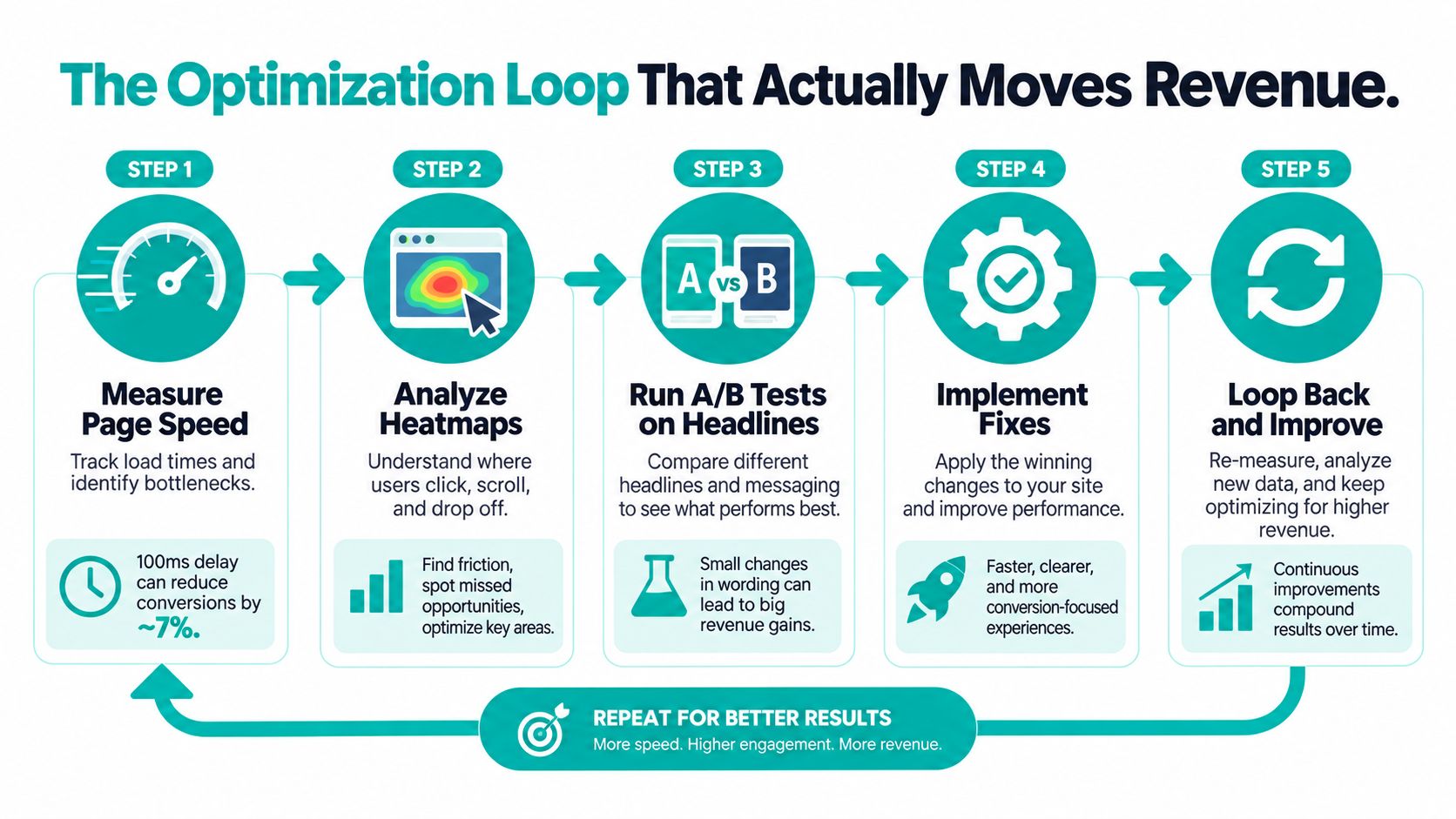
A funnel becomes valuable after traffic arrives. That's when the operator can observe friction, form a hypothesis, change one meaningful element, and measure what happened. The loop is simple in theory: test, measure, decide, redeploy. In practice, teams often skip the middle and declare victory because one dashboard number moved.
Start with speed. Landing-page benchmarks indicate that pages loading in 1 to 2 seconds convert about 2.5 times better than pages taking 5 or more seconds, and that each additional second of load time reduces conversion by roughly 7%. Searchlab's conversion optimization data explains why image compression, lazy-loaded media, and unused-script removal belong in conversion work, not just technical maintenance.
Faster pages protect the first decision
A slow page can lose a visitor before the headline, offer, or form has a chance to work. Measure the experience on the devices and connections your audience uses, then inspect the largest content element, asset weight, scripts, and interaction readiness.
Next comes experimentation. Standard funnel A/B testing compares two versions of the same page, changes one element, splits traffic randomly, and continues until the evidence reaches statistical significance. ClickFunnels' explanation of funnel testing describes that controlled workflow, while Crazy Egg's A/B testing guidance identifies 95% confidence, with α=0.05, as the common decision threshold.
Don't promote a winner because it has a higher conversion rate after a small burst of traffic. Estimate sample size from the baseline rate and minimum detectable effect, keep the variants exposed fairly, and account for the cost of a false positive. A test that stops early can turn random variation into a permanent page.
Analytics should create the next question
Track the events that correspond to each stage, including page views, form starts, form completions, checkout starts, purchases, upsells, and recovered payments. Then ask a narrow question: did the new headline improve qualified clicks, or did it attract curiosity that failed at checkout?
For a practical look at tools that support this discipline, see A/B testing tools for funnel optimization. The goal isn't a busier dashboard. It's a reliable flow from observation to decision, with each improvement based on evidence rather than dashboard confetti.
A One Sentence Funnel in Action, Building With Web Mage
A useful prompt might read: “Build a funnel for a live course that teaches freelance designers how to price their services, using a confident but approachable tone, with a course purchase, a bundle upsell, and a simple confirmation flow.”
From that sentence, Web Mage can generate a landing page with a headline, hero section, offer explanation, and CTA. It can also create the order form, add a bundle offer, and produce a thank-you page that directs the buyer toward the next relevant step.

The wiring matters more than the wizardry
The useful part isn't merely that several pages appear. The pages need to know where the visitor came from and what happened next. Form fields should persist between steps where appropriate. The checkout should pass the purchase state forward. The upsell should distinguish a buyer who accepted the bundle from one who declined it. The thank-you page should confirm the correct result rather than showing a generic message to everyone.
The same flow can attach pixel and email integrations to relevant events, so a form submission, purchase, or upsell acceptance becomes usable data. Analytics events then show whether visitors moved from the landing page to checkout, where they abandoned, and which offer path they followed.
A traditional workflow would divide the work across roles. A designer might shape the pages, a copywriter might develop the promise and objections, and a developer might connect forms, checkout, tracking, and redirects. Prompt generation compresses those handoffs into a starting system that an operator can review and refine.
The video below shows the broader idea of building a funnel from a plain-language description.
The generated funnel still needs human checks. Confirm that the course promise is accurate, the payment logic works, the bundle is relevant, the tracking fires once, and the copy sounds like the business rather than a generic spellbook. Examples of connected funnel work can be explored through Web Mage case studies.
The Governance Question Most Funnel Builder Reviews Skip
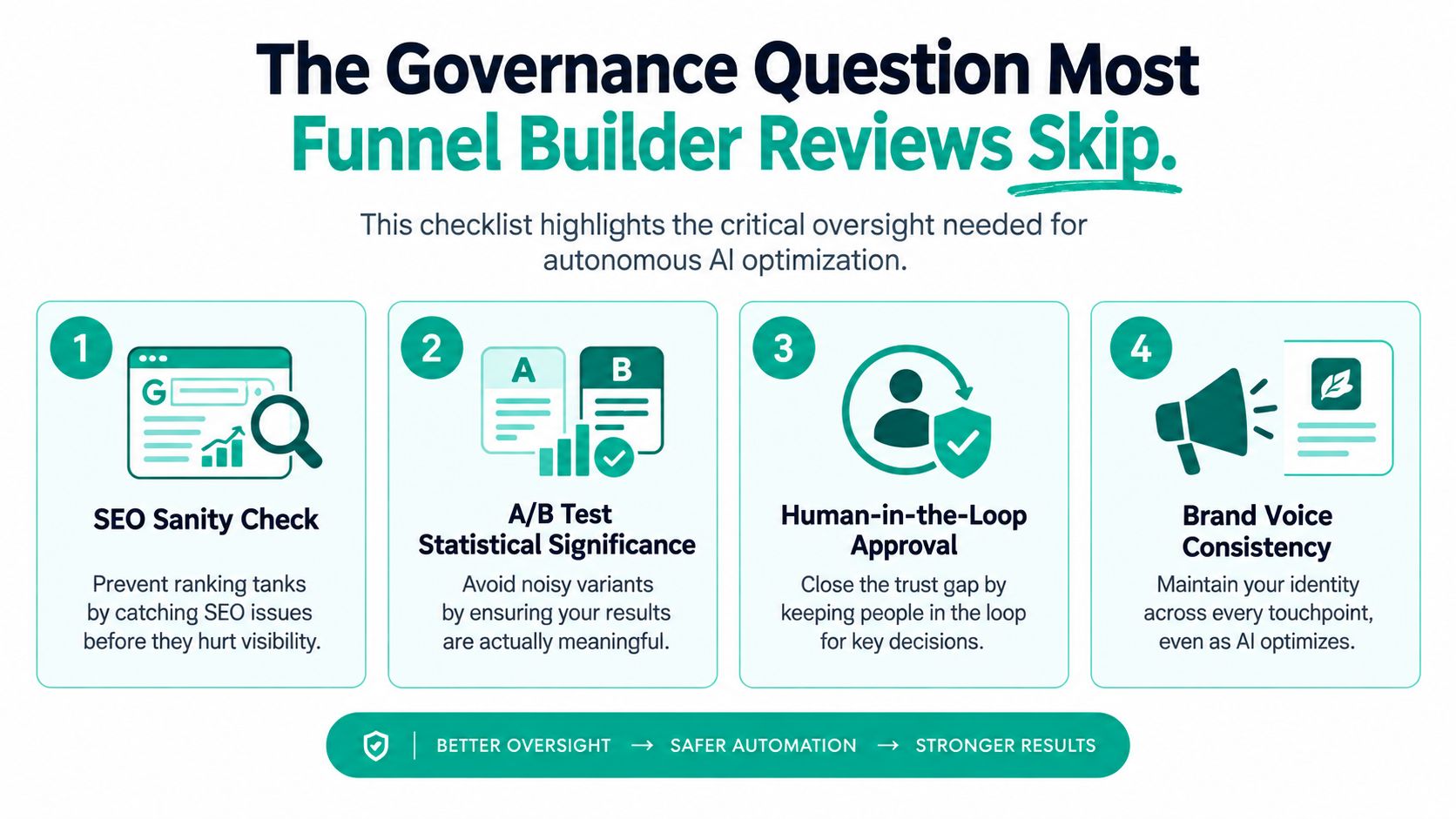
Autonomous optimization sounds wonderful until an automated change affects a page that ranks, a paid campaign that spends, or a checkout that customers trust. Speed is useful, but speed without permission boundaries turns a copilot into an unsupervised apprentice with access to the treasury.
Three risk surfaces deserve attention. First, an automated SEO rewrite can remove the intent signals that made a page useful, even if the new metadata sounds polished. Second, an A/B system can promote a noisy variant when the sample is too small. Third, analytics can mistake correlation for lift, especially when traffic sources, seasonality, offer changes, and audience quality move at the same time.
Guardrails for the resident agents
A practical governance policy can stay lightweight while still protecting the important surfaces:
- Require human approval: Copy changes on indexable pages, pricing pages, regulated claims, and core brand messaging should wait for review.
- Document experiment thresholds: Record the baseline rate, minimum detectable effect, sample-size logic, and confidence threshold before promotion.
- Separate recommendations from deployments: Let the system identify a likely fix without granting it permission to publish every change.
- Compare forecast with reality: Review predicted lift against actual conversion, revenue, lead quality, and refund behavior on a regular schedule.
- Keep a rollback path: Store previous versions, preserve experiment history, and make reversal simple when a change harms performance.
The point isn't to ban automation. Manual review can also miss broken links, ignore mobile problems, and allow weak pages to run unchanged. Governance gives automation a boundary, an audit trail, and a definition of “good enough.”
Trust test: If you can't explain why the system promoted a variant, you aren't ready to let it spend more traffic on that variant.
A funnel builder becomes a dependable marketing operator when it knows what it may change, what it must ask permission to change, and what evidence it must provide afterward.
Choosing Your Online Sales Funnel Builder, A Practical Decision Guide
Begin with a short triage. Do you need one campaign, or a repeatable system for multiple offers and audiences? Do you need only a landing page, or do you also need checkout, recovery, upsells, CRM events, and post-purchase delivery? The answer should shape the platform before a flashy feature list does.
Then test the builder against the work that happens after launch.
| Criterion | What to Test | Pass Signal |
|---|---|---|
| Page speed | Publish a representative page and inspect its mobile experience | The page feels responsive and gives you useful performance diagnostics |
| Split testing depth | Create a single-variable experiment and inspect its controls | Traffic allocation, significance, and stopping rules are visible |
| Checkout and tax handling | Run a complete test purchase, including the intended offer path | Payments, taxes, receipts, redirects, and recovery behave predictably |
| Integration coverage | Connect email, analytics, CRM, and advertising events | Data arrives with clear event names and usable contact context |
| Optimization governance | Review approvals, version history, thresholds, and rollback options | Automation has guardrails instead of unrestricted publishing access |
Look for evidence, not feature confetti
Landing-page benchmarks offer useful context, but they aren't promises for your business. Unbounce's Q4 2024 dataset analyzed 41,000 landing pages, 464 million visitors, and 57 million conversions, reporting a 6.6% median conversion rate across industries. Its reported industry medians ranged from 3.8% in SaaS to 12.3% in some sectors, while top-quartile pages exceeded 11%. The benchmark summary shows why context matters: a platform should help you learn from your own audience rather than encourage blind comparison.
A second benchmark places average landing-page conversion at 2.35%, with the top quarter at 5.31% or higher and the strongest pages at about 11.45% or more. This sales funnel benchmark collection reinforces the size of the gap, but the useful buying question remains operational: can the builder help you identify and close your specific leaks?
Use this checklist before committing:
- Publish a realistic page, not just a demo template.
- Test the complete path from first visit through purchase and follow-up.
- Run one controlled experiment and inspect its evidence.
- Review what the system can change automatically.
- Confirm that you can export, audit, and roll back important work.
The fastest way to understand the difference between a page assembler and an autonomous marketing operator is to describe a one-sentence funnel, inspect what gets generated, and then challenge every connection before sending real traffic.
Web Mage creates complete websites and connected funnels from plain-language prompts, including pages, copy, imagery, styling, checkout, upsell, and thank-you steps. Try describing your own offer and visit Web Mage to see whether its automated approach fits the way you want to build and optimize.