
The cheapest affordable website builder is often the worst spell in the book. A low sticker price can hide renewal jumps, extra fees, clunky upkeep, and missing basics like hosting or SSL, so this roundup weighs real buying decisions instead of chasing the tiniest number. I'm comparing seven builders by launch speed, included services, scaling limits, customization, and how much maintenance they leave on your plate, with Web Mage as the automation-heavy option for readers who want pages, funnels, and optimization handled by AI familiars. Pricing language here stays careful, because what matters is the supplied plan price, billing term, credits, and plan-dependent features, not a made-up “best deal” fairy tale.
Table of Contents
- 1. Web Mage
- 2. WordPress.com
- 3. Hostinger Website AI Builder
- 4. Strikingly
- 5. Tilda
- 6. Dorik
- 7. Carrd
- Top 7 Affordable Website Builders Comparison
- Choose the Builder That Fits Your Quest
1. Web Mage
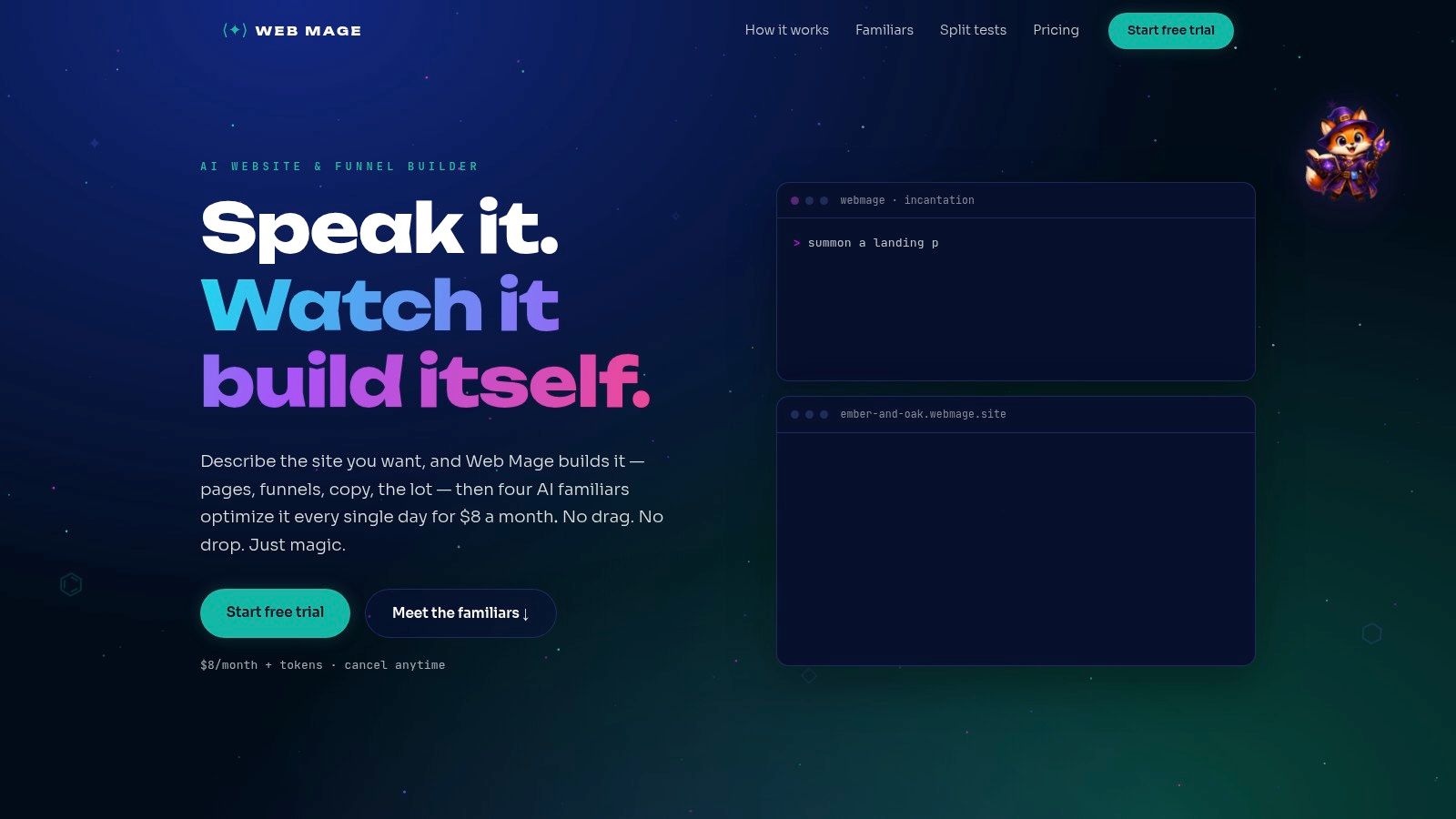
Web Mage is the pick for anyone who wants the mage, not the toolbox. You give it plain-language direction, and it generates launch-ready pages, copy, images, styling, and wired funnels without making you wrestle a blank canvas. That matters because the market already has plenty of template builders, but very few that try to automate the whole opening spell from prompt to published page.
The pricing is simple and aggressive. The plan is $8/month, and it includes 500 monthly credits, managed hosting, SSL, and a .webmage.site subdomain. Bought credits never expire, and 1,000-credit top-ups cost $20, which is the kind of structure that rewards occasional heavy work without punishing the quiet months.
Practical rule: If you need a site that keeps improving after launch, don't compare Web Mage to a static builder. Compare it to the hours you'd spend on SEO cleanup, speed tuning, analytics review, and split testing.
Its four resident familiars do the maintenance work most builders ignore. SEO Seer handles metadata, broken links, and keyword discovery, Speed Sprite compresses images and prunes bloat, Analytics Oracle watches behavior and drop-off, and Conversion Alchemist drafts A/B variants and promotes winners automatically. That makes it a strong fit for solo founders, agencies, course creators, and growth teams that care about launch speed and ongoing optimization, not just getting something live.
The trade-off is control. If you need a pixel-perfect drag-and-drop workflow, Web Mage will feel less like a craft studio and more like a clever familiar doing the heavy lifting. For teams that want prompt-to-page creation, nightly upkeep, and automated testing in one flat plan, that trade is worth it.
2. WordPress.com
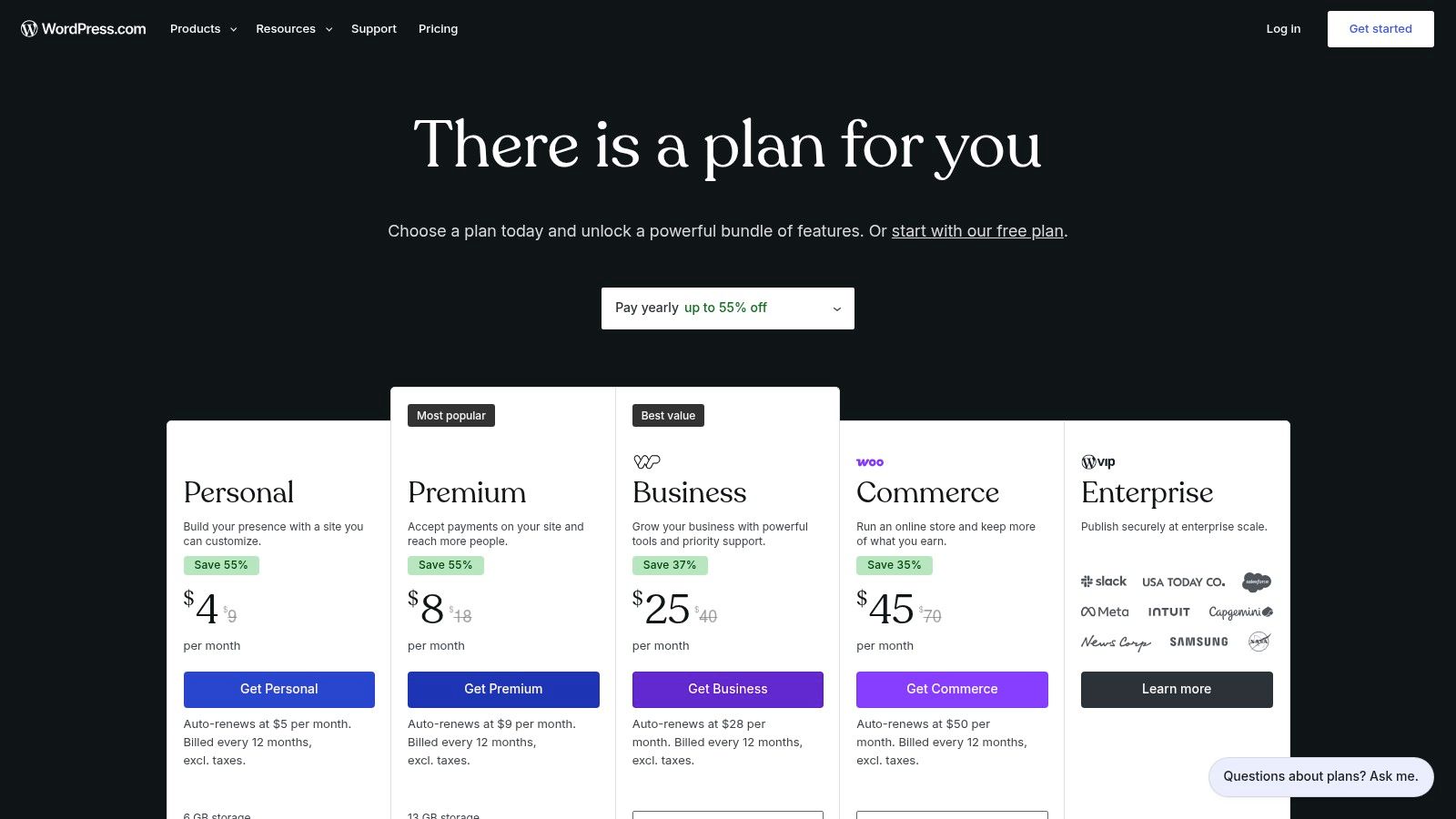
WordPress.com is the safest choice if you want to start simple and keep the door open to bigger things later. It gives you a guided builder, a large theme library, built-in stats, backups, and SSL, so you're not piecing together a site with a bunch of separate charms. For blogs, business sites, portfolios, and stores that may grow into something more serious, it's a practical middle path.
The big draw is flexibility without jumping straight into technical chaos. Premium and higher plans open the door to plugins, and that's where WordPress.com starts to look less like a starter wand and more like a full wizard's kit. If you want room to expand into more advanced functionality, this ecosystem is hard to beat.
A few details matter for buying decisions. The platform includes a free domain for year one on paid plans, and its guided setup can be especially useful if you don't want to assemble every page from scratch. The catch is that plugin access and ecommerce capability sit behind higher tiers, so the “cheap” plan can become a stronger bill once your site needs real growth features.
WordPress.com is the right spell when you want a mainstream platform that can grow with you without forcing a rebuild.
This is the builder for people who value long-term flexibility over clever automation. It won't feel as magical as Web Mage's prompt-driven flow, but it does offer a mature path from simple site to more advanced website operations. For publishers, consultants, and small businesses that expect their site to evolve, that ecosystem depth carries the actual value.
3. Hostinger Website AI Builder
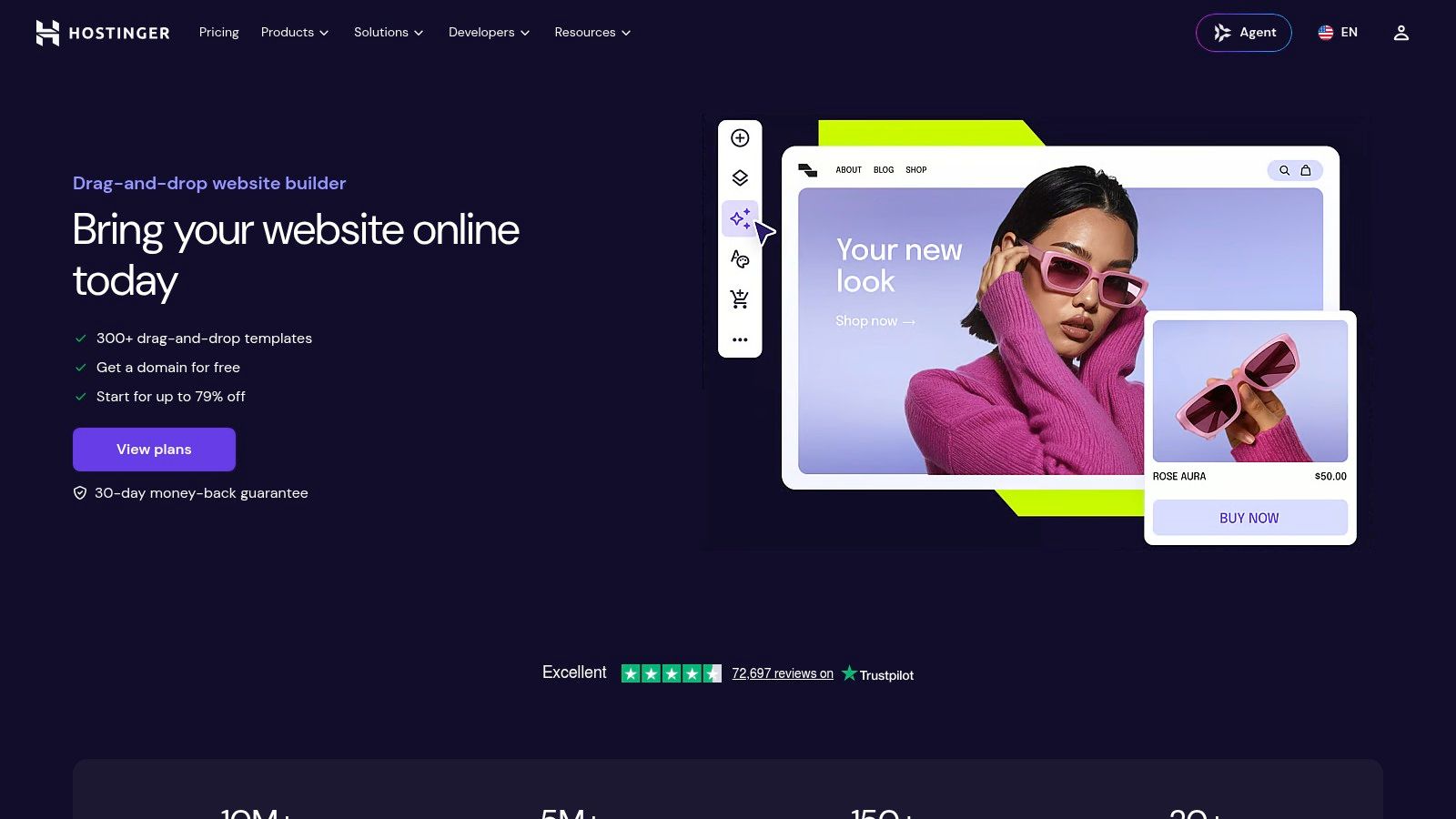
Hostinger is the familiar you pick when you want one vendor to handle the messy plumbing. It bundles the builder, hosting, SSL, and a domain credit on longer terms, which keeps the setup tidy for small businesses that don't want to juggle separate services. If your priority is low ongoing friction, that all-in-one structure is the main draw.
Its editor gives you both manual and more agentic modes, so you can build quickly without giving up the ability to tweak the result. The builder also includes ecommerce support, an AI SEO assistant, and AI heatmaps, which makes it more than a basic brochure-site spell. For small marketing sites and straightforward SMB projects, that combination is strong value.
The cost story is why people look at Hostinger first. Independent cost coverage says builder plans commonly bundle hosting and SSL in one subscription, and low-cost plans often sit in the same general range as cheap hosting plus separate tools, which is exactly the kind of simplification buyers want. Hostinger's own model leans into that by making the vendor stack feel less fragmented than piecing together separate services.
For readers who want a deeper breakdown of how bundled hosting changes the value equation, Web Mage's guide to website builders with hosting is a useful companion read. It reinforces the same point, bundled hosting can be the difference between a tidy bill and a messy one.
Hostinger is best for people who care about predictable management more than limitless extensibility. It's not the most open ecosystem in the market, but it is a sensible, low-drama choice for small businesses that want to launch quickly and keep operations simple. If you want the cheapest-looking plan to stay cheap in real life, Hostinger deserves a close look.
4. Strikingly
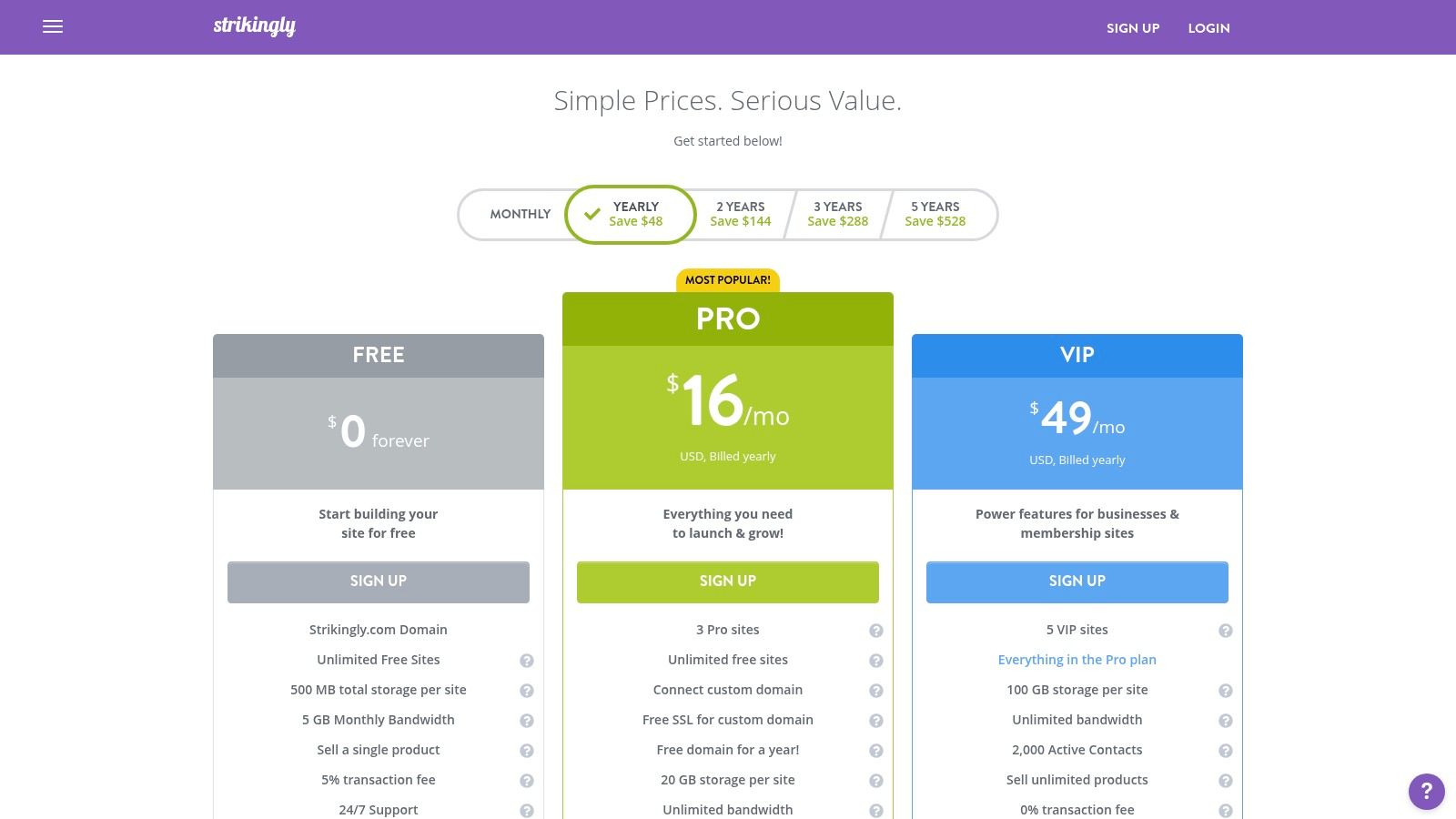
Strikingly is the speed spell. It's built for landing pages, personal sites, and simple shops, and it gets you from idea to published page without a lot of ritual. If your main job is to look polished quickly, the platform does that with minimal fuss.
The pricing model is straightforward enough to suit a solo founder's budget. Managed hosting and SSL are included, paid plans can include a free domain for year one, and the higher tiers add things like memberships, larger catalogs, newsletters, and live chat. The key detail is that the platform keeps the launch process simple while still giving you room to grow a small shop or membership site later.
Its strongest advantage is the speed of the build. You can get a good-looking site live fast, and the mobile layouts are strong out of the box, which matters when most of your traffic is likely to care more about the phone than the desktop tower on your desk. The downside is that design depth is limited compared with more advanced editors, so this is not the place for pixel-perfect layout experimentation.
Bottom line: Strikingly is for people who need a site that looks clean today, not a design system they'll keep reworking for months.
There's a ceiling to be aware of. Lower plans cap page counts, and sales can carry a platform fee on some tiers, so the “cheap” option is best for compact sites with simple goals. If you want a fast, tidy, low-maintenance web presence and don't need elaborate design sorcery, Strikingly is an easy recommendation.
5. Tilda
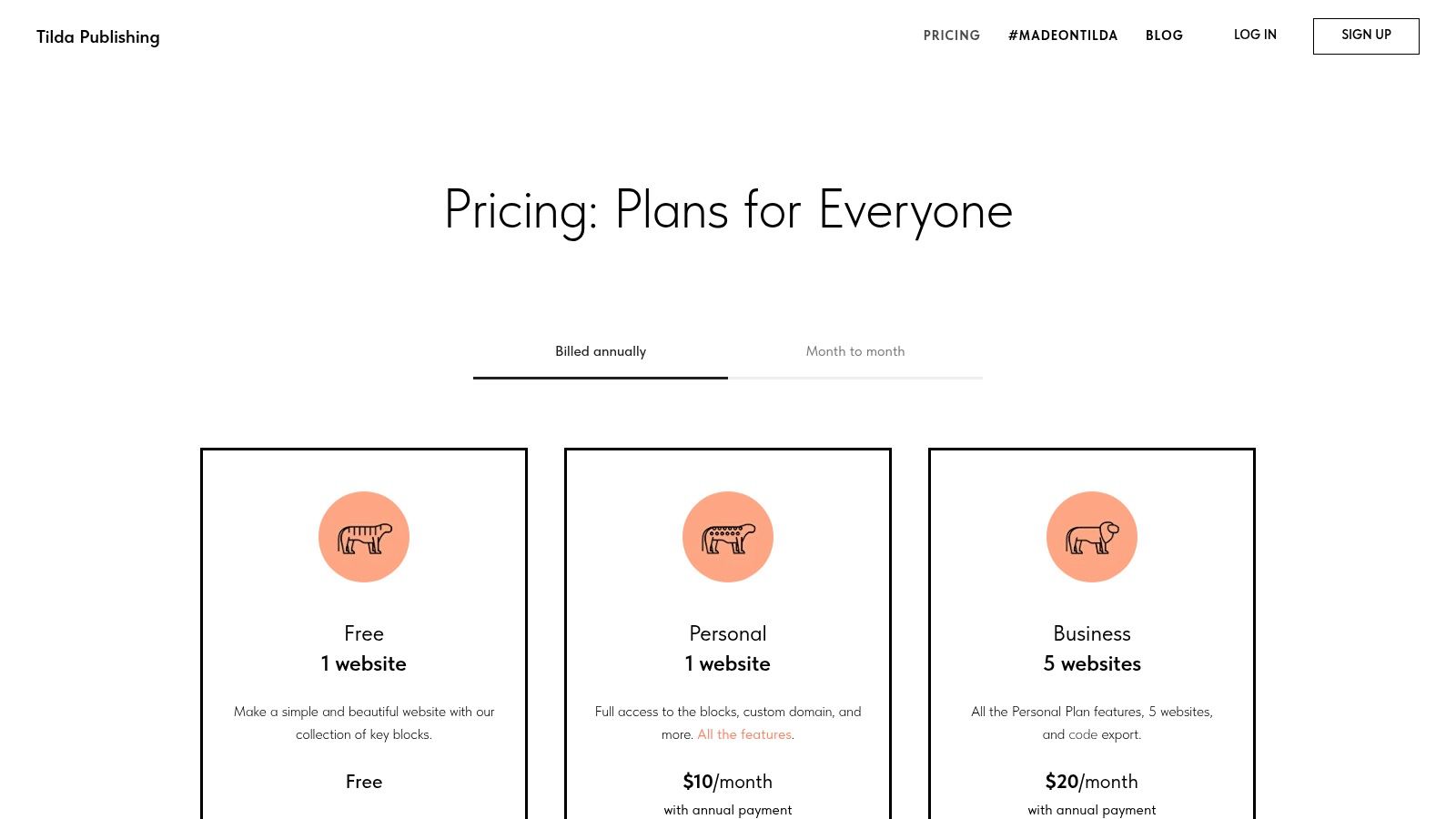
Tilda earns its place through design control, not the lowest sticker price. Its block system is easy to learn, while Zero Block lets you shape layouts far beyond standard sections. That makes it a strong choice for landing pages, portfolios, and content sites that need a deliberate visual identity.
The feature set reaches beyond a basic brochure builder. Built-in ecommerce, CRM, email campaigns, and memberships support more serious projects, while the AI website builder and SEO tools speed up setup. For a deeper look at visual builders without code, see Web Mage's no-code website builder guide.
Launch speed is another advantage. Tilda's structured blocks reduce production and maintenance work, especially when a site needs polished pages rather than constant technical changes. Before choosing a plan, check which hosting and SSL provisions are included, along with any ecommerce transaction costs and limits on the features you need. Those details determine the actual cost more than the headline subscription.
Tilda also offers an escape route if the project outgrows the platform. Code export on the Business plan supports a later move to another hosting setup, and annual plans can remove Tilda branding. That flexibility matters to freelancers, creators, and small businesses planning a handoff or a longer project life.
The trade-off is a smaller app ecosystem than the largest platforms. You get visual precision and a tidy workflow, not an endless catalogue of integrations. If your site should look carefully composed and deliberate, Tilda is a smart pick. If it must become an all-purpose platform with every possible plugin, choose a broader system instead.
6. Dorik
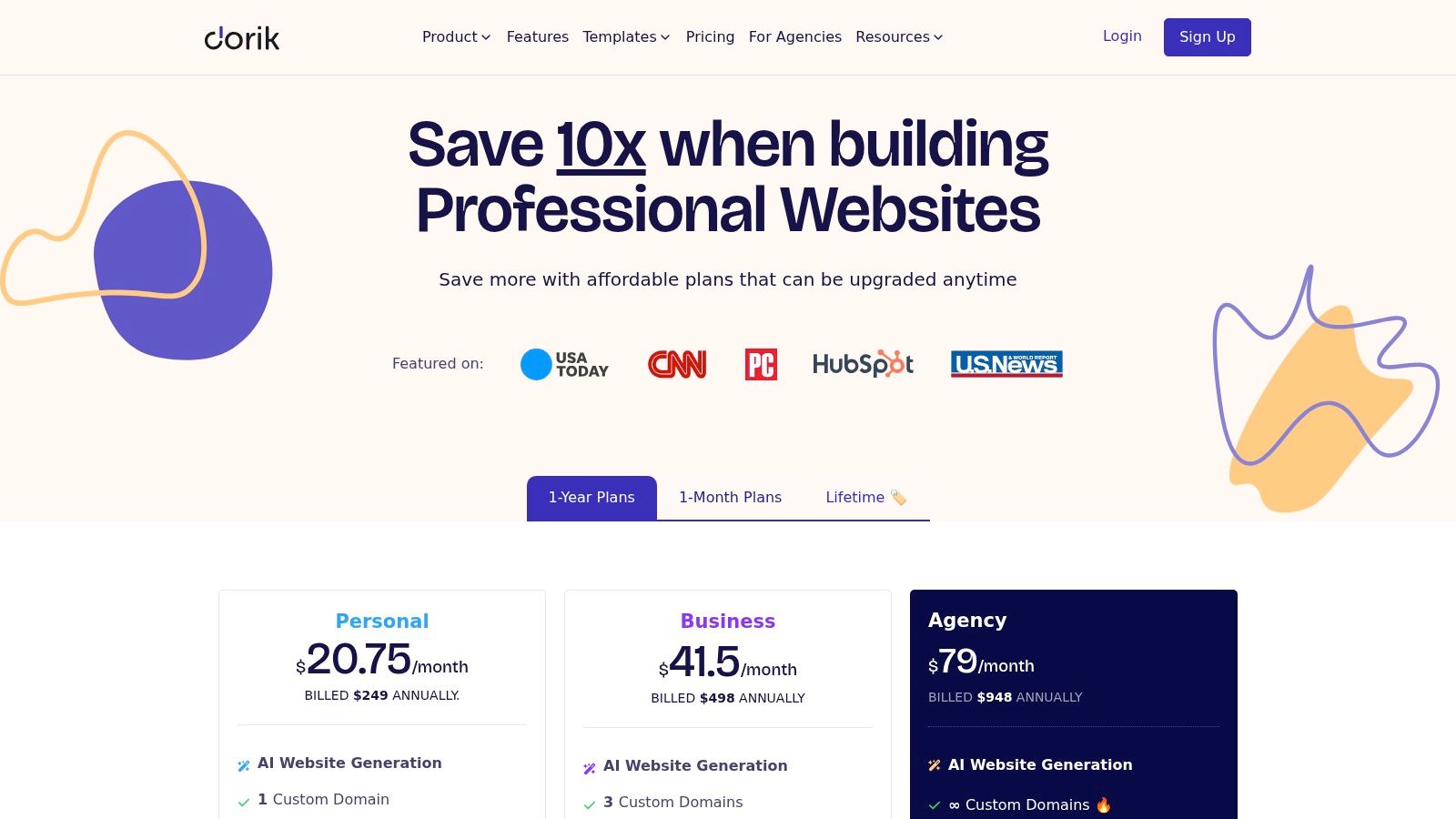
Dorik is the lean, practical goblin of the group, and that's a compliment. It focuses on simplicity, budget control, and agency-friendly tooling, which makes it a strong fit for freelancers, small studios, and people who build a lot of modest sites. If you don't want bloat, Dorik keeps the spell ingredients lean.
Its AI site generation and starter layouts make it easy to get moving, and the CMS, blog importers, redirects, and SEO controls give it enough substance for real business use. White-label options and client billing are the standout features for agencies, because they let you package the builder as part of your own service instead of sending clients off to a separate system.
The platform's appeal is especially strong when you care about predictability. Unlimited pageviews and storage across plans remove some of the usual anxiety around small-site growth, and the clean editor keeps the performance profile simple. That's a sensible bargain for teams that want to build, ship, and move on.
Agency rule of thumb: If a client needs a simple site, a blog, and a clean handoff, Dorik is enough. If they need complex ecommerce or deep integrations, move up the ladder.
The limits are just as clear. Ecommerce and broad integrations are thinner than what you'd get from larger suites, so this isn't the right spell for a sprawling online store. Dorik is best when the job is clean, fast, and controlled, and when the person paying the bill cares more about value than glamour.
7. Carrd
Carrd is the cheapest practical wand in the pile, and it knows exactly what it is. It's built for one-page sites, link-in-bio pages, MVP validation, event pages, and fast lead capture, which means it does one job brilliantly instead of trying to be everything at once. If you need a compact web presence, Carrd is ruthless about keeping things simple.
The editing experience is easy to understand, and the build-to-publish time is very fast. Pro features add custom domains, forms, embeds, and analytics, but the core appeal stays the same, minimal effort, small footprint, clean mobile-first design. That's why Carrd is such a strong fit for founders testing an offer or creators who need a polished landing page without the usual fuss.
The ceiling is obvious, and that's part of the appeal. Carrd doesn't try to sell you a bloated multi-page architecture, and it doesn't pretend to be a native ecommerce engine. If you need a serious multi-page site, move on. If you need a one-page launch pad that does its job without a drama troupe of extra features, this is the right familiar.
You can also use it as a fast companion to larger product launches. For example, a course creator can use Carrd for a webinar sign-up page, then hand the heavier content over to a bigger platform later. For that specific use case, it's hard to beat.
Web Mage's startup builder guide is a good next stop if you're deciding between a bare-bones page and a more automated launch system. Carrd is the simplest answer, but not always the most scalable one.
Top 7 Affordable Website Builders Comparison
| Product | Implementation complexity | Resource requirements | Expected outcomes | Ideal use cases | Key advantages |
|---|---|---|---|---|---|
| Web Mage | Very low, plain-language prompts, minimal manual editing | $8/mo plan includes hosting+SSL + 500 credits; optional credit top-ups | Fast launch (minutes), continuous nightly SEO/perf improvements, automated A/B wins | Solo founders, small businesses, growth teams needing rapid funnels | AI-first generation, autonomous SEO/speed/analytics/conversion agents |
| WordPress.com | Moderate, guided builder but can grow complex with plugins | Tiered pricing; plugins/ecommerce require higher plans; hosting included | Broad scalability from blogs to full-featured stores and custom sites | Blogs, business sites, portfolios, WooCommerce stores | Mature ecosystem, massive plugin/theme library and community |
| Hostinger Website/AI Builder | Low to moderate, AI flow plus drag-and-drop editing | Bundled hosting, SSL, email and domain credit; best rates on multi-year plans | Quick AI-assisted setup with solid basic performance for SMBs | Small businesses wanting one-vendor hosting + builder | Strong value for money and integrated hosting bundle |
| Strikingly | Very low, template-driven, fastest for single pages | Free tier; managed hosting included; Pro/VIP for larger stores/features | Very rapid mobile-first landing pages and simple shops | Landing pages, personal sites, small catalog shops | Fast launch, mobile-optimized layouts, simple pricing |
| Tilda | Moderate, block system with Zero Block for precise control | Paid plans for code export and advanced features; includes ecommerce/CRM | High visual fidelity and landing-page quality; exportable code on business plan | Designers, portfolios, conversion-focused landing pages | Strong visual control without heavy coding, code export option |
| Dorik | Low, clean editor with AI generation and starter layouts | Budget pricing; unlimited bandwidth/storage; white-label options | Lightweight, fast business sites and simple portfolios | Freelancers, agencies, small client sites | Very low cost, white-label/client-billing, simple performance profile |
| Carrd | Very low, purpose-built one-page builder | Ultra-low cost; Pro unlocks custom domains, forms and embeds | Extremely fast one-page launches for MVPs and link-in-bio pages | Single-page landing pages, event pages, simple lead capture | Lowest TCO for one-pagers, fastest build-to-publish time |
Choose the Builder That Fits Your Quest
Carrd is the right call for a focused one-page launch, especially when you care about speed and cost more than depth. Strikingly fits fast simple sites where you want a clean result without heavy design work. Tilda is the pick for visual control, Dorik is the smart move for freelancers and agencies, Hostinger is the bundled SMB value play, WordPress.com is the ecosystem beast, and Web Mage is the prompt-driven choice for pages, funnels, autonomous optimization, and integrated testing.
The core test isn't which builder has the flashiest home page. It's whether the site type matches the tool, whether the number of pages and commerce features are enough, whether the commitment and fee structure stay sane after renewal, whether hosting and SSL are included, and whether the maintenance burden will turn your cheap plan into an expensive headache.
If you need a quick rule, use this one. Buy the builder that reduces the most painful work you'd otherwise do by hand. For some teams, that means a simple one-page wizard. For others, it means an automated familiar that keeps tuning SEO, performance, and conversion after launch.
Web Mage is built for people who want more than a live website. It turns prompts into pages and funnels, then keeps improving them with built-in optimization agents so your site doesn't go stale the moment it ships. If you're comparing an affordable website builder by total value, not just sticker price, visit Web Mage and see whether the magic fits your next launch.