
Your agency's day starts the same way every week. A strategist is chasing briefs, a copywriter is juggling ad variants, someone else is rebuilding a landing page, and the account lead is asking for a report that won't embarrass anyone in client review. The strongest ai tools for marketing agencies are not the flashiest ones, they're the ones that remove a real bottleneck without weakening brand control, factual review, measurement, or creative judgment.
That's why the right stack looks less like a wand closet and more like a spellbook with different charms for different jobs. Some tools are built for strategy and SEO, some for governed copy, some for ad creative at scale, some for landing-page conversion, and some for personalization or autonomous optimization. The magic trick is choosing the right creature for the right dungeon.
For a quick field guide, I'm looking at each tool through the lens that matters in agency life, best use case, workflow fit, limitations, pricing or credit model, and how much of the job is automated. Web Mage leads because it's the closest thing here to a full launch-and-improve spell. The rest earn their keep by handling a specific stage of the client journey well enough to save time without creating chaos.
Table of Contents
- 1. Web Mage
- 2. Jasper
- 3. Copy.ai
- 4. Anyword
- 5. AdCreative.ai
- 6. Unbounce
- 7. Surfer
- 8. MarketMuse
- 9. Mutiny
- 10. Writer
- Top 10 AI Tools for Marketing Agencies, Comparison
- Choose the Spell That Fits Your Workflow
1. Web Mage
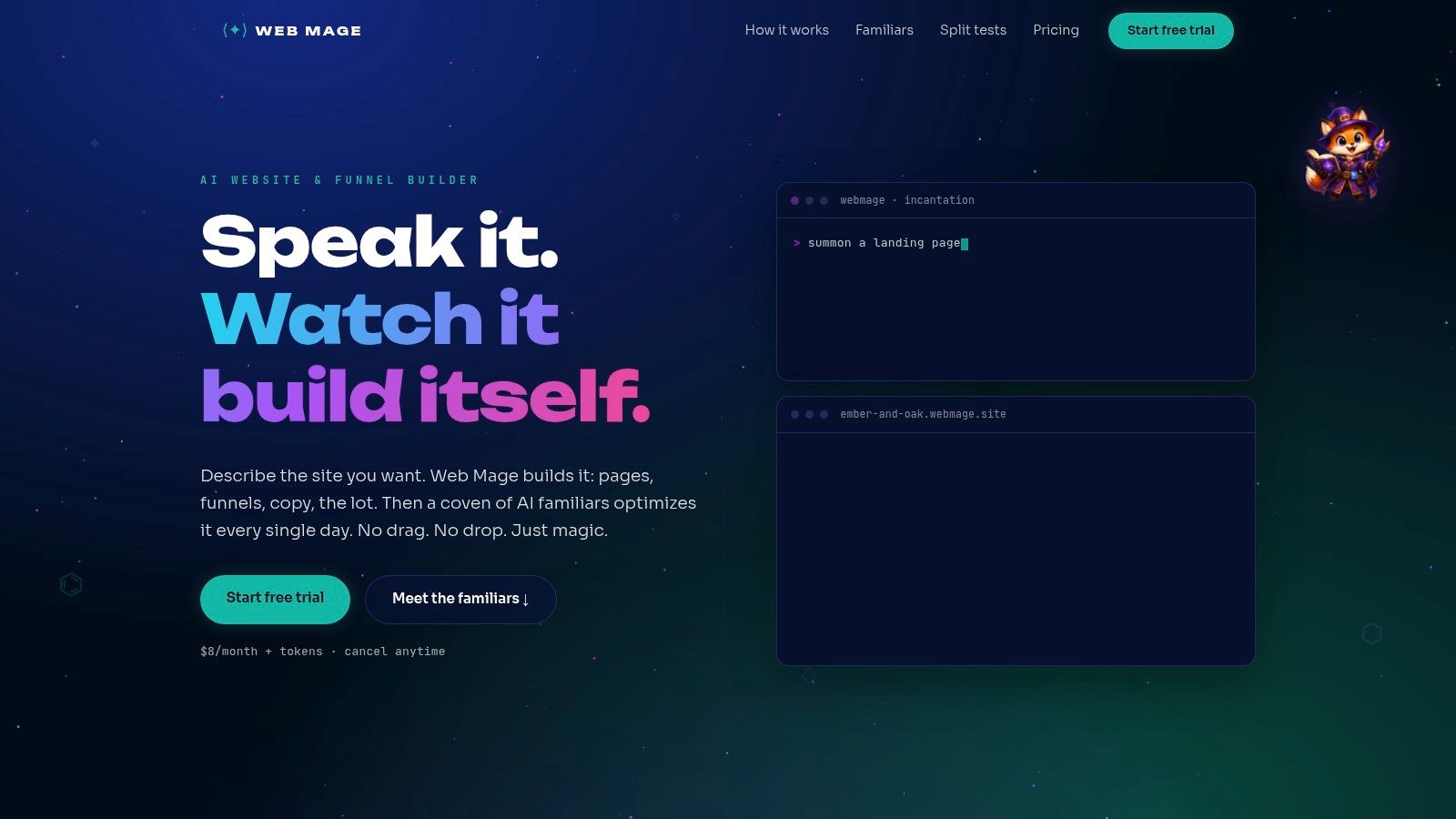
A client needs a funnel by Friday, the designer is booked, the developer is unavailable, and the copy is buried in a document full of unresolved comments. Web Mage addresses that bottleneck by turning a plain-language prompt into a complete page or multi-step funnel, including structure, copy, images, styling, and post-launch optimization.
Why it fits an agency workflow
The value extends beyond initial page generation. Web Mage can connect a landing page, checkout, upsell, and thank-you flow, then use autonomous agents to monitor SEO, speed, analytics, and conversions after launch. Its performance examples report LCP improving from 2.4s to 1.1s, pricing-page CTR rising by 18%, and conversions increasing by 11% from promoted variants (Web Mage performance examples). Those results are the kind of evidence an agency can bring into a client review, although each account still needs its own measurement plan.
The pricing model is straightforward for a launch platform: $8/month, 500 monthly credits, a 14-day free trial with no card required, and top-ups of 1,000 credits for $20. Credit planning matters. A full page can use about 60 credits, while a full funnel can use about 300. SEO reviews, analytics checks, and split tests also draw from the available balance, so agencies should estimate activity across the whole client portfolio rather than judging the subscription by its headline price.
Practical rule: Choose Web Mage when a client needs rapid launch, ongoing testing, and fewer handoffs between production and CRO.
The trade-off is control. Pixel-perfect bespoke design, unusual third-party integrations, and specific custom-domain hosting requirements should be verified before committing the workflow to the platform. Agencies with a highly specialized development process may still need separate tools or engineering support.
For lean teams, the operational benefit is clear. Prompts can produce a launch-ready page or funnel in minutes, while nightly agents can handle SEO rewrites, broken links, asset compression, and lazy-loading. Built-in split testing can create variants, allocate traffic, and promote winners automatically. Hosting, SSL, and a .webmage.site subdomain are included, keeping the launch stack compact while the team handles strategy, approvals, and quality control.
Website: Web Mage
2. Jasper
When an agency manages multiple brands, the biggest challenge is not writing words, it's keeping those words on-brand without creating a governance circus. Jasper is built for that kind of controlled chaos. It gives teams brand voice controls, style guides, visual guidelines, collaboration features, and a no-code automation layer, which makes it a stronger fit for organized marketing departments than for freelancers who just want a quick paragraph generator.
Where Jasper earns its robe
The platform's appeal is consistency across clients. If one account needs a formal tone, another wants a playful brand voice, and a third has legal guardrails, Jasper's governance features are the point. It's also built around multi-model routing through the Jasper AI Engine, so agencies aren't locked into one flavor of text generation when a workflow needs flexibility.
The practical upside is that teams can standardize briefs, campaign copy, and content variants without every writer improvising their own style rules. That matters when the account team is promising “brand-safe scale” and the creative team knows what that promise usually costs.
Governance is the feature that saves agencies from redoing work at 11 p.m. because a client hated the tone.
The limitation is that Jasper behaves like a heavier platform. Advanced automation and agent capabilities sit behind higher business tiers, and that means onboarding time, training, and internal process design. It's not the tool you grab for a one-off campaign asset. It's the tool you adopt when a portfolio of clients needs a repeatable machine for on-brand content.
Website: Jasper
3. Copy.ai
Some agency work is less about writing from scratch and more about turning a messy internal process into a reusable machine. Copy.ai is useful because it has moved beyond copy generation into a workflow and automation layer, with no-code workflows, Actions for research and generation, forms, API access, permissions, and teamspaces.
Best when you need SOPs, not just sentences
For agencies, that means you can codify repeatable jobs. A client intake form can trigger research, enrichment, or categorization. A content request can move through a workflow instead of bouncing between Slack, email, and someone's memory. That's the kind of magic that effectively scales, because it doesn't depend on one person knowing where all the bones are buried.
The catch is credit management. Complex workflows consume more credits, so this is a tool that rewards operational discipline. If your team throws every odd task into one giant pipeline, the billing can get fuzzy fast. It also works best when someone on the agency side takes time to design the workflow properly instead of expecting the platform to rescue a broken process.
This internal guide on landing page copy generation pairs well with Copy.ai because both reward structured inputs rather than vague wishes. One helps you systematize the words, the other helps you systematize the process.
Agency truth: If the workflow isn't written down, software won't save it. It'll just expose the mess faster.
Website: Copy.ai
4. Anyword
Paid media teams love certainty, or at least the illusion of it. Anyword is attractive because it adds predictive scoring to the copy workflow, helping agencies compare ad, landing-page, email, and social variants before clients commit to a direction. That makes it especially handy when a strategist needs to explain why one line is stronger than another without falling back on vibes and caffeine.
Why predictive scoring changes the client conversation
Anyword's scoring layer gives a practical framework for decision-making. Instead of presenting three equally polished lines and hoping the client “feels” the best one, you can show a data-informed recommendation and keep the conversation focused on why that variant should win. The Chrome extension and brand voice templates also make it easier to work inside the tools a team already uses, rather than forcing a separate creative ritual.
The limitation is obvious to any operator who has shipped campaigns before. Predictive scores are useful, but they're not a guarantee, and they should be validated against each account's data and audience behavior. Higher-tier features also come with more expensive plans, so this is a tool you justify when the team needs a reliable way to prioritize copy ideas, not when someone just wants another writing toy.
If your agency sells “we'll pick the variant most likely to work” as part of the service, Anyword gives you a cleaner story. It turns copy review from a debate into a process.
Website: Anyword
5. AdCreative.ai
When an account manager says, “We need more ad variations by tomorrow,” the design team usually hears a small thunderclap. AdCreative.ai is built for that exact storm. It generates ad images and copy for paid channels at scale, and it's especially helpful when an agency has to make many platform-sized variants fast enough to keep testing alive.
Bulk creative without dragging designers into every version
The value is speed and breadth. Non-designers can produce campaign-ready creative variants, which helps agencies push more testing into paid media without waiting for every concept to be handcrafted. Team collaboration and brand assets intake also make it easier to keep the output anchored to the client's visual world, rather than inventing a new one every time the prompt changes.
The downside is that pricing and credit terms have changed often enough that you should verify them before you build a client budget around the tool. That's not a cute administrative footnote, it's a real operational risk when you're setting retainer expectations or predicting monthly production costs. Some users also report billing or trial frustrations, so the procurement side deserves as much attention as the creative side.
Useful rule: AdCreative.ai is strongest when the agency's bottleneck is volume, not art direction.
Website: AdCreative.ai
6. Unbounce
Landing pages are where agencies stop pretending and start proving. Unbounce is still one of the more useful tools in that world because it combines mature landing-page infrastructure with AI features, including Smart Traffic, which routes visitors toward the variant they're more likely to convert on.
Why it fits paid media teams
This is the kind of platform that makes sense when a PPC team needs a reliable conversion surface rather than a one-off experiment. The AI copy assistant helps teams move faster inside the builder, and integrations with external assistants like Claude and ChatGPT make it easier to support content workflows without bolting on another system. For agencies running paid media and CRO together, that combination matters because it reduces the gap between “we have an idea” and “the page is live.”
The limitation is that the smarter features sit higher in the plan stack, so the nicest magic is not always the cheapest. Smart Traffic can help improve routing, but it doesn't replace actual CRO expertise, offer strategy, or human review of the page's story. If the client's offer is weak, no amount of routing pixie dust will fix it.
This guide to A/B testing tools is worth keeping nearby when your team is comparing testing logic across landing-page platforms. Unbounce is one of the sturdier choices when you need testing, analytics, and conversion infrastructure in one place.
Website: Unbounce
7. Surfer
An agency writer has a client brief, three competing pages, and a deadline before lunch. Surfer turns SERP research into outlines, content-editor targets, draft support, internal-link suggestions, and audits, giving teams a repeatable production path instead of a new process for every account.
Strong for briefs, drafts, and handoffs
Surfer is most useful at the handoff between strategist and writer. A strategist can build a structured brief, then give a junior writer or freelancer clear search topics and coverage targets. That protects senior time while keeping the assignment more specific than “write about this keyword.”
For teams that want to automate the research-and-brief loop further, this guide to SEO automation software pairs naturally with Surfer's content editor. The combination can reduce manual preparation, but it still needs a defined editorial workflow.
Generated copy requires brand, factual, and search-intent review. If writers follow every recommendation mechanically, articles can sound repetitive or force topics where they do not belong. Pricing and bundle details may also vary through partner links, so confirm inclusions before rolling the platform across client accounts.
Where Surfer fits best
- Rapid research: Builds outlines and draft support from SERP data.
- Editorial structure: Keeps coverage targets visible during writing.
- Operational consistency: Makes freelancer briefs and revisions easier to manage.
Surfer fits agencies producing SEO content at volume, provided an editor remains responsible for accuracy, voice, and final decisions.
Website: Surfer
8. MarketMuse
If Surfer is the content-production mage, MarketMuse is the strategist in the tower with the map on the wall. It's built around inventory, topic authority mapping, prioritization, and detailed briefs, which makes it a better choice for agencies that want to explain why a topic should exist before anyone starts drafting.
Why strategy-first agencies like it
MarketMuse helps teams identify topical gaps and prioritize opportunities, which is a powerful story in client meetings. Instead of saying, “We think this topic matters,” you can show the logic behind the recommendation and connect it to content coverage, writer alignment, and roadmap decisions. That's especially useful when a client needs a budget case for new content rather than just another random blog post.
The platform also reduces research time, which is not glamorous, but it's where a lot of agency margin disappears. The learning curve is real for non-SEOs, and draft quality still needs editor oversight, so this is not a plug-and-play replacement for a strategist. It's more like a topic authority engine with an editorial brain attached.
If your agency sells roadmaps, not just output, MarketMuse gives you the kind of clarity that clients remember.
Website: MarketMuse
9. Mutiny
Personalization is where many agencies promise sorcery and accidentally deliver static pages with a company name swapped in. Mutiny is more serious about the job. It personalizes website experiences for defined segments, such as industry or account lists, and it runs experiments to help lift conversions without heavy development work.
Best for ABM and B2B conversion work
That makes it a strong fit for B2B and SaaS agencies working on account-based marketing or enterprise CRO. The visual editor lets teams create personalized variants with AI help, and the experimentation layer keeps the work tied to outcomes instead of vanity personalization. For clients with reliable firmographic or intent data, the platform begins to pay for itself in reduced engineering dependency.
The trade-off is that Mutiny is not a casual buy. It tends to make the most sense when traffic and average contract value are high enough to justify the platform cost, and the data plumbing has to be solid. If the client's CRM and segmentation are a mess, personalization becomes decorative very quickly.
Practical rule: Don't personalize everything. Personalize the pages that can actually change revenue.
Website: Mutiny
10. Writer
There's a whole class of agency work where “good enough” is a liability. Writer is built for those jobs. It focuses on governance, factual grounding, brand voice, audit logs, roles, and compliance, which makes it a strong choice for regulated clients or any brand that treats its content like something legal might read.
The governed spellbook
Writer's Knowledge Graph, inline citations, brand voice and personality profiles, Agent builder, and Playbooks create a more controlled environment than lightweight tools do. That matters when an agency needs verifiable output and a traceable process, not just generated text that sounds polished in a draft window. The platform feels especially right for teams that must defend what was written, where it came from, and who approved it.
The cost of that control is setup overhead. Enterprise access usually means more governance work and a sales conversation, not a quick self-serve checkout. But if the client's tolerance for hallucination is basically zero, the extra ritual is part of the value.
Writer is the tool you bring when the client doesn't want magic for its own sake. They want magic with a paper trail.
Website: Writer
Top 10 AI Tools for Marketing Agencies, Comparison
| Product | Core features | UX & performance | Price / value | Target audience | Unique selling point |
|---|---|---|---|---|---|
| Web Mage | Prompt-to-page & one-sentence funnels, chat edits, nightly agents (SEO Seer, Speed Sprite, Analytics Oracle, Conversion Alchemist), built-in A/B testing, managed hosting & SSL | Launch in minutes; continuous nightly optimizations; cited LCP and CTR uplifts; automated variant promotion | $8/mo includes 500 credits, hosting + .webmage.site; top-ups (1k credits $20); purchased credits never expire | Solo founders, SMBs, agencies, course creators, DTC startups, growth/product teams | Natural‑language site+funnel generation + autonomous daily optimization and fully automated A/B lifecycle |
| Jasper | Generative copy, brand voice/style controls, no-code agents, collaboration & governance | Agency workflows, brand-safe outputs; requires onboarding | Tiered plans; Pro trial available; advanced Agents/credits on Business tiers | Marketing teams, agencies, multi-brand operations | Scalable, brand-governed content production with no-code automation |
| Copy.ai | No-code Workflows builder (Actions), multi-model access, forms & API, teamspaces | Flexible automation; best with workflow design | Workflow-credit bundles; monitor usage for complex flows | Agencies, marketing & sales teams scaling SOPs | Automatable generation + client intake forms for repeatable services |
| Anyword | Copy generation across channels, Predictive Performance scoring, API, templates | Data‑backed variant prioritization; practical UI | Tiered pricing; higher tiers for more seats/data rows | Agencies and marketers prioritizing high‑impact copy | Predictive scoring to estimate CTR/conversion and prioritize variants |
| AdCreative.ai | Multi-platform ad image + copy generation, many sized variants, performance scoring | Fast bulk creative production; non‑designer friendly | Credit‑based plans for bulk production; verify current terms | Agencies producing high volumes of ad creatives | Bulk platform-sized ad variants with performance guidance |
| Unbounce | Landing page builder, Smart Traffic routing, AI copy assistant, testing & analytics | Mature CRO tooling; Smart Traffic improves variant routing | SaaS tiers; Smart Traffic and advanced features on higher plans | Paid media teams, CRO-focused agencies | Auto-routing visitors to best variant (Smart Traffic) within a proven landing-page stack |
| Surfer | SERP-driven outlines, Content Editor with NLP targets, audits, internal linking | Speeds research & drafts; generated content needs review | Subscription; bundles and partner pricing vary | SEO/content teams, agencies producing SEO content at scale | SERP-aligned content guidance and NLP coverage targets for better ranking drafts |
| MarketMuse | Topic inventory & authority mapping, briefs, optimizer, opportunity metrics | Strategy-first planning; learning curve for non‑SEOs | Priced for strategy teams/enterprise; tiered plans | Content strategists, agencies building editorial roadmaps | Topic gap analysis + prioritized briefs to justify content investments |
| Mutiny | Visual editor for personalized variants, experimentation, analytics, GTM integrations | On-site personalization without heavy engineering; measures lifts | Premium, contract-based pricing; best ROI at higher traffic/ACV | B2B/SaaS ABM & CRO teams, mid-market & enterprise | Account-based website personalization with built-in experiments |
| Writer | Knowledge Graph RAG, inline citations, brand voice profiles, governance & audit logs | Enterprise governance; setup and maintenance overhead | Enterprise-focused pricing; full features via sales | Regulated brands, enterprises needing compliance & auditability | Verifiable, on‑brand outputs with strong governance and traceability |
Choose the Spell That Fits Your Workflow
No agency needs all ten of these tools, and pretending otherwise is how teams end up with too many subscriptions and not enough outcomes. The right choice depends on where your workflow breaks first. If your pain starts with strategy-heavy SEO work, MarketMuse or Surfer are the clearer fits. If the problem is governed multi-brand content, Jasper or Writer make more sense. If your team keeps rebuilding the same process by hand, Copy.ai is the more practical automation layer. If you need predictive copy selection, Anyword brings a useful scoring spell to the table.
For high-volume ad production, AdCreative.ai is the obvious pick. For landing-page testing and paid-media conversion work, Unbounce stays relevant because it combines mature page tooling with AI routing. For B2B personalization and ABM, Mutiny is the sharper blade. And if your agency needs fast launch speed plus ongoing autonomous optimization, Web Mage is the one that tries to do the whole loop, from prompt to page to nightly improvements.
The smartest way to evaluate these tools is not to ask which one is “best.” Ask which workflow you can pilot first without wrecking your approval chain. Pick one client brief, one approval checkpoint, one quality review, and one outcome measure. Then compare total usage, onboarding effort, human review load, and pricing terms before you expand across accounts. That's how agencies separate real magic from shiny smoke.
What matters most is control. A tool should make the team faster without making the brand sloppier, the reporting noisier, or the client more nervous. The winning stack is the one that protects judgment while automating the repeatable work around it.
If you want the closest thing to a launch-and-optimize spell in one place, Web Mage is built for that job. It turns prompts into live pages and funnels, then keeps tuning SEO, speed, analytics, and conversion without making your team babysit every step. Visit Web Mage and see how quickly it can move a client from blank page to working funnel.